

12.10 Principles of Solitons
501
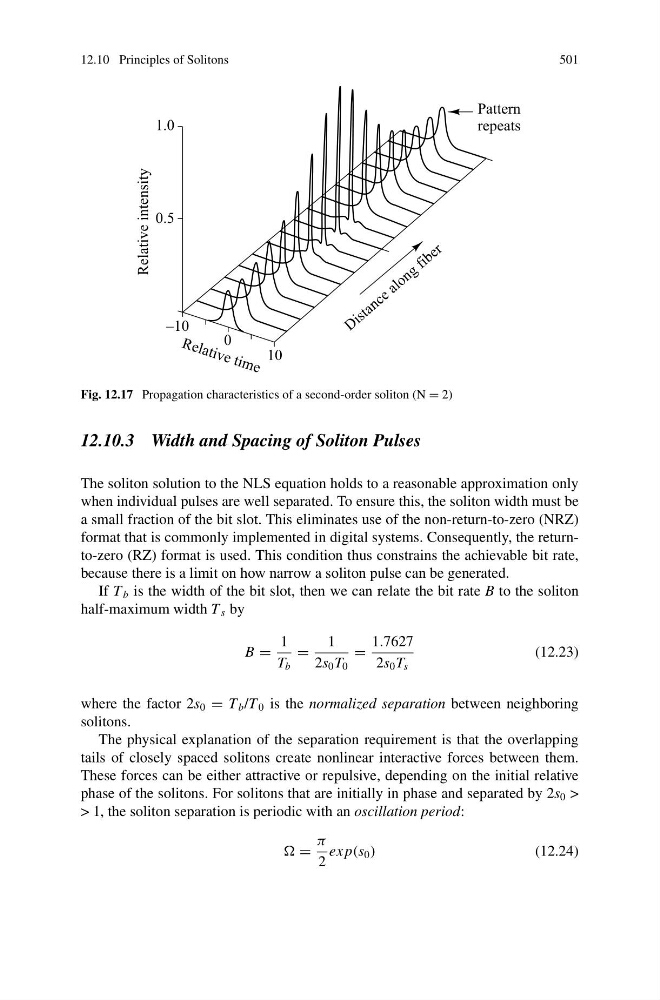
Fig. 12.17 Propagation characteristics of a second-order soliton (N = 2)
12.10.3 Width and Spacing of Soliton Pulses
The soliton solution to the NLS equation holds to a reasonable approximation only
when individual pulses are well separated. To ensure this, the soliton width must be
a small fraction of the bit slot. This eliminates use of the non-return-to-zero (NRZ)
format that is commonly implemented in digital systems. Consequently, the returnto-zero (RZ) format is used. This condition thus constrains the achievable bit rate,
because there is a limit on how narrow a soliton pulse can be generated.
If T b is the width of the bit slot, then we can relate the bit rate B to the soliton
half-maximum width T s by
B =
1
T b
=
1
2s 0 T 0
=
1.7627
2s 0 T s
(12.23)
where the factor 2s 0 = T b /T 0 is the normalized separation between neighboring
solitons.
The physical explanation of the separation requirement is that the overlapping
tails of closely spaced solitons create nonlinear interactive forces between them.
These forces can be either attractive or repulsive, depending on the initial relative
phase of the solitons. For solitons that are initially in phase and separated by 2s 0 >
> 1, the soliton separation is periodic with an oscillation period:
=
π
2
ex p(s 0 )
(12.24)
501
Fig. 12.17 Propagation characteristics of a second-order soliton (N = 2)
12.10.3 Width and Spacing of Soliton Pulses
The soliton solution to the NLS equation holds to a reasonable approximation only
when individual pulses are well separated. To ensure this, the soliton width must be
a small fraction of the bit slot. This eliminates use of the non-return-to-zero (NRZ)
format that is commonly implemented in digital systems. Consequently, the returnto-zero (RZ) format is used. This condition thus constrains the achievable bit rate,
because there is a limit on how narrow a soliton pulse can be generated.
If T b is the width of the bit slot, then we can relate the bit rate B to the soliton
half-maximum width T s by
B =
1
T b
=
1
2s 0 T 0
=
1.7627
2s 0 T s
(12.23)
where the factor 2s 0 = T b /T 0 is the normalized separation between neighboring
solitons.
The physical explanation of the separation requirement is that the overlapping
tails of closely spaced solitons create nonlinear interactive forces between them.
These forces can be either attractive or repulsive, depending on the initial relative
phase of the solitons. For solitons that are initially in phase and separated by 2s 0 >
> 1, the soliton separation is periodic with an oscillation period:
=
π
2
ex p(s 0 )
(12.24)