

12.10 Principles of Solitons
499
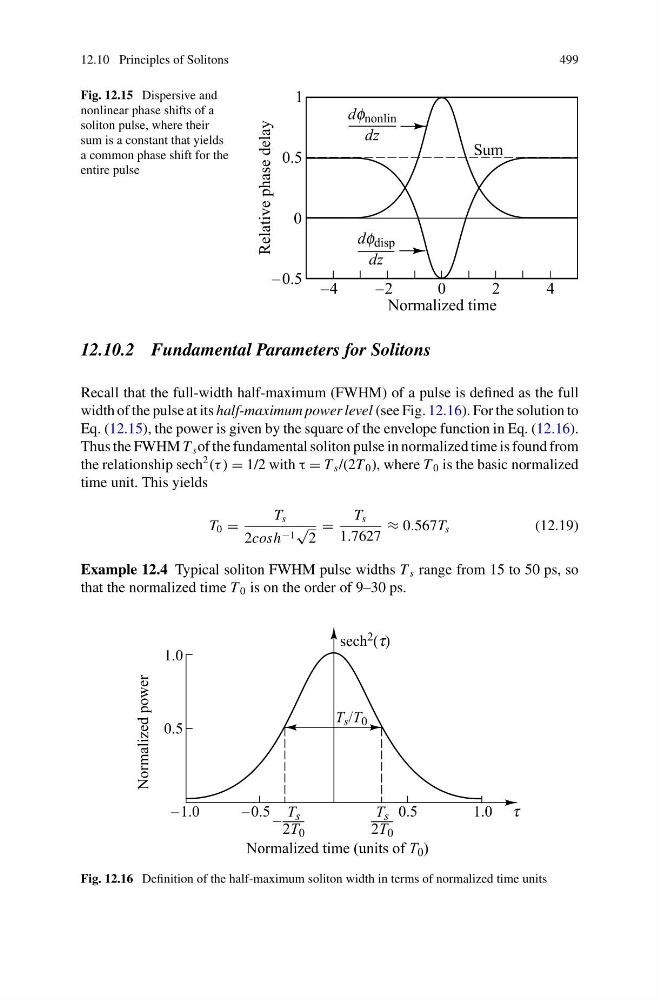
Fig. 12.15 Dispersive and
nonlinear phase shifts of a
soliton pulse, where their
sum is a constant that yields
a common phase shift for the
entire pulse
12.10.2 Fundamental Parameters for Solitons
Recall that the full-width half-maximum (FWHM) of a pulse is defined as the full
width of the pulse at its half-maximum power level (see Fig. 12.16). For the solution to
Eq. (12.15), the power is given by the square of the envelope function in Eq. (12.16).
Thus the FWHM T s of the fundamental soliton pulse in normalized time is found from
the relationship sech
2
(τ ) = 1/2 with τ = T s /(2T 0 ), where T 0 is the basic normalized
time unit. This yields
T 0 =
T s
2cosh −1
√
2
=
T s
1.7627
≈ 0.567T s
(12.19)
Example 12.4 Typical soliton FWHM pulse widths T s range from 15 to 50 ps, so
that the normalized time T 0 is on the order of 9–30 ps.
Fig. 12.16 Definition of the half-maximum soliton width in terms of normalized time units
499
Fig. 12.15 Dispersive and
nonlinear phase shifts of a
soliton pulse, where their
sum is a constant that yields
a common phase shift for the
entire pulse
12.10.2 Fundamental Parameters for Solitons
Recall that the full-width half-maximum (FWHM) of a pulse is defined as the full
width of the pulse at its half-maximum power level (see Fig. 12.16). For the solution to
Eq. (12.15), the power is given by the square of the envelope function in Eq. (12.16).
Thus the FWHM T s of the fundamental soliton pulse in normalized time is found from
the relationship sech
2
(τ ) = 1/2 with τ = T s /(2T 0 ), where T 0 is the basic normalized
time unit. This yields
T 0 =
T s
2cosh −1
√
2
=
T s
1.7627
≈ 0.567T s
(12.19)
Example 12.4 Typical soliton FWHM pulse widths T s range from 15 to 50 ps, so
that the normalized time T 0 is on the order of 9–30 ps.
Fig. 12.16 Definition of the half-maximum soliton width in terms of normalized time units