

498
12 Nonlinear Processes in Optical Fibers
Solving the NLS equation analytically yields a pulse envelop that is either independent of z (for the fundamental soliton with N = 1) or that is periodic in z (for
higher-order solitons with N ≥ 2). The general theory of solitons is mathematically complex and can be found in the literature [18–20]. Thus, this chapter presents
only the basic concepts for fundamental solitons. The solution to Eq. (12.15) for the
fundamental soliton is given by
u(z, t) = sech(t) exp( j z/2)
(12.16)
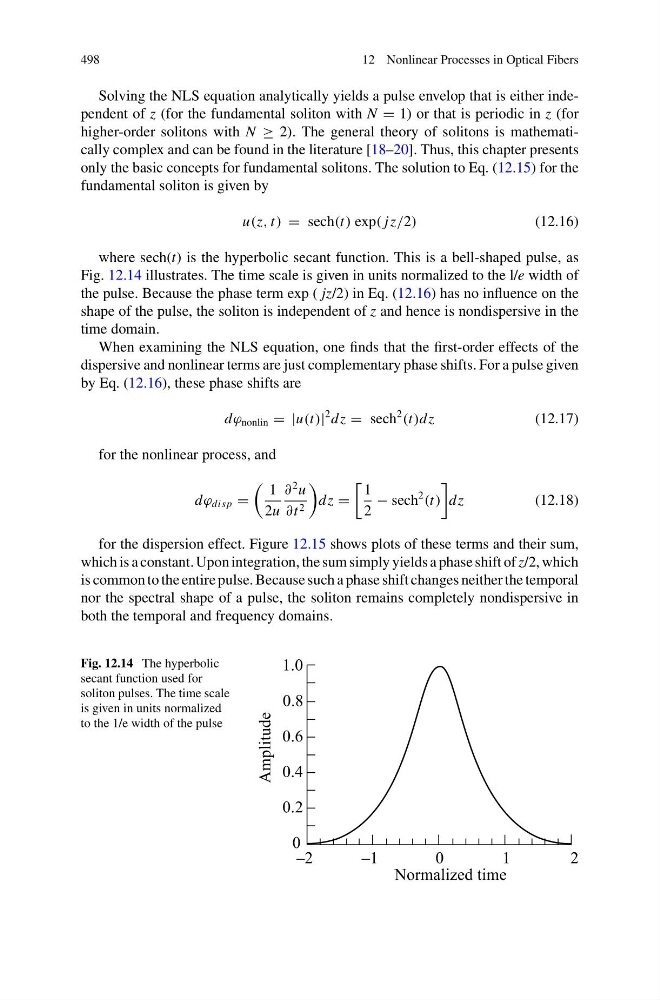
where sech(t) is the hyperbolic secant function. This is a bell-shaped pulse, as
Fig. 12.14 illustrates. The time scale is given in units normalized to the l/e width of
the pulse. Because the phase term exp ( jz/2) in Eq. (12.16) has no influence on the
shape of the pulse, the soliton is independent of z and hence is nondispersive in the
time domain.
When examining the NLS equation, one finds that the first-order effects of the
dispersive and nonlinear terms are just complementary phase shifts. For a pulse given
by Eq. (12.16), these phase shifts are
dϕ nonlin = |u(t)|
2 dz = sech
2
(t)dz
(12.17)
for the nonlinear process, and
dϕ disp =
1
2u
∂
2 u
∂t 2
dz =
1
2
− sech
2
(t)
dz
(12.18)
for the dispersion effect. Figure 12.15 shows plots of these terms and their sum,
which is a constant. Upon integration, the sum simply yields a phase shift of z/2, which
is common to the entire pulse. Because such a phase shift changes neither the temporal
nor the spectral shape of a pulse, the soliton remains completely nondispersive in
both the temporal and frequency domains.
Fig. 12.14 The hyperbolic
secant function used for
soliton pulses. The time scale
is given in units normalized
to the 1/e width of the pulse
12 Nonlinear Processes in Optical Fibers
Solving the NLS equation analytically yields a pulse envelop that is either independent of z (for the fundamental soliton with N = 1) or that is periodic in z (for
higher-order solitons with N ≥ 2). The general theory of solitons is mathematically complex and can be found in the literature [18–20]. Thus, this chapter presents
only the basic concepts for fundamental solitons. The solution to Eq. (12.15) for the
fundamental soliton is given by
u(z, t) = sech(t) exp( j z/2)
(12.16)
where sech(t) is the hyperbolic secant function. This is a bell-shaped pulse, as
Fig. 12.14 illustrates. The time scale is given in units normalized to the l/e width of
the pulse. Because the phase term exp ( jz/2) in Eq. (12.16) has no influence on the
shape of the pulse, the soliton is independent of z and hence is nondispersive in the
time domain.
When examining the NLS equation, one finds that the first-order effects of the
dispersive and nonlinear terms are just complementary phase shifts. For a pulse given
by Eq. (12.16), these phase shifts are
dϕ nonlin = |u(t)|
2 dz = sech
2
(t)dz
(12.17)
for the nonlinear process, and
dϕ disp =
1
2u
∂
2 u
∂t 2
dz =
1
2
− sech
2
(t)
dz
(12.18)
for the dispersion effect. Figure 12.15 shows plots of these terms and their sum,
which is a constant. Upon integration, the sum simply yields a phase shift of z/2, which
is common to the entire pulse. Because such a phase shift changes neither the temporal
nor the spectral shape of a pulse, the soliton remains completely nondispersive in
both the temporal and frequency domains.
Fig. 12.14 The hyperbolic
secant function used for
soliton pulses. The time scale
is given in units normalized
to the 1/e width of the pulse