

12.10 Principles of Solitons
497
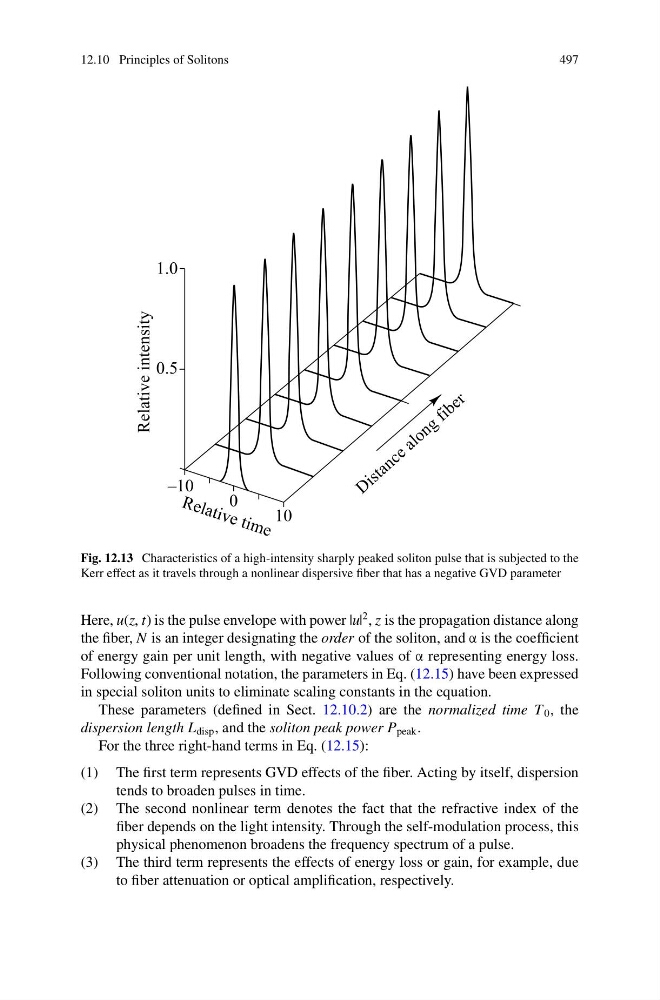
Fig. 12.13 Characteristics of a high-intensity sharply peaked soliton pulse that is subjected to the
Kerr effect as it travels through a nonlinear dispersive fiber that has a negative GVD parameter
Here, u(z, t) is the pulse envelope with power |u|
2 , z is the propagation distance along
the fiber, N is an integer designating the order of the soliton, and α is the coefficient
of energy gain per unit length, with negative values of α representing energy loss.
Following conventional notation, the parameters in Eq. (12.15) have been expressed
in special soliton units to eliminate scaling constants in the equation.
These parameters (defined in Sect. 12.10.2) are the normalized time T 0 , the
dispersion length L disp , and the soliton peak power P peak .
For the three right-hand terms in Eq. (12.15):
(1) The first term represents GVD effects of the fiber. Acting by itself, dispersion
tends to broaden pulses in time.
(2) The second nonlinear term denotes the fact that the refractive index of the
fiber depends on the light intensity. Through the self-modulation process, this
physical phenomenon broadens the frequency spectrum of a pulse.
(3) The third term represents the effects of energy loss or gain, for example, due
to fiber attenuation or optical amplification, respectively.
497
Fig. 12.13 Characteristics of a high-intensity sharply peaked soliton pulse that is subjected to the
Kerr effect as it travels through a nonlinear dispersive fiber that has a negative GVD parameter
Here, u(z, t) is the pulse envelope with power |u|
2 , z is the propagation distance along
the fiber, N is an integer designating the order of the soliton, and α is the coefficient
of energy gain per unit length, with negative values of α representing energy loss.
Following conventional notation, the parameters in Eq. (12.15) have been expressed
in special soliton units to eliminate scaling constants in the equation.
These parameters (defined in Sect. 12.10.2) are the normalized time T 0 , the
dispersion length L disp , and the soliton peak power P peak .
For the three right-hand terms in Eq. (12.15):
(1) The first term represents GVD effects of the fiber. Acting by itself, dispersion
tends to broaden pulses in time.
(2) The second nonlinear term denotes the fact that the refractive index of the
fiber depends on the light intensity. Through the self-modulation process, this
physical phenomenon broadens the frequency spectrum of a pulse.
(3) The third term represents the effects of energy loss or gain, for example, due
to fiber attenuation or optical amplification, respectively.