

496
12 Nonlinear Processes in Optical Fibers
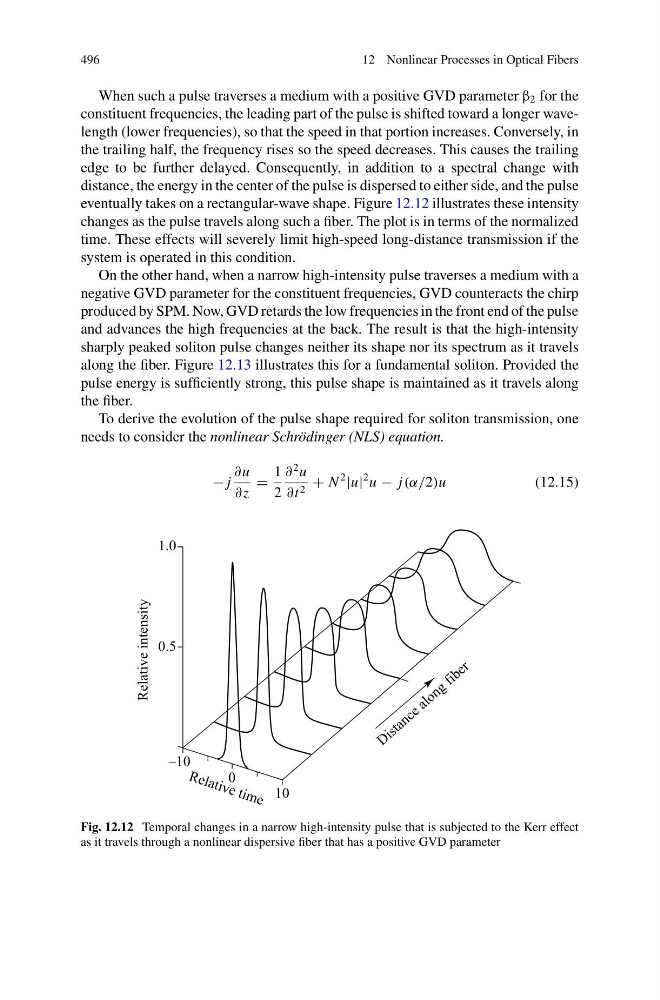
When such a pulse traverses a medium with a positive GVD parameter β 2 for the
constituent frequencies, the leading part of the pulse is shifted toward a longer wavelength (lower frequencies), so that the speed in that portion increases. Conversely, in
the trailing half, the frequency rises so the speed decreases. This causes the trailing
edge to be further delayed. Consequently, in addition to a spectral change with
distance, the energy in the center of the pulse is dispersed to either side, and the pulse
eventually takes on a rectangular-wave shape. Figure 12.12 illustrates these intensity
changes as the pulse travels along such a fiber. The plot is in terms of the normalized
time. These effects will severely limit high-speed long-distance transmission if the
system is operated in this condition.
On the other hand, when a narrow high-intensity pulse traverses a medium with a
negative GVD parameter for the constituent frequencies, GVD counteracts the chirp
produced by SPM. Now, GVD retards the low frequencies in the front end of the pulse
and advances the high frequencies at the back. The result is that the high-intensity
sharply peaked soliton pulse changes neither its shape nor its spectrum as it travels
along the fiber. Figure 12.13 illustrates this for a fundamental soliton. Provided the
pulse energy is sufficiently strong, this pulse shape is maintained as it travels along
the fiber.
To derive the evolution of the pulse shape required for soliton transmission, one
needs to consider the nonlinear Schrödinger (NLS) equation.
− j
∂u
∂z
=
1
2
∂
2 u
∂t 2 + N
2
|u|
2 u − j(α/2)u
(12.15)
Fig. 12.12 Temporal changes in a narrow high-intensity pulse that is subjected to the Kerr effect
as it travels through a nonlinear dispersive fiber that has a positive GVD parameter
12 Nonlinear Processes in Optical Fibers
When such a pulse traverses a medium with a positive GVD parameter β 2 for the
constituent frequencies, the leading part of the pulse is shifted toward a longer wavelength (lower frequencies), so that the speed in that portion increases. Conversely, in
the trailing half, the frequency rises so the speed decreases. This causes the trailing
edge to be further delayed. Consequently, in addition to a spectral change with
distance, the energy in the center of the pulse is dispersed to either side, and the pulse
eventually takes on a rectangular-wave shape. Figure 12.12 illustrates these intensity
changes as the pulse travels along such a fiber. The plot is in terms of the normalized
time. These effects will severely limit high-speed long-distance transmission if the
system is operated in this condition.
On the other hand, when a narrow high-intensity pulse traverses a medium with a
negative GVD parameter for the constituent frequencies, GVD counteracts the chirp
produced by SPM. Now, GVD retards the low frequencies in the front end of the pulse
and advances the high frequencies at the back. The result is that the high-intensity
sharply peaked soliton pulse changes neither its shape nor its spectrum as it travels
along the fiber. Figure 12.13 illustrates this for a fundamental soliton. Provided the
pulse energy is sufficiently strong, this pulse shape is maintained as it travels along
the fiber.
To derive the evolution of the pulse shape required for soliton transmission, one
needs to consider the nonlinear Schrödinger (NLS) equation.
− j
∂u
∂z
=
1
2
∂
2 u
∂t 2 + N
2
|u|
2 u − j(α/2)u
(12.15)
Fig. 12.12 Temporal changes in a narrow high-intensity pulse that is subjected to the Kerr effect
as it travels through a nonlinear dispersive fiber that has a positive GVD parameter