

492
12 Nonlinear Processes in Optical Fibers
-10
0
10
20
1480
1510
1540
1570
1600
Wavelength (nm)
Dispersion [ps/(nm-km)]
G.652
G.653
C-Band
1450
1630
G.655b
L-Band
S-Band
G.655
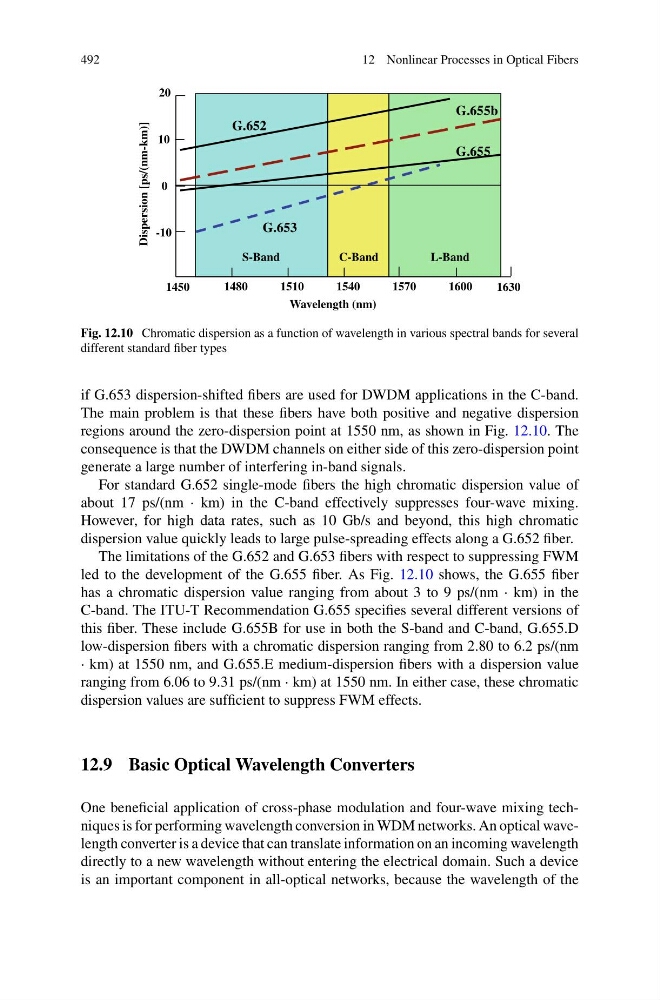
Fig. 12.10 Chromatic dispersion as a function of wavelength in various spectral bands for several
different standard fiber types
if G.653 dispersion-shifted fibers are used for DWDM applications in the C-band.
The main problem is that these fibers have both positive and negative dispersion
regions around the zero-dispersion point at 1550 nm, as shown in Fig. 12.10. The
consequence is that the DWDM channels on either side of this zero-dispersion point
generate a large number of interfering in-band signals.
For standard G.652 single-mode fibers the high chromatic dispersion value of
about 17 ps/(nm · km) in the C-band effectively suppresses four-wave mixing.
However, for high data rates, such as 10 Gb/s and beyond, this high chromatic
dispersion value quickly leads to large pulse-spreading effects along a G.652 fiber.
The limitations of the G.652 and G.653 fibers with respect to suppressing FWM
led to the development of the G.655 fiber. As Fig. 12.10 shows, the G.655 fiber
has a chromatic dispersion value ranging from about 3 to 9 ps/(nm · km) in the
C-band. The ITU-T Recommendation G.655 specifies several different versions of
this fiber. These include G.655B for use in both the S-band and C-band, G.655.D
low-dispersion fibers with a chromatic dispersion ranging from 2.80 to 6.2 ps/(nm
· km) at 1550 nm, and G.655.E medium-dispersion fibers with a dispersion value
ranging from 6.06 to 9.31 ps/(nm · km) at 1550 nm. In either case, these chromatic
dispersion values are sufficient to suppress FWM effects.
12.9 Basic Optical Wavelength Converters
One beneficial application of cross-phase modulation and four-wave mixing techniques is for performing wavelength conversion in WDM networks. An optical wavelength converter is a device that can translate information on an incoming wavelength
directly to a new wavelength without entering the electrical domain. Such a device
is an important component in all-optical networks, because the wavelength of the
12 Nonlinear Processes in Optical Fibers
-10
0
10
20
1480
1510
1540
1570
1600
Wavelength (nm)
Dispersion [ps/(nm-km)]
G.652
G.653
C-Band
1450
1630
G.655b
L-Band
S-Band
G.655
Fig. 12.10 Chromatic dispersion as a function of wavelength in various spectral bands for several
different standard fiber types
if G.653 dispersion-shifted fibers are used for DWDM applications in the C-band.
The main problem is that these fibers have both positive and negative dispersion
regions around the zero-dispersion point at 1550 nm, as shown in Fig. 12.10. The
consequence is that the DWDM channels on either side of this zero-dispersion point
generate a large number of interfering in-band signals.
For standard G.652 single-mode fibers the high chromatic dispersion value of
about 17 ps/(nm · km) in the C-band effectively suppresses four-wave mixing.
However, for high data rates, such as 10 Gb/s and beyond, this high chromatic
dispersion value quickly leads to large pulse-spreading effects along a G.652 fiber.
The limitations of the G.652 and G.653 fibers with respect to suppressing FWM
led to the development of the G.655 fiber. As Fig. 12.10 shows, the G.655 fiber
has a chromatic dispersion value ranging from about 3 to 9 ps/(nm · km) in the
C-band. The ITU-T Recommendation G.655 specifies several different versions of
this fiber. These include G.655B for use in both the S-band and C-band, G.655.D
low-dispersion fibers with a chromatic dispersion ranging from 2.80 to 6.2 ps/(nm
· km) at 1550 nm, and G.655.E medium-dispersion fibers with a dispersion value
ranging from 6.06 to 9.31 ps/(nm · km) at 1550 nm. In either case, these chromatic
dispersion values are sufficient to suppress FWM effects.
12.9 Basic Optical Wavelength Converters
One beneficial application of cross-phase modulation and four-wave mixing techniques is for performing wavelength conversion in WDM networks. An optical wavelength converter is a device that can translate information on an incoming wavelength
directly to a new wavelength without entering the electrical domain. Such a device
is an important component in all-optical networks, because the wavelength of the