

12.7 Four-Wave Mixing in WDM Channels
491
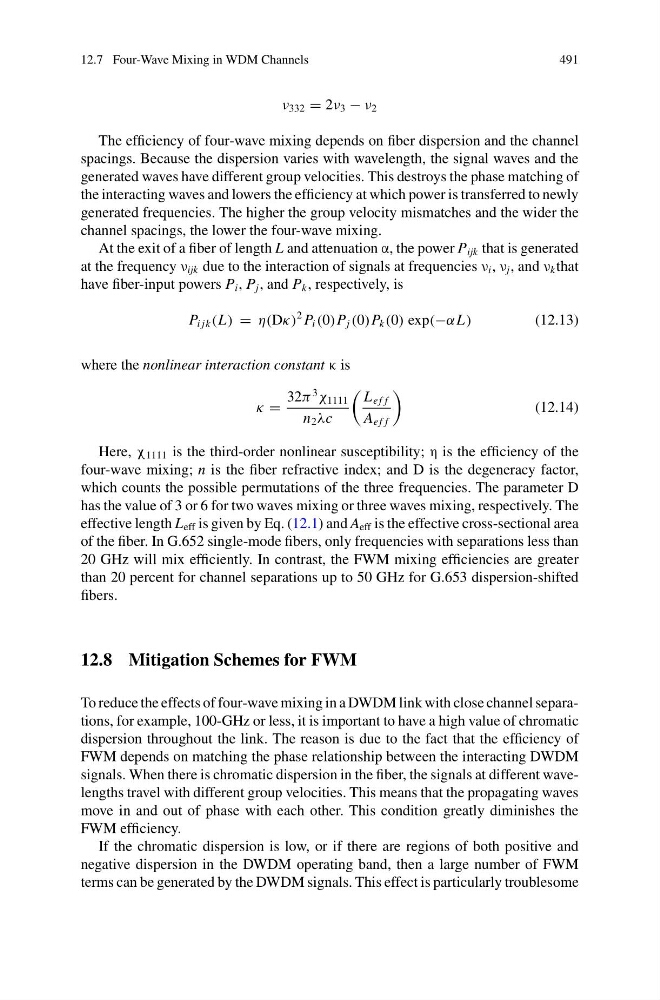
ν 332 = 2ν 3 − ν 2
The efficiency of four-wave mixing depends on fiber dispersion and the channel
spacings. Because the dispersion varies with wavelength, the signal waves and the
generated waves have different group velocities. This destroys the phase matching of
the interacting waves and lowers the efficiency at which power is transferred to newly
generated frequencies. The higher the group velocity mismatches and the wider the
channel spacings, the lower the four-wave mixing.
At the exit of a fiber of length L and attenuation α, the power P ijk that is generated
at the frequency ν ijk due to the interaction of signals at frequencies ν i , ν j , and ν k that
have fiber-input powers P i , P j , and P k , respectively, is
P i jk (L) = η(Dκ)
2 P i (0)P j (0)P k (0) exp(−αL)
(12.13)
where the nonlinear interaction constant κ is
κ =
32π
3
χ 1111
n 2 λc
L e f f
A e f f
(12.14)
Here, χ 1111 is the third-order nonlinear susceptibility; η is the efficiency of the
four-wave mixing; n is the fiber refractive index; and D is the degeneracy factor,
which counts the possible permutations of the three frequencies. The parameter D
has the value of 3 or 6 for two waves mixing or three waves mixing, respectively. The
effective length L eff is given by Eq. (12.1) and A eff is the effective cross-sectional area
of the fiber. In G.652 single-mode fibers, only frequencies with separations less than
20 GHz will mix efficiently. In contrast, the FWM mixing efficiencies are greater
than 20 percent for channel separations up to 50 GHz for G.653 dispersion-shifted
fibers.
12.8 Mitigation Schemes for FWM
To reduce the effects of four-wave mixing in a DWDM link with close channel separations, for example, 100-GHz or less, it is important to have a high value of chromatic
dispersion throughout the link. The reason is due to the fact that the efficiency of
FWM depends on matching the phase relationship between the interacting DWDM
signals. When there is chromatic dispersion in the fiber, the signals at different wavelengths travel with different group velocities. This means that the propagating waves
move in and out of phase with each other. This condition greatly diminishes the
FWM efficiency.
If the chromatic dispersion is low, or if there are regions of both positive and
negative dispersion in the DWDM operating band, then a large number of FWM
terms can be generated by the DWDM signals. This effect is particularly troublesome
491
ν 332 = 2ν 3 − ν 2
The efficiency of four-wave mixing depends on fiber dispersion and the channel
spacings. Because the dispersion varies with wavelength, the signal waves and the
generated waves have different group velocities. This destroys the phase matching of
the interacting waves and lowers the efficiency at which power is transferred to newly
generated frequencies. The higher the group velocity mismatches and the wider the
channel spacings, the lower the four-wave mixing.
At the exit of a fiber of length L and attenuation α, the power P ijk that is generated
at the frequency ν ijk due to the interaction of signals at frequencies ν i , ν j , and ν k that
have fiber-input powers P i , P j , and P k , respectively, is
P i jk (L) = η(Dκ)
2 P i (0)P j (0)P k (0) exp(−αL)
(12.13)
where the nonlinear interaction constant κ is
κ =
32π
3
χ 1111
n 2 λc
L e f f
A e f f
(12.14)
Here, χ 1111 is the third-order nonlinear susceptibility; η is the efficiency of the
four-wave mixing; n is the fiber refractive index; and D is the degeneracy factor,
which counts the possible permutations of the three frequencies. The parameter D
has the value of 3 or 6 for two waves mixing or three waves mixing, respectively. The
effective length L eff is given by Eq. (12.1) and A eff is the effective cross-sectional area
of the fiber. In G.652 single-mode fibers, only frequencies with separations less than
20 GHz will mix efficiently. In contrast, the FWM mixing efficiencies are greater
than 20 percent for channel separations up to 50 GHz for G.653 dispersion-shifted
fibers.
12.8 Mitigation Schemes for FWM
To reduce the effects of four-wave mixing in a DWDM link with close channel separations, for example, 100-GHz or less, it is important to have a high value of chromatic
dispersion throughout the link. The reason is due to the fact that the efficiency of
FWM depends on matching the phase relationship between the interacting DWDM
signals. When there is chromatic dispersion in the fiber, the signals at different wavelengths travel with different group velocities. This means that the propagating waves
move in and out of phase with each other. This condition greatly diminishes the
FWM efficiency.
If the chromatic dispersion is low, or if there are regions of both positive and
negative dispersion in the DWDM operating band, then a large number of FWM
terms can be generated by the DWDM signals. This effect is particularly troublesome