

12.9 Basic Optical Wavelength Converters
493
incoming signal may already be in use by another information channel residing on
the destined outgoing path. Converting the incoming signal to a new wavelength will
allow both information channels to traverse the same outbound fiber simultaneously.
This section describes two classes of wavelength converters with one example from
each class [10–15].
12.9.1 Wavelength Converters Using Optical Gatings
A wide variety of optical-gating techniques using devices such as semiconductor
optical amplifiers, semiconductor lasers, or nonlinear optical-loop mirrors have been
investigated to achieve wavelength conversion. The use of a semiconductor optical
amplifier (SOA) in a cross-phase modulation (XPM) mode has been one of the most
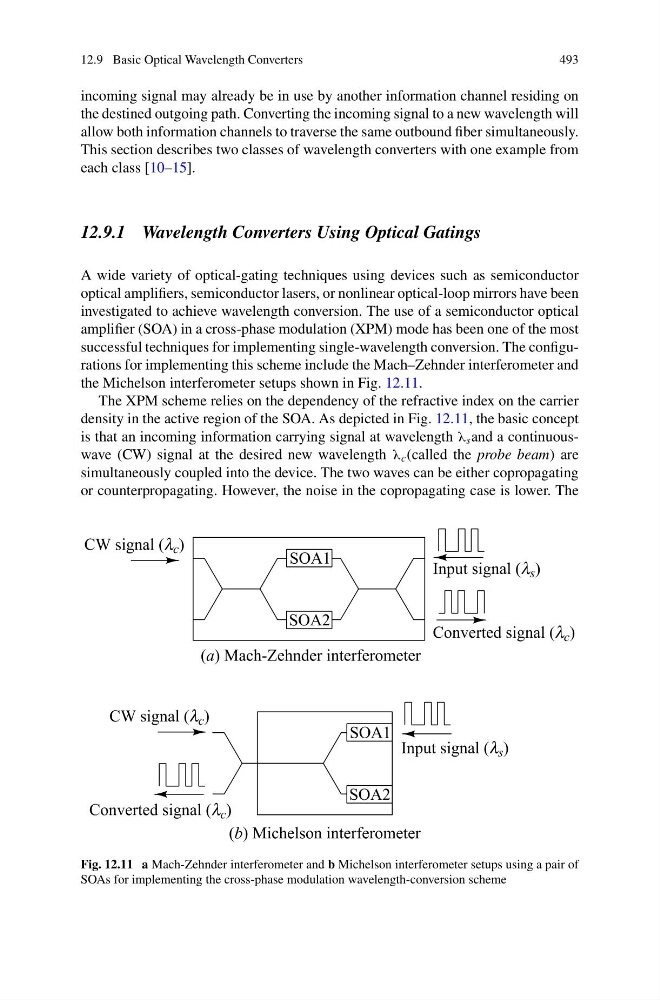
successful techniques for implementing single-wavelength conversion. The configurations for implementing this scheme include the Mach–Zehnder interferometer and
the Michelson interferometer setups shown in Fig. 12.11.
The XPM scheme relies on the dependency of the refractive index on the carrier
density in the active region of the SOA. As depicted in Fig. 12.11, the basic concept
is that an incoming information carrying signal at wavelength λ s and a continuouswave (CW) signal at the desired new wavelength λ c (called the probe beam) are
simultaneously coupled into the device. The two waves can be either copropagating
or counterpropagating. However, the noise in the copropagating case is lower. The
Fig. 12.11 a Mach-Zehnder interferometer and b Michelson interferometer setups using a pair of
SOAs for implementing the cross-phase modulation wavelength-conversion scheme
493
incoming signal may already be in use by another information channel residing on
the destined outgoing path. Converting the incoming signal to a new wavelength will
allow both information channels to traverse the same outbound fiber simultaneously.
This section describes two classes of wavelength converters with one example from
each class [10–15].
12.9.1 Wavelength Converters Using Optical Gatings
A wide variety of optical-gating techniques using devices such as semiconductor
optical amplifiers, semiconductor lasers, or nonlinear optical-loop mirrors have been
investigated to achieve wavelength conversion. The use of a semiconductor optical
amplifier (SOA) in a cross-phase modulation (XPM) mode has been one of the most
successful techniques for implementing single-wavelength conversion. The configurations for implementing this scheme include the Mach–Zehnder interferometer and
the Michelson interferometer setups shown in Fig. 12.11.
The XPM scheme relies on the dependency of the refractive index on the carrier
density in the active region of the SOA. As depicted in Fig. 12.11, the basic concept
is that an incoming information carrying signal at wavelength λ s and a continuouswave (CW) signal at the desired new wavelength λ c (called the probe beam) are
simultaneously coupled into the device. The two waves can be either copropagating
or counterpropagating. However, the noise in the copropagating case is lower. The
Fig. 12.11 a Mach-Zehnder interferometer and b Michelson interferometer setups using a pair of
SOAs for implementing the cross-phase modulation wavelength-conversion scheme