

12.1 Classifications of Nonlinearities
479
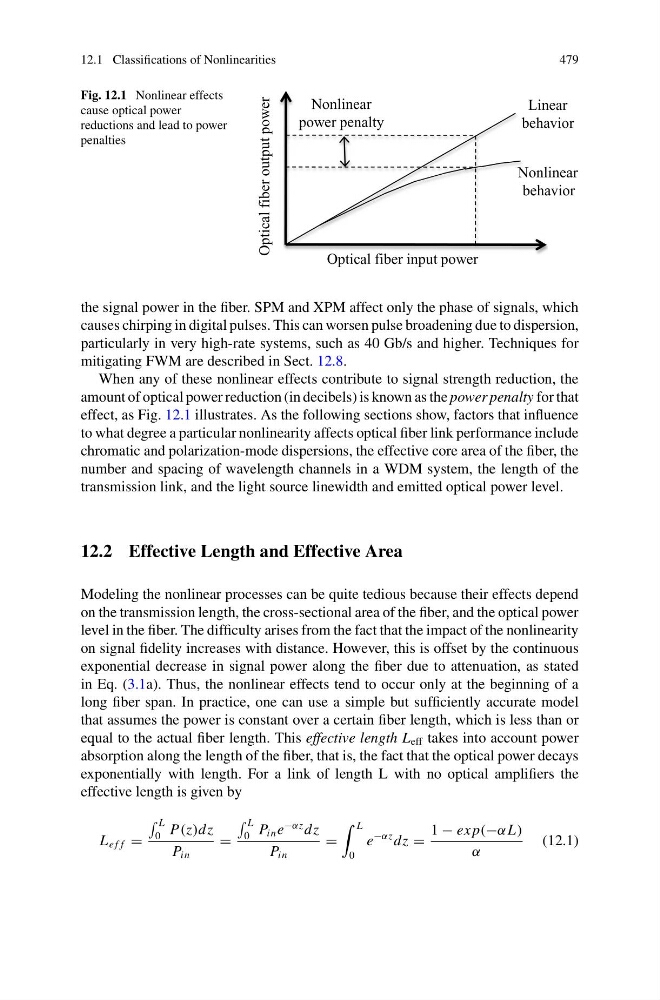
Fig. 12.1 Nonlinear effects
cause optical power
reductions and lead to power
penalties
the signal power in the fiber. SPM and XPM affect only the phase of signals, which
causes chirping in digital pulses. This can worsen pulse broadening due to dispersion,
particularly in very high-rate systems, such as 40 Gb/s and higher. Techniques for
mitigating FWM are described in Sect. 12.8.
When any of these nonlinear effects contribute to signal strength reduction, the
amount of optical power reduction (in decibels) is known as the power penalty for that
effect, as Fig. 12.1 illustrates. As the following sections show, factors that influence
to what degree a particular nonlinearity affects optical fiber link performance include
chromatic and polarization-mode dispersions, the effective core area of the fiber, the
number and spacing of wavelength channels in a WDM system, the length of the
transmission link, and the light source linewidth and emitted optical power level.
12.2 Effective Length and Effective Area
Modeling the nonlinear processes can be quite tedious because their effects depend
on the transmission length, the cross-sectional area of the fiber, and the optical power
level in the fiber. The difficulty arises from the fact that the impact of the nonlinearity
on signal fidelity increases with distance. However, this is offset by the continuous
exponential decrease in signal power along the fiber due to attenuation, as stated
in Eq. (3.1a). Thus, the nonlinear effects tend to occur only at the beginning of a
long fiber span. In practice, one can use a simple but sufficiently accurate model
that assumes the power is constant over a certain fiber length, which is less than or
equal to the actual fiber length. This effective length L eff takes into account power
absorption along the length of the fiber, that is, the fact that the optical power decays
exponentially with length. For a link of length L with no optical amplifiers the
effective length is given by
L e f f =
L
0 P(z)dz
P in
=
L
0 P in e
−αz dz
P in
=
L
0
e
−αz dz =
1 − ex p(−αL)
α
(12.1)
479
Fig. 12.1 Nonlinear effects
cause optical power
reductions and lead to power
penalties
the signal power in the fiber. SPM and XPM affect only the phase of signals, which
causes chirping in digital pulses. This can worsen pulse broadening due to dispersion,
particularly in very high-rate systems, such as 40 Gb/s and higher. Techniques for
mitigating FWM are described in Sect. 12.8.
When any of these nonlinear effects contribute to signal strength reduction, the
amount of optical power reduction (in decibels) is known as the power penalty for that
effect, as Fig. 12.1 illustrates. As the following sections show, factors that influence
to what degree a particular nonlinearity affects optical fiber link performance include
chromatic and polarization-mode dispersions, the effective core area of the fiber, the
number and spacing of wavelength channels in a WDM system, the length of the
transmission link, and the light source linewidth and emitted optical power level.
12.2 Effective Length and Effective Area
Modeling the nonlinear processes can be quite tedious because their effects depend
on the transmission length, the cross-sectional area of the fiber, and the optical power
level in the fiber. The difficulty arises from the fact that the impact of the nonlinearity
on signal fidelity increases with distance. However, this is offset by the continuous
exponential decrease in signal power along the fiber due to attenuation, as stated
in Eq. (3.1a). Thus, the nonlinear effects tend to occur only at the beginning of a
long fiber span. In practice, one can use a simple but sufficiently accurate model
that assumes the power is constant over a certain fiber length, which is less than or
equal to the actual fiber length. This effective length L eff takes into account power
absorption along the length of the fiber, that is, the fact that the optical power decays
exponentially with length. For a link of length L with no optical amplifiers the
effective length is given by
L e f f =
L
0 P(z)dz
P in
=
L
0 P in e
−αz dz
P in
=
L
0
e
−αz dz =
1 − ex p(−αL)
α
(12.1)