

478
12 Nonlinear Processes in Optical Fibers
This chapter first gives a general overview of nonlinear processes in optical fibers
in Sect. 12.1. Because the nonlinearities arise above a certain optical power threshold,
the effect becomes negligible once the signal has become sufficiently attenuated
after traveling a certain distance along the fiber. This gives rise to the concept of
an effective length and an associated parameter called effective area, as Sect. 12.2
describes. The next five sections discuss how the major nonlinear processes physically affect system performance. These nonlinearities are stimulated Raman scattering (Sect. 12.3), stimulated Brillouin scattering (Sect. 12.4), self-phase modulation
(Sect. 12.5), cross-phase modulation (Sect. 12.6), and four-wave mixing (Sect. 12.7).
Mitigation of four-wave mixing can be achieved by means of a special fiber design
or by a chromatic dispersion-compensation method, which is the topic of Sect. 12.8.
On the other hand, nonlinear effects also can have beneficial uses. Section 12.9
describes applications of cross-phase-modulation and four-wave-mixing techniques
for performing wavelength conversion in WDM networks. Another application of
nonlinear effects in a silica fiber is the use of solitons for optical communications,
which depends on self-phase modulation effects. Section 12.10 addresses this topic.
12.1 Classifications of Nonlinearities
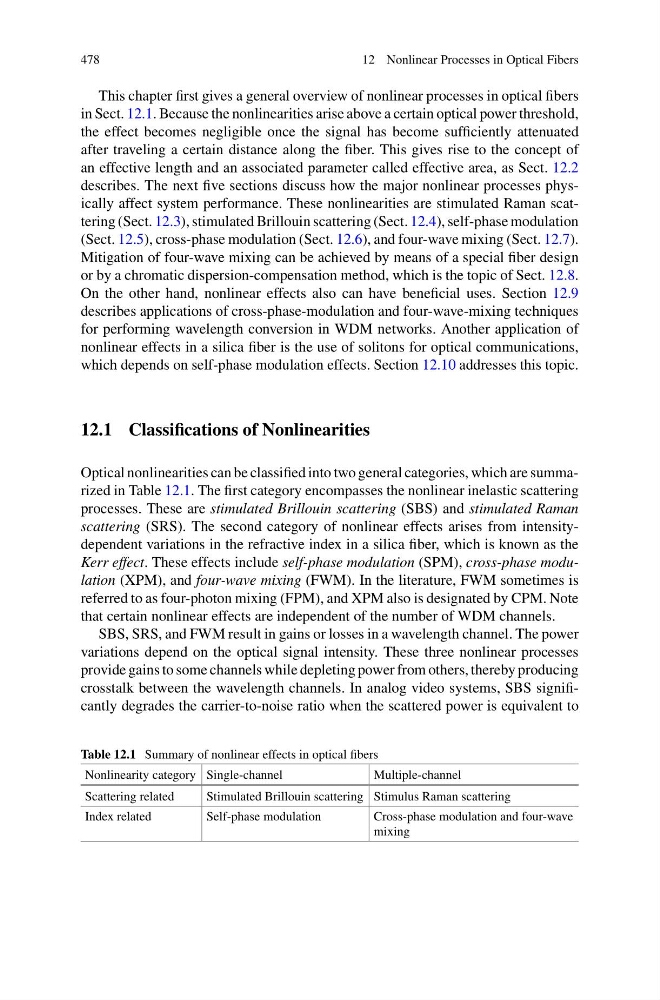
Optical nonlinearities can be classified into two general categories, which are summarized in Table 12.1. The first category encompasses the nonlinear inelastic scattering
processes. These are stimulated Brillouin scattering (SBS) and stimulated Raman
scattering (SRS). The second category of nonlinear effects arises from intensitydependent variations in the refractive index in a silica fiber, which is known as the
Kerr effect. These effects include self-phase modulation (SPM), cross-phase modulation (XPM), and four-wave mixing (FWM). In the literature, FWM sometimes is
referred to as four-photon mixing (FPM), and XPM also is designated by CPM. Note
that certain nonlinear effects are independent of the number of WDM channels.
SBS, SRS, and FWM result in gains or losses in a wavelength channel. The power
variations depend on the optical signal intensity. These three nonlinear processes
provide gains to some channels while depleting power from others, thereby producing
crosstalk between the wavelength channels. In analog video systems, SBS significantly degrades the carrier-to-noise ratio when the scattered power is equivalent to
Table 12.1 Summary of nonlinear effects in optical fibers
Nonlinearity category Single-channel
Multiple-channel
Scattering related
Stimulated Brillouin scattering Stimulus Raman scattering
Index related
Self-phase modulation
Cross-phase modulation and four-wave
mixing
12 Nonlinear Processes in Optical Fibers
This chapter first gives a general overview of nonlinear processes in optical fibers
in Sect. 12.1. Because the nonlinearities arise above a certain optical power threshold,
the effect becomes negligible once the signal has become sufficiently attenuated
after traveling a certain distance along the fiber. This gives rise to the concept of
an effective length and an associated parameter called effective area, as Sect. 12.2
describes. The next five sections discuss how the major nonlinear processes physically affect system performance. These nonlinearities are stimulated Raman scattering (Sect. 12.3), stimulated Brillouin scattering (Sect. 12.4), self-phase modulation
(Sect. 12.5), cross-phase modulation (Sect. 12.6), and four-wave mixing (Sect. 12.7).
Mitigation of four-wave mixing can be achieved by means of a special fiber design
or by a chromatic dispersion-compensation method, which is the topic of Sect. 12.8.
On the other hand, nonlinear effects also can have beneficial uses. Section 12.9
describes applications of cross-phase-modulation and four-wave-mixing techniques
for performing wavelength conversion in WDM networks. Another application of
nonlinear effects in a silica fiber is the use of solitons for optical communications,
which depends on self-phase modulation effects. Section 12.10 addresses this topic.
12.1 Classifications of Nonlinearities
Optical nonlinearities can be classified into two general categories, which are summarized in Table 12.1. The first category encompasses the nonlinear inelastic scattering
processes. These are stimulated Brillouin scattering (SBS) and stimulated Raman
scattering (SRS). The second category of nonlinear effects arises from intensitydependent variations in the refractive index in a silica fiber, which is known as the
Kerr effect. These effects include self-phase modulation (SPM), cross-phase modulation (XPM), and four-wave mixing (FWM). In the literature, FWM sometimes is
referred to as four-photon mixing (FPM), and XPM also is designated by CPM. Note
that certain nonlinear effects are independent of the number of WDM channels.
SBS, SRS, and FWM result in gains or losses in a wavelength channel. The power
variations depend on the optical signal intensity. These three nonlinear processes
provide gains to some channels while depleting power from others, thereby producing
crosstalk between the wavelength channels. In analog video systems, SBS significantly degrades the carrier-to-noise ratio when the scattered power is equivalent to
Table 12.1 Summary of nonlinear effects in optical fibers
Nonlinearity category Single-channel
Multiple-channel
Scattering related
Stimulated Brillouin scattering Stimulus Raman scattering
Index related
Self-phase modulation
Cross-phase modulation and four-wave
mixing