

468
11 Basics of Optical Amplifiers
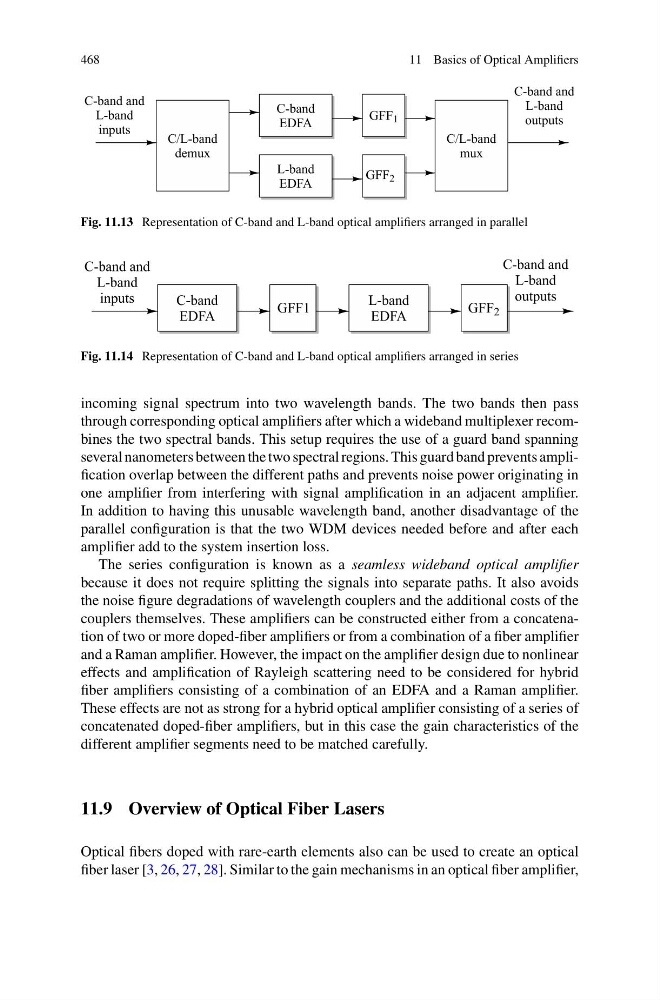
Fig. 11.13 Representation of C-band and L-band optical amplifiers arranged in parallel
Fig. 11.14 Representation of C-band and L-band optical amplifiers arranged in series
incoming signal spectrum into two wavelength bands. The two bands then pass
through corresponding optical amplifiers after which a wideband multiplexer recombines the two spectral bands. This setup requires the use of a guard band spanning
several nanometers between the two spectral regions. This guard band prevents amplification overlap between the different paths and prevents noise power originating in
one amplifier from interfering with signal amplification in an adjacent amplifier.
In addition to having this unusable wavelength band, another disadvantage of the
parallel configuration is that the two WDM devices needed before and after each
amplifier add to the system insertion loss.
The series configuration is known as a seamless wideband optical amplifier
because it does not require splitting the signals into separate paths. It also avoids
the noise figure degradations of wavelength couplers and the additional costs of the
couplers themselves. These amplifiers can be constructed either from a concatenation of two or more doped-fiber amplifiers or from a combination of a fiber amplifier
and a Raman amplifier. However, the impact on the amplifier design due to nonlinear
effects and amplification of Rayleigh scattering need to be considered for hybrid
fiber amplifiers consisting of a combination of an EDFA and a Raman amplifier.
These effects are not as strong for a hybrid optical amplifier consisting of a series of
concatenated doped-fiber amplifiers, but in this case the gain characteristics of the
different amplifier segments need to be matched carefully.
11.9 Overview of Optical Fiber Lasers
Optical fibers doped with rare-earth elements also can be used to create an optical
fiber laser [3, 26, 27, 28]. Similar to the gain mechanisms in an optical fiber amplifier,
11 Basics of Optical Amplifiers
Fig. 11.13 Representation of C-band and L-band optical amplifiers arranged in parallel
Fig. 11.14 Representation of C-band and L-band optical amplifiers arranged in series
incoming signal spectrum into two wavelength bands. The two bands then pass
through corresponding optical amplifiers after which a wideband multiplexer recombines the two spectral bands. This setup requires the use of a guard band spanning
several nanometers between the two spectral regions. This guard band prevents amplification overlap between the different paths and prevents noise power originating in
one amplifier from interfering with signal amplification in an adjacent amplifier.
In addition to having this unusable wavelength band, another disadvantage of the
parallel configuration is that the two WDM devices needed before and after each
amplifier add to the system insertion loss.
The series configuration is known as a seamless wideband optical amplifier
because it does not require splitting the signals into separate paths. It also avoids
the noise figure degradations of wavelength couplers and the additional costs of the
couplers themselves. These amplifiers can be constructed either from a concatenation of two or more doped-fiber amplifiers or from a combination of a fiber amplifier
and a Raman amplifier. However, the impact on the amplifier design due to nonlinear
effects and amplification of Rayleigh scattering need to be considered for hybrid
fiber amplifiers consisting of a combination of an EDFA and a Raman amplifier.
These effects are not as strong for a hybrid optical amplifier consisting of a series of
concatenated doped-fiber amplifiers, but in this case the gain characteristics of the
different amplifier segments need to be matched carefully.
11.9 Overview of Optical Fiber Lasers
Optical fibers doped with rare-earth elements also can be used to create an optical
fiber laser [3, 26, 27, 28]. Similar to the gain mechanisms in an optical fiber amplifier,