

11.9 Overview of Optical Fiber Lasers
469
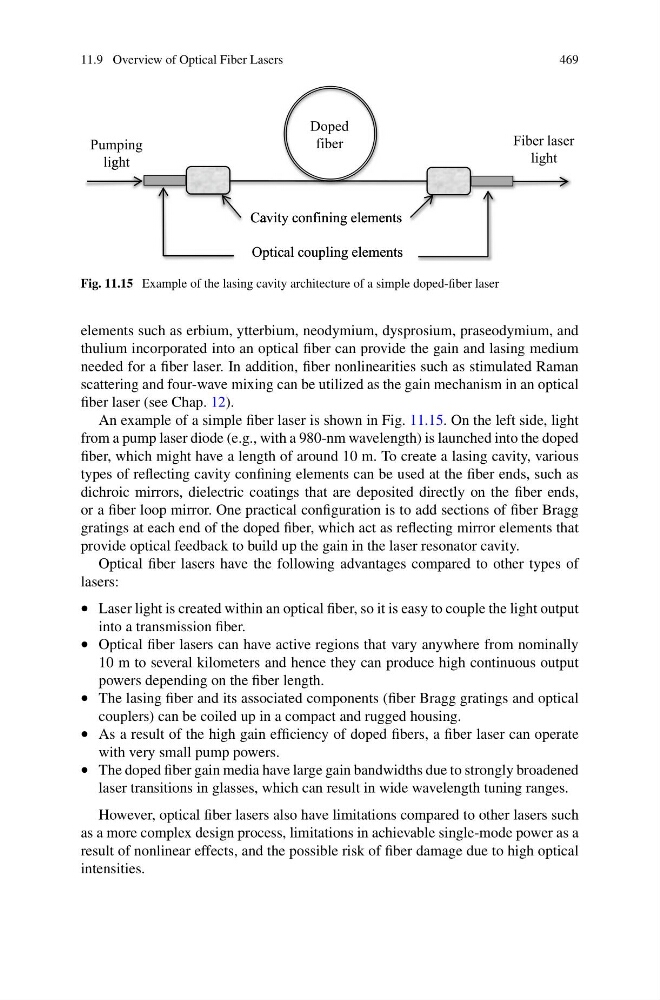
Fig. 11.15 Example of the lasing cavity architecture of a simple doped-fiber laser
elements such as erbium, ytterbium, neodymium, dysprosium, praseodymium, and
thulium incorporated into an optical fiber can provide the gain and lasing medium
needed for a fiber laser. In addition, fiber nonlinearities such as stimulated Raman
scattering and four-wave mixing can be utilized as the gain mechanism in an optical
fiber laser (see Chap. 12).
An example of a simple fiber laser is shown in Fig. 11.15. On the left side, light
from a pump laser diode (e.g., with a 980-nm wavelength) is launched into the doped
fiber, which might have a length of around 10 m. To create a lasing cavity, various
types of reflecting cavity confining elements can be used at the fiber ends, such as
dichroic mirrors, dielectric coatings that are deposited directly on the fiber ends,
or a fiber loop mirror. One practical configuration is to add sections of fiber Bragg
gratings at each end of the doped fiber, which act as reflecting mirror elements that
provide optical feedback to build up the gain in the laser resonator cavity.
Optical fiber lasers have the following advantages compared to other types of
lasers:
• Laser light is created within an optical fiber, so it is easy to couple the light output
into a transmission fiber.
• Optical fiber lasers can have active regions that vary anywhere from nominally
10 m to several kilometers and hence they can produce high continuous output
powers depending on the fiber length.
• The lasing fiber and its associated components (fiber Bragg gratings and optical
couplers) can be coiled up in a compact and rugged housing.
• As a result of the high gain efficiency of doped fibers, a fiber laser can operate
with very small pump powers.
• The doped fiber gain media have large gain bandwidths due to strongly broadened
laser transitions in glasses, which can result in wide wavelength tuning ranges.
However, optical fiber lasers also have limitations compared to other lasers such
as a more complex design process, limitations in achievable single-mode power as a
result of nonlinear effects, and the possible risk of fiber damage due to high optical
intensities.
469
Fig. 11.15 Example of the lasing cavity architecture of a simple doped-fiber laser
elements such as erbium, ytterbium, neodymium, dysprosium, praseodymium, and
thulium incorporated into an optical fiber can provide the gain and lasing medium
needed for a fiber laser. In addition, fiber nonlinearities such as stimulated Raman
scattering and four-wave mixing can be utilized as the gain mechanism in an optical
fiber laser (see Chap. 12).
An example of a simple fiber laser is shown in Fig. 11.15. On the left side, light
from a pump laser diode (e.g., with a 980-nm wavelength) is launched into the doped
fiber, which might have a length of around 10 m. To create a lasing cavity, various
types of reflecting cavity confining elements can be used at the fiber ends, such as
dichroic mirrors, dielectric coatings that are deposited directly on the fiber ends,
or a fiber loop mirror. One practical configuration is to add sections of fiber Bragg
gratings at each end of the doped fiber, which act as reflecting mirror elements that
provide optical feedback to build up the gain in the laser resonator cavity.
Optical fiber lasers have the following advantages compared to other types of
lasers:
• Laser light is created within an optical fiber, so it is easy to couple the light output
into a transmission fiber.
• Optical fiber lasers can have active regions that vary anywhere from nominally
10 m to several kilometers and hence they can produce high continuous output
powers depending on the fiber length.
• The lasing fiber and its associated components (fiber Bragg gratings and optical
couplers) can be coiled up in a compact and rugged housing.
• As a result of the high gain efficiency of doped fibers, a fiber laser can operate
with very small pump powers.
• The doped fiber gain media have large gain bandwidths due to strongly broadened
laser transitions in glasses, which can result in wide wavelength tuning ranges.
However, optical fiber lasers also have limitations compared to other lasers such
as a more complex design process, limitations in achievable single-mode power as a
result of nonlinear effects, and the possible risk of fiber damage due to high optical
intensities.