

11.8 Multiband Optical Amplifiers
467
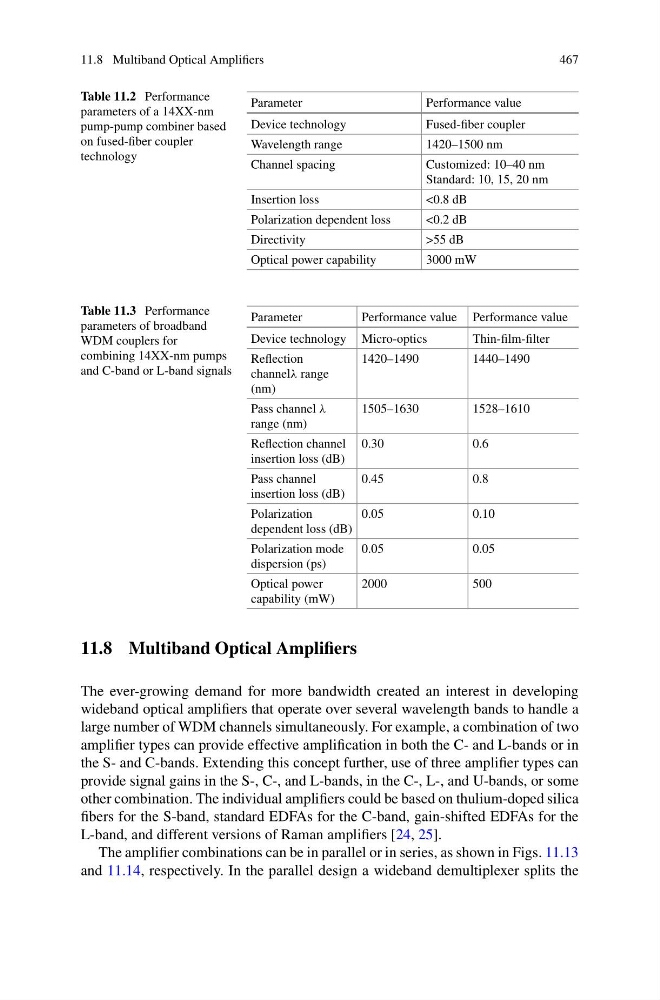
Table 11.2 Performance
parameters of a 14XX-nm
pump-pump combiner based
on fused-fiber coupler
technology
Parameter
Performance value
Device technology
Fused-fiber coupler
Wavelength range
1420–1500 nm
Channel spacing
Customized: 10–40 nm
Standard: 10, 15, 20 nm
Insertion loss
<0.8 dB
Polarization dependent loss
<0.2 dB
Directivity
>55 dB
Optical power capability
3000 mW
Table 11.3 Performance
parameters of broadband
WDM couplers for
combining 14XX-nm pumps
and C-band or L-band signals
Parameter
Performance value Performance value
Device technology Micro-optics
Thin-film-filter
Reflection
channelλ range
(nm)
1420–1490
1440–1490
Pass channel λ
range (nm)
1505–1630
1528–1610
Reflection channel
insertion loss (dB)
0.30
0.6
Pass channel
insertion loss (dB)
0.45
0.8
Polarization
dependent loss (dB)
0.05
0.10
Polarization mode
dispersion (ps)
0.05
0.05
Optical power
capability (mW)
2000
500
11.8 Multiband Optical Amplifiers
The ever-growing demand for more bandwidth created an interest in developing
wideband optical amplifiers that operate over several wavelength bands to handle a
large number of WDM channels simultaneously. For example, a combination of two
amplifier types can provide effective amplification in both the C- and L-bands or in
the S- and C-bands. Extending this concept further, use of three amplifier types can
provide signal gains in the S-, C-, and L-bands, in the C-, L-, and U-bands, or some
other combination. The individual amplifiers could be based on thulium-doped silica
fibers for the S-band, standard EDFAs for the C-band, gain-shifted EDFAs for the
L-band, and different versions of Raman amplifiers [24, 25].
The amplifier combinations can be in parallel or in series, as shown in Figs. 11.13
and 11.14, respectively. In the parallel design a wideband demultiplexer splits the
467
Table 11.2 Performance
parameters of a 14XX-nm
pump-pump combiner based
on fused-fiber coupler
technology
Parameter
Performance value
Device technology
Fused-fiber coupler
Wavelength range
1420–1500 nm
Channel spacing
Customized: 10–40 nm
Standard: 10, 15, 20 nm
Insertion loss
<0.8 dB
Polarization dependent loss
<0.2 dB
Directivity
>55 dB
Optical power capability
3000 mW
Table 11.3 Performance
parameters of broadband
WDM couplers for
combining 14XX-nm pumps
and C-band or L-band signals
Parameter
Performance value Performance value
Device technology Micro-optics
Thin-film-filter
Reflection
channelλ range
(nm)
1420–1490
1440–1490
Pass channel λ
range (nm)
1505–1630
1528–1610
Reflection channel
insertion loss (dB)
0.30
0.6
Pass channel
insertion loss (dB)
0.45
0.8
Polarization
dependent loss (dB)
0.05
0.10
Polarization mode
dispersion (ps)
0.05
0.05
Optical power
capability (mW)
2000
500
11.8 Multiband Optical Amplifiers
The ever-growing demand for more bandwidth created an interest in developing
wideband optical amplifiers that operate over several wavelength bands to handle a
large number of WDM channels simultaneously. For example, a combination of two
amplifier types can provide effective amplification in both the C- and L-bands or in
the S- and C-bands. Extending this concept further, use of three amplifier types can
provide signal gains in the S-, C-, and L-bands, in the C-, L-, and U-bands, or some
other combination. The individual amplifiers could be based on thulium-doped silica
fibers for the S-band, standard EDFAs for the C-band, gain-shifted EDFAs for the
L-band, and different versions of Raman amplifiers [24, 25].
The amplifier combinations can be in parallel or in series, as shown in Figs. 11.13
and 11.14, respectively. In the parallel design a wideband demultiplexer splits the