

458
11 Basics of Optical Amplifiers
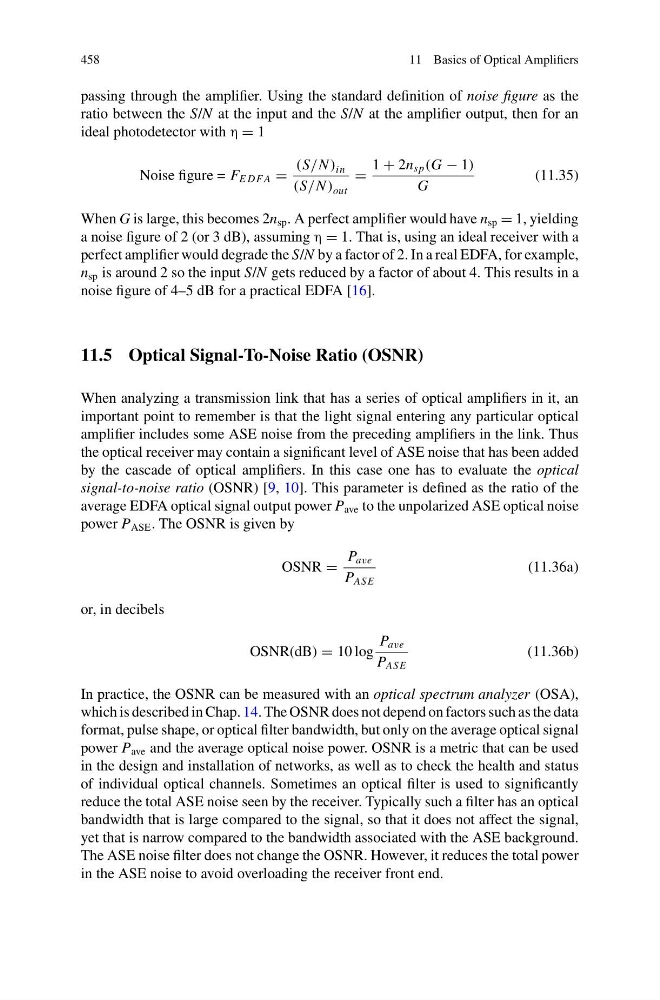
passing through the amplifier. Using the standard definition of noise figure as the
ratio between the S/N at the input and the S/N at the amplifier output, then for an
ideal photodetector with η = 1
Noise figure = F E DF A =
(S/N ) in
(S/N ) out
=
1 + 2n sp (G − 1)
G
(11.35)
When G is large, this becomes 2n sp . A perfect amplifier would have n sp = 1, yielding
a noise figure of 2 (or 3 dB), assuming η = 1. That is, using an ideal receiver with a
perfect amplifier would degrade the S/N by a factor of 2. In a real EDFA, for example,
n sp is around 2 so the input S/N gets reduced by a factor of about 4. This results in a
noise figure of 4–5 dB for a practical EDFA [16].
11.5 Optical Signal-To-Noise Ratio (OSNR)
When analyzing a transmission link that has a series of optical amplifiers in it, an
important point to remember is that the light signal entering any particular optical
amplifier includes some ASE noise from the preceding amplifiers in the link. Thus
the optical receiver may contain a significant level of ASE noise that has been added
by the cascade of optical amplifiers. In this case one has to evaluate the optical
signal-to-noise ratio (OSNR) [9, 10]. This parameter is defined as the ratio of the
average EDFA optical signal output power P ave to the unpolarized ASE optical noise
power P ASE . The OSNR is given by
OSNR =
P ave
P AS E
(11.36a)
or, in decibels
OSNR(dB) = 10 log
P ave
P AS E
(11.36b)
In practice, the OSNR can be measured with an optical spectrum analyzer (OSA),
which is described in Chap. 14. The OSNR does not depend on factors such as the data
format, pulse shape, or optical filter bandwidth, but only on the average optical signal
power P ave and the average optical noise power. OSNR is a metric that can be used
in the design and installation of networks, as well as to check the health and status
of individual optical channels. Sometimes an optical filter is used to significantly
reduce the total ASE noise seen by the receiver. Typically such a filter has an optical
bandwidth that is large compared to the signal, so that it does not affect the signal,
yet that is narrow compared to the bandwidth associated with the ASE background.
The ASE noise filter does not change the OSNR. However, it reduces the total power
in the ASE noise to avoid overloading the receiver front end.
11 Basics of Optical Amplifiers
passing through the amplifier. Using the standard definition of noise figure as the
ratio between the S/N at the input and the S/N at the amplifier output, then for an
ideal photodetector with η = 1
Noise figure = F E DF A =
(S/N ) in
(S/N ) out
=
1 + 2n sp (G − 1)
G
(11.35)
When G is large, this becomes 2n sp . A perfect amplifier would have n sp = 1, yielding
a noise figure of 2 (or 3 dB), assuming η = 1. That is, using an ideal receiver with a
perfect amplifier would degrade the S/N by a factor of 2. In a real EDFA, for example,
n sp is around 2 so the input S/N gets reduced by a factor of about 4. This results in a
noise figure of 4–5 dB for a practical EDFA [16].
11.5 Optical Signal-To-Noise Ratio (OSNR)
When analyzing a transmission link that has a series of optical amplifiers in it, an
important point to remember is that the light signal entering any particular optical
amplifier includes some ASE noise from the preceding amplifiers in the link. Thus
the optical receiver may contain a significant level of ASE noise that has been added
by the cascade of optical amplifiers. In this case one has to evaluate the optical
signal-to-noise ratio (OSNR) [9, 10]. This parameter is defined as the ratio of the
average EDFA optical signal output power P ave to the unpolarized ASE optical noise
power P ASE . The OSNR is given by
OSNR =
P ave
P AS E
(11.36a)
or, in decibels
OSNR(dB) = 10 log
P ave
P AS E
(11.36b)
In practice, the OSNR can be measured with an optical spectrum analyzer (OSA),
which is described in Chap. 14. The OSNR does not depend on factors such as the data
format, pulse shape, or optical filter bandwidth, but only on the average optical signal
power P ave and the average optical noise power. OSNR is a metric that can be used
in the design and installation of networks, as well as to check the health and status
of individual optical channels. Sometimes an optical filter is used to significantly
reduce the total ASE noise seen by the receiver. Typically such a filter has an optical
bandwidth that is large compared to the signal, so that it does not affect the signal,
yet that is narrow compared to the bandwidth associated with the ASE background.
The ASE noise filter does not change the OSNR. However, it reduces the total power
in the ASE noise to avoid overloading the receiver front end.