

11.3 Erbium-Doped Fiber Amplifiers
455
dependent. This leads to gain skew among different wavelengths as they emerge
from the amplifier.
• The 980-nm pumping yields a complete population inversion (maximum gain) at
shorter amplifier lengths than 1480-nm pumping. This results in a lower amplifier
noise figure when using 980-nm pumping.
11.4 Noises Generated in Optical Amplifiers
The dominant noise generated in an optical amplifier is called amplified spontaneous
emission (ASE) noise. The origin of this noise is the spontaneous recombination
of electrons and holes in the amplifier medium (transition 5 in Fig. 11.5). This
recombination occurs over a wide range of electron–hole energy differences and
thus gives rise to a broad spectral background of noise photons that get amplified
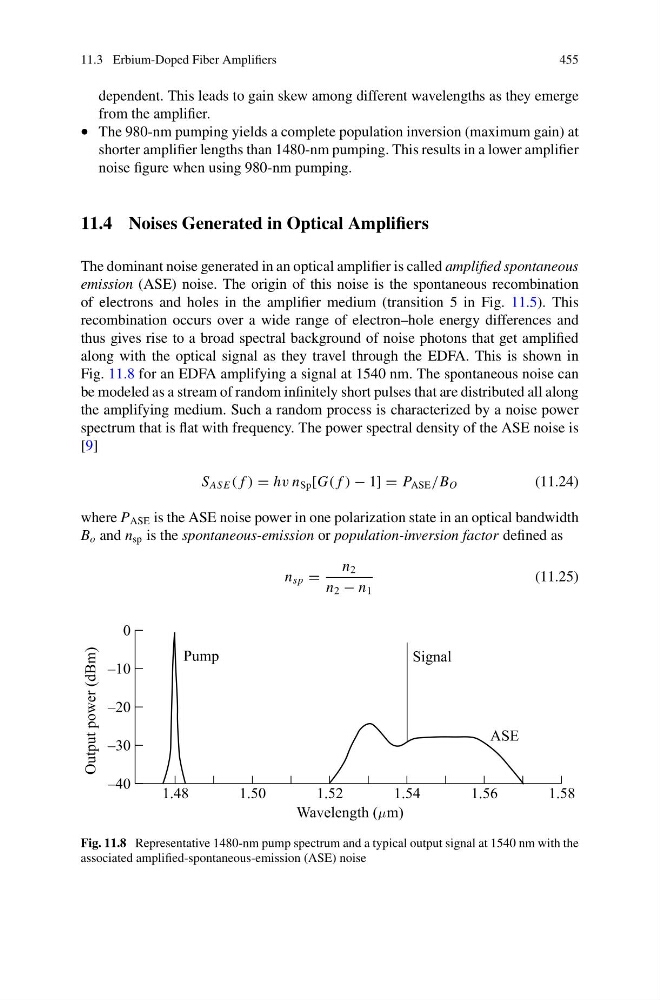
along with the optical signal as they travel through the EDFA. This is shown in
Fig. 11.8 for an EDFA amplifying a signal at 1540 nm. The spontaneous noise can
be modeled as a stream of random infinitely short pulses that are distributed all along
the amplifying medium. Such a random process is characterized by a noise power
spectrum that is flat with frequency. The power spectral density of the ASE noise is
[9]
S AS E ( f ) = hv n Sp [G( f ) − 1] = P ASE /B O
(11.24)
where P ASE is the ASE noise power in one polarization state in an optical bandwidth
B o and n sp is the spontaneous-emission or population-inversion factor defined as
n sp =
n 2
n 2 − n 1
(11.25)
Fig. 11.8 Representative 1480-nm pump spectrum and a typical output signal at 1540 nm with the
associated amplified-spontaneous-emission (ASE) noise
455
dependent. This leads to gain skew among different wavelengths as they emerge
from the amplifier.
• The 980-nm pumping yields a complete population inversion (maximum gain) at
shorter amplifier lengths than 1480-nm pumping. This results in a lower amplifier
noise figure when using 980-nm pumping.
11.4 Noises Generated in Optical Amplifiers
The dominant noise generated in an optical amplifier is called amplified spontaneous
emission (ASE) noise. The origin of this noise is the spontaneous recombination
of electrons and holes in the amplifier medium (transition 5 in Fig. 11.5). This
recombination occurs over a wide range of electron–hole energy differences and
thus gives rise to a broad spectral background of noise photons that get amplified
along with the optical signal as they travel through the EDFA. This is shown in
Fig. 11.8 for an EDFA amplifying a signal at 1540 nm. The spontaneous noise can
be modeled as a stream of random infinitely short pulses that are distributed all along
the amplifying medium. Such a random process is characterized by a noise power
spectrum that is flat with frequency. The power spectral density of the ASE noise is
[9]
S AS E ( f ) = hv n Sp [G( f ) − 1] = P ASE /B O
(11.24)
where P ASE is the ASE noise power in one polarization state in an optical bandwidth
B o and n sp is the spontaneous-emission or population-inversion factor defined as
n sp =
n 2
n 2 − n 1
(11.25)
Fig. 11.8 Representative 1480-nm pump spectrum and a typical output signal at 1540 nm with the
associated amplified-spontaneous-emission (ASE) noise