

448
11 Basics of Optical Amplifiers
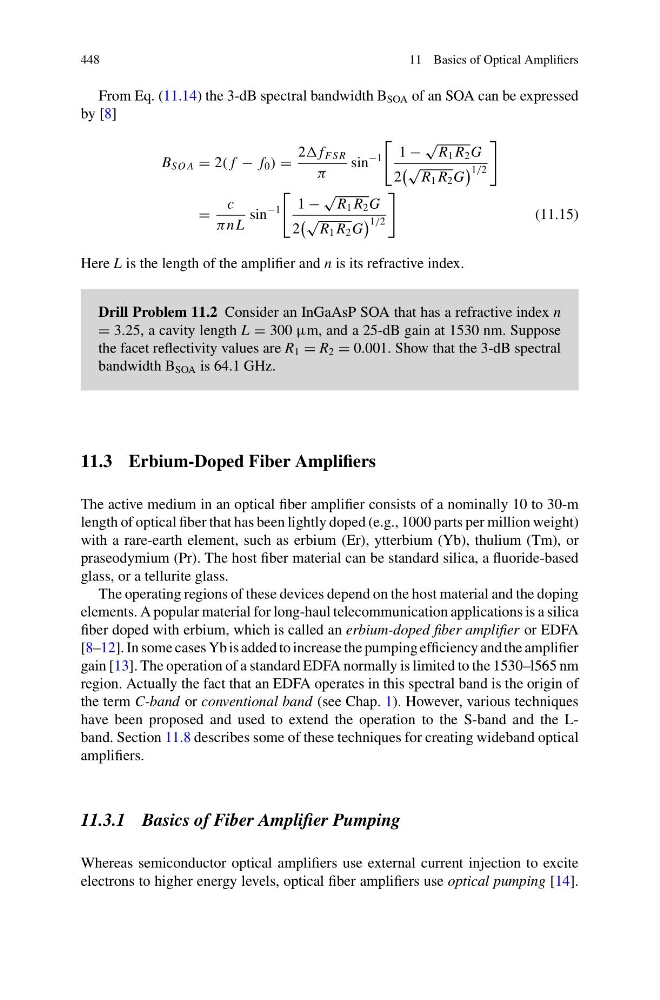
From Eq. (11.14) the 3-dB spectral bandwidth B SOA of an SOA can be expressed
by [8]
B SO A = 2( f − f 0 ) =
2 f F S R
π
sin
−1
1 −
√
R 1 R 2 G
2
√
R 1 R 2 G
1/2
=
c
π nL
sin
−1
1 −
√
R 1 R 2 G
2
√
R 1 R 2 G
1/2
(11.15)
Here L is the length of the amplifier and n is its refractive index.
Drill Problem 11.2 Consider an InGaAsP SOA that has a refractive index n
= 3.25, a cavity length L = 300 μm, and a 25-dB gain at 1530 nm. Suppose
the facet reflectivity values are R 1 = R 2 = 0.001. Show that the 3-dB spectral
bandwidth B SOA is 64.1 GHz.
11.3 Erbium-Doped Fiber Amplifiers
The active medium in an optical fiber amplifier consists of a nominally 10 to 30-m
length of optical fiber that has been lightly doped (e.g., 1000 parts per million weight)
with a rare-earth element, such as erbium (Er), ytterbium (Yb), thulium (Tm), or
praseodymium (Pr). The host fiber material can be standard silica, a fluoride-based
glass, or a tellurite glass.
The operating regions of these devices depend on the host material and the doping
elements. A popular material for long-haul telecommunication applications is a silica
fiber doped with erbium, which is called an erbium-doped fiber amplifier or EDFA
[8–12]. In some cases Yb is added to increase the pumping efficiency and the amplifier
gain [13]. The operation of a standard EDFA normally is limited to the 1530–l565 nm
region. Actually the fact that an EDFA operates in this spectral band is the origin of
the term C-band or conventional band (see Chap. 1). However, various techniques
have been proposed and used to extend the operation to the S-band and the Lband. Section 11.8 describes some of these techniques for creating wideband optical
amplifiers.
11.3.1 Basics of Fiber Amplifier Pumping
Whereas semiconductor optical amplifiers use external current injection to excite
electrons to higher energy levels, optical fiber amplifiers use optical pumping [14].
11 Basics of Optical Amplifiers
From Eq. (11.14) the 3-dB spectral bandwidth B SOA of an SOA can be expressed
by [8]
B SO A = 2( f − f 0 ) =
2 f F S R
π
sin
−1
1 −
√
R 1 R 2 G
2
√
R 1 R 2 G
1/2
=
c
π nL
sin
−1
1 −
√
R 1 R 2 G
2
√
R 1 R 2 G
1/2
(11.15)
Here L is the length of the amplifier and n is its refractive index.
Drill Problem 11.2 Consider an InGaAsP SOA that has a refractive index n
= 3.25, a cavity length L = 300 μm, and a 25-dB gain at 1530 nm. Suppose
the facet reflectivity values are R 1 = R 2 = 0.001. Show that the 3-dB spectral
bandwidth B SOA is 64.1 GHz.
11.3 Erbium-Doped Fiber Amplifiers
The active medium in an optical fiber amplifier consists of a nominally 10 to 30-m
length of optical fiber that has been lightly doped (e.g., 1000 parts per million weight)
with a rare-earth element, such as erbium (Er), ytterbium (Yb), thulium (Tm), or
praseodymium (Pr). The host fiber material can be standard silica, a fluoride-based
glass, or a tellurite glass.
The operating regions of these devices depend on the host material and the doping
elements. A popular material for long-haul telecommunication applications is a silica
fiber doped with erbium, which is called an erbium-doped fiber amplifier or EDFA
[8–12]. In some cases Yb is added to increase the pumping efficiency and the amplifier
gain [13]. The operation of a standard EDFA normally is limited to the 1530–l565 nm
region. Actually the fact that an EDFA operates in this spectral band is the origin of
the term C-band or conventional band (see Chap. 1). However, various techniques
have been proposed and used to extend the operation to the S-band and the Lband. Section 11.8 describes some of these techniques for creating wideband optical
amplifiers.
11.3.1 Basics of Fiber Amplifier Pumping
Whereas semiconductor optical amplifiers use external current injection to excite
electrons to higher energy levels, optical fiber amplifiers use optical pumping [14].