

11.3 Erbium-Doped Fiber Amplifiers
449
In this process, one uses photons to directly raise electrons into excited states. The
optical pumping process requires three or more energy levels. The top energy level
to which the electron is elevated initially must lie energetically above the desired
final emission level. After reaching its initial excited state, the electron must quickly
release some of its energy and drop to a slightly lower energy level. A signal photon
can then trigger the excited electron sitting in this new lower level into stimulated
emission, whereby the electron releases its remaining energy in the form of a new
photon with a wavelength identical to that of the signal photon. Because the pump
photon must have a higher energy than the signal photon, the pump wavelength is
shorter than the signal wavelength.
To get a phenomenological understanding of how an EDFA works, it is helpful to
look at the energy-level structure of erbium. The erbium atoms in silica are Er
3+ ions,
which are erbium atoms that have lost three of their outer electrons. In describing the
transitions of the outer electrons in these ions to higher energy states, it is common
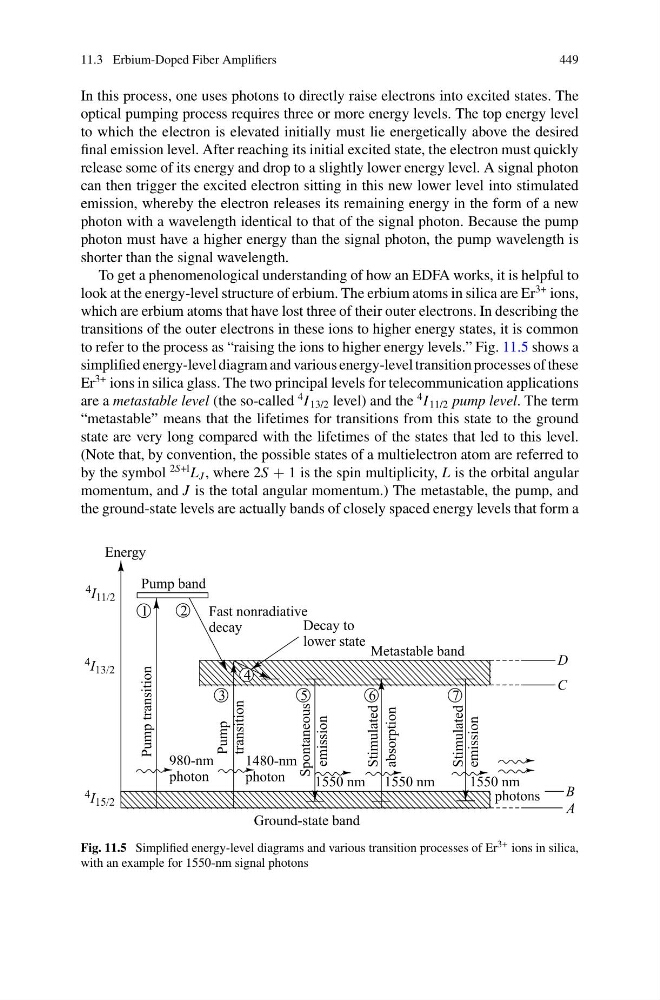
to refer to the process as “raising the ions to higher energy levels.” Fig. 11.5 shows a
simplified energy-level diagram and various energy-level transition processes of these
Er
3+ ions in silica glass. The two principal levels for telecommunication applications
are a metastable level (the so-called
4 I 13/2 level) and the
4 I 11/2 pump level. The term
“metastable” means that the lifetimes for transitions from this state to the ground
state are very long compared with the lifetimes of the states that led to this level.
(Note that, by convention, the possible states of a multielectron atom are referred to
by the symbol
2S+l L J , where 2S + 1 is the spin multiplicity, L is the orbital angular
momentum, and J is the total angular momentum.) The metastable, the pump, and
the ground-state levels are actually bands of closely spaced energy levels that form a
Fig. 11.5 Simplified energy-level diagrams and various transition processes of Er 3+ ions in silica,
with an example for 1550-nm signal photons
449
In this process, one uses photons to directly raise electrons into excited states. The
optical pumping process requires three or more energy levels. The top energy level
to which the electron is elevated initially must lie energetically above the desired
final emission level. After reaching its initial excited state, the electron must quickly
release some of its energy and drop to a slightly lower energy level. A signal photon
can then trigger the excited electron sitting in this new lower level into stimulated
emission, whereby the electron releases its remaining energy in the form of a new
photon with a wavelength identical to that of the signal photon. Because the pump
photon must have a higher energy than the signal photon, the pump wavelength is
shorter than the signal wavelength.
To get a phenomenological understanding of how an EDFA works, it is helpful to
look at the energy-level structure of erbium. The erbium atoms in silica are Er
3+ ions,
which are erbium atoms that have lost three of their outer electrons. In describing the
transitions of the outer electrons in these ions to higher energy states, it is common
to refer to the process as “raising the ions to higher energy levels.” Fig. 11.5 shows a
simplified energy-level diagram and various energy-level transition processes of these
Er
3+ ions in silica glass. The two principal levels for telecommunication applications
are a metastable level (the so-called
4 I 13/2 level) and the
4 I 11/2 pump level. The term
“metastable” means that the lifetimes for transitions from this state to the ground
state are very long compared with the lifetimes of the states that led to this level.
(Note that, by convention, the possible states of a multielectron atom are referred to
by the symbol
2S+l L J , where 2S + 1 is the spin multiplicity, L is the orbital angular
momentum, and J is the total angular momentum.) The metastable, the pump, and
the ground-state levels are actually bands of closely spaced energy levels that form a
Fig. 11.5 Simplified energy-level diagrams and various transition processes of Er 3+ ions in silica,
with an example for 1550-nm signal photons