

10.7 WDM Applications of Diffraction Gratings
429
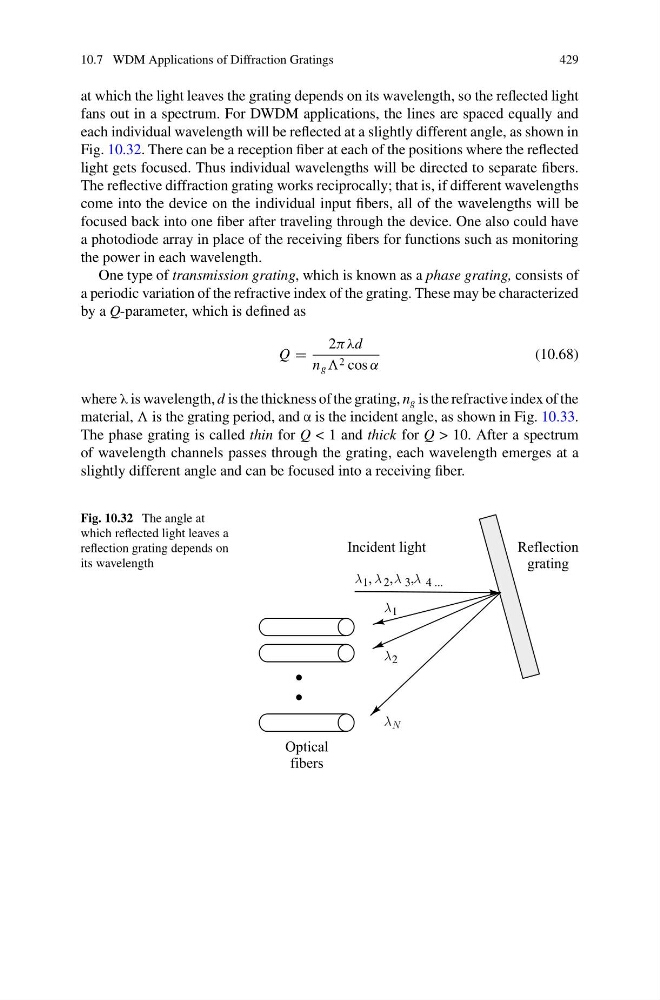
at which the light leaves the grating depends on its wavelength, so the reflected light
fans out in a spectrum. For DWDM applications, the lines are spaced equally and
each individual wavelength will be reflected at a slightly different angle, as shown in
Fig. 10.32. There can be a reception fiber at each of the positions where the reflected
light gets focused. Thus individual wavelengths will be directed to separate fibers.
The reflective diffraction grating works reciprocally; that is, if different wavelengths
come into the device on the individual input fibers, all of the wavelengths will be
focused back into one fiber after traveling through the device. One also could have
a photodiode array in place of the receiving fibers for functions such as monitoring
the power in each wavelength.
One type of transmission grating, which is known as a phase grating, consists of
a periodic variation of the refractive index of the grating. These may be characterized
by a Q-parameter, which is defined as
Q =
2πλd
n g 2 cos α
(10.68)
where λ is wavelength, d is the thickness of the grating, n g is the refractive index of the
material, is the grating period, and α is the incident angle, as shown in Fig. 10.33.
The phase grating is called thin for Q < 1 and thick for Q > 10. After a spectrum
of wavelength channels passes through the grating, each wavelength emerges at a
slightly different angle and can be focused into a receiving fiber.
Fig. 10.32 The angle at
which reflected light leaves a
reflection grating depends on
its wavelength
429
at which the light leaves the grating depends on its wavelength, so the reflected light
fans out in a spectrum. For DWDM applications, the lines are spaced equally and
each individual wavelength will be reflected at a slightly different angle, as shown in
Fig. 10.32. There can be a reception fiber at each of the positions where the reflected
light gets focused. Thus individual wavelengths will be directed to separate fibers.
The reflective diffraction grating works reciprocally; that is, if different wavelengths
come into the device on the individual input fibers, all of the wavelengths will be
focused back into one fiber after traveling through the device. One also could have
a photodiode array in place of the receiving fibers for functions such as monitoring
the power in each wavelength.
One type of transmission grating, which is known as a phase grating, consists of
a periodic variation of the refractive index of the grating. These may be characterized
by a Q-parameter, which is defined as
Q =
2πλd
n g 2 cos α
(10.68)
where λ is wavelength, d is the thickness of the grating, n g is the refractive index of the
material, is the grating period, and α is the incident angle, as shown in Fig. 10.33.
The phase grating is called thin for Q < 1 and thick for Q > 10. After a spectrum
of wavelength channels passes through the grating, each wavelength emerges at a
slightly different angle and can be focused into a receiving fiber.
Fig. 10.32 The angle at
which reflected light leaves a
reflection grating depends on
its wavelength