

428
10 Wavelength Division Multiplexing (WDM)
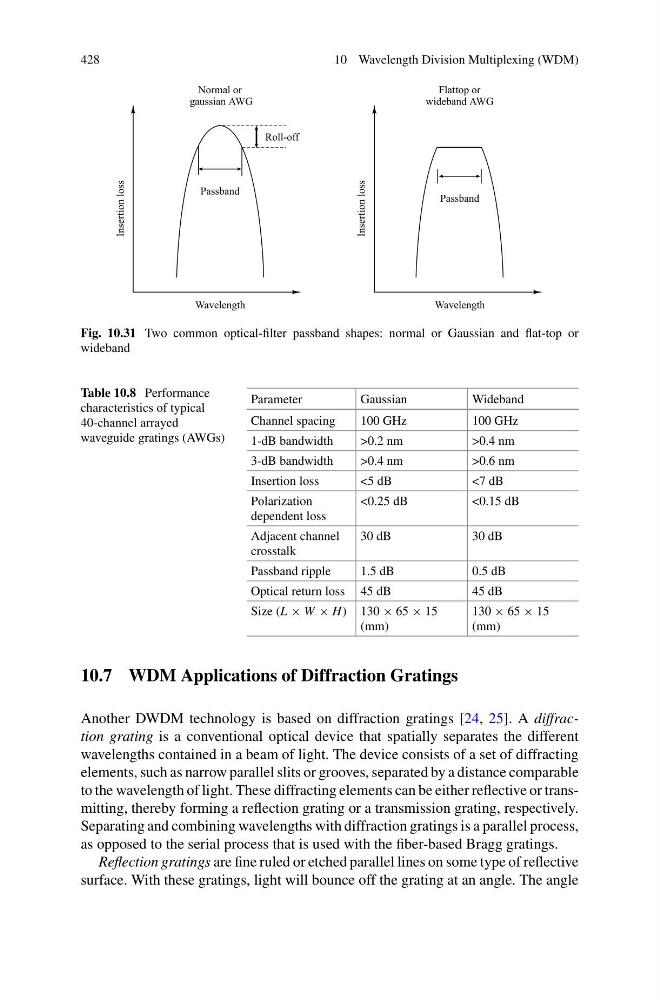
Fig. 10.31 Two common optical-filter passband shapes: normal or Gaussian and flat-top or
wideband
Table 10.8 Performance
characteristics of typical
40-channel arrayed
waveguide gratings (AWGs)
Parameter
Gaussian
Wideband
Channel spacing
100 GHz
100 GHz
1-dB bandwidth
>0.2 nm
>0.4 nm
3-dB bandwidth
>0.4 nm
>0.6 nm
Insertion loss
<5 dB
<7 dB
Polarization
dependent loss
<0.25 dB
<0.15 dB
Adjacent channel
crosstalk
30 dB
30 dB
Passband ripple
1.5 dB
0.5 dB
Optical return loss 45 dB
45 dB
Size (L × W × H) 130 × 65 × 15
(mm)
130 × 65 × 15
(mm)
10.7 WDM Applications of Diffraction Gratings
Another DWDM technology is based on diffraction gratings [24, 25]. A diffraction grating is a conventional optical device that spatially separates the different
wavelengths contained in a beam of light. The device consists of a set of diffracting
elements, such as narrow parallel slits or grooves, separated by a distance comparable
to the wavelength of light. These diffracting elements can be either reflective or transmitting, thereby forming a reflection grating or a transmission grating, respectively.
Separating and combining wavelengths with diffraction gratings is a parallel process,
as opposed to the serial process that is used with the fiber-based Bragg gratings.
Reflection gratings are fine ruled or etched parallel lines on some type of reflective
surface. With these gratings, light will bounce off the grating at an angle. The angle
10 Wavelength Division Multiplexing (WDM)
Fig. 10.31 Two common optical-filter passband shapes: normal or Gaussian and flat-top or
wideband
Table 10.8 Performance
characteristics of typical
40-channel arrayed
waveguide gratings (AWGs)
Parameter
Gaussian
Wideband
Channel spacing
100 GHz
100 GHz
1-dB bandwidth
>0.2 nm
>0.4 nm
3-dB bandwidth
>0.4 nm
>0.6 nm
Insertion loss
<5 dB
<7 dB
Polarization
dependent loss
<0.25 dB
<0.15 dB
Adjacent channel
crosstalk
30 dB
30 dB
Passband ripple
1.5 dB
0.5 dB
Optical return loss 45 dB
45 dB
Size (L × W × H) 130 × 65 × 15
(mm)
130 × 65 × 15
(mm)
10.7 WDM Applications of Diffraction Gratings
Another DWDM technology is based on diffraction gratings [24, 25]. A diffraction grating is a conventional optical device that spatially separates the different
wavelengths contained in a beam of light. The device consists of a set of diffracting
elements, such as narrow parallel slits or grooves, separated by a distance comparable
to the wavelength of light. These diffracting elements can be either reflective or transmitting, thereby forming a reflection grating or a transmission grating, respectively.
Separating and combining wavelengths with diffraction gratings is a parallel process,
as opposed to the serial process that is used with the fiber-based Bragg gratings.
Reflection gratings are fine ruled or etched parallel lines on some type of reflective
surface. With these gratings, light will bounce off the grating at an angle. The angle