

10.6 Arrayed Waveguide Devices
427
FSR = λ F S R =
λ
2
c
Ln c
(10.67)
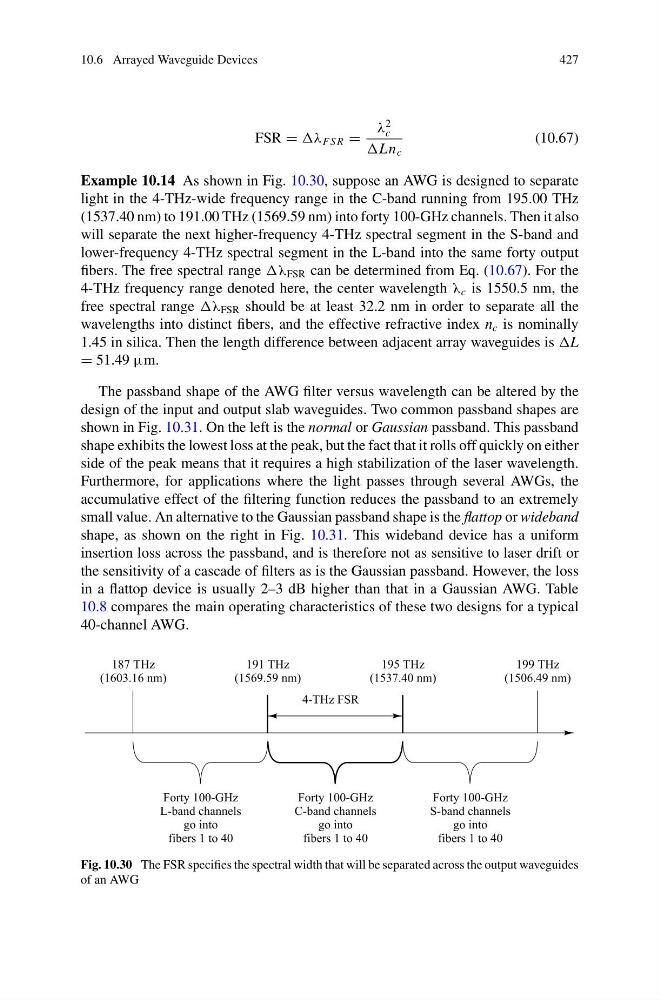
Example 10.14 As shown in Fig. 10.30, suppose an AWG is designed to separate
light in the 4-THz-wide frequency range in the C-band running from 195.00 THz
(1537.40 nm) to 191.00 THz (1569.59 nm) into forty 100-GHz channels. Then it also
will separate the next higher-frequency 4-THz spectral segment in the S-band and
lower-frequency 4-THz spectral segment in the L-band into the same forty output
fibers. The free spectral range FSR can be determined from Eq. (10.67). For the
4-THz frequency range denoted here, the center wavelength λ c is 1550.5 nm, the
free spectral range FSR should be at least 32.2 nm in order to separate all the
wavelengths into distinct fibers, and the effective refractive index n c is nominally
1.45 in silica. Then the length difference between adjacent array waveguides is
= 51.49 μm.
The passband shape of the AWG filter versus wavelength can be altered by the
design of the input and output slab waveguides. Two common passband shapes are
shown in Fig. 10.31. On the left is the normal or Gaussian passband. This passband
shape exhibits the lowest loss at the peak, but the fact that it rolls off quickly on either
side of the peak means that it requires a high stabilization of the laser wavelength.
Furthermore, for applications where the light passes through several AWGs, the
accumulative effect of the filtering function reduces the passband to an extremely
small value. An alternative to the Gaussian passband shape is the flattop or wideband
shape, as shown on the right in Fig. 10.31. This wideband device has a uniform
insertion loss across the passband, and is therefore not as sensitive to laser drift or
the sensitivity of a cascade of filters as is the Gaussian passband. However, the loss
in a flattop device is usually 2–3 dB higher than that in a Gaussian AWG. Table
10.8 compares the main operating characteristics of these two designs for a typical
40-channel AWG.
Fig. 10.30 The FSR specifies the spectral width that will be separated across the output waveguides
of an AWG
427
FSR = λ F S R =
λ
2
c
Ln c
(10.67)
Example 10.14 As shown in Fig. 10.30, suppose an AWG is designed to separate
light in the 4-THz-wide frequency range in the C-band running from 195.00 THz
(1537.40 nm) to 191.00 THz (1569.59 nm) into forty 100-GHz channels. Then it also
will separate the next higher-frequency 4-THz spectral segment in the S-band and
lower-frequency 4-THz spectral segment in the L-band into the same forty output
fibers. The free spectral range FSR can be determined from Eq. (10.67). For the
4-THz frequency range denoted here, the center wavelength λ c is 1550.5 nm, the
free spectral range FSR should be at least 32.2 nm in order to separate all the
wavelengths into distinct fibers, and the effective refractive index n c is nominally
1.45 in silica. Then the length difference between adjacent array waveguides is
= 51.49 μm.
The passband shape of the AWG filter versus wavelength can be altered by the
design of the input and output slab waveguides. Two common passband shapes are
shown in Fig. 10.31. On the left is the normal or Gaussian passband. This passband
shape exhibits the lowest loss at the peak, but the fact that it rolls off quickly on either
side of the peak means that it requires a high stabilization of the laser wavelength.
Furthermore, for applications where the light passes through several AWGs, the
accumulative effect of the filtering function reduces the passband to an extremely
small value. An alternative to the Gaussian passband shape is the flattop or wideband
shape, as shown on the right in Fig. 10.31. This wideband device has a uniform
insertion loss across the passband, and is therefore not as sensitive to laser drift or
the sensitivity of a cascade of filters as is the Gaussian passband. However, the loss
in a flattop device is usually 2–3 dB higher than that in a Gaussian AWG. Table
10.8 compares the main operating characteristics of these two designs for a typical
40-channel AWG.
Fig. 10.30 The FSR specifies the spectral width that will be separated across the output waveguides
of an AWG