

430
10 Wavelength Division Multiplexing (WDM)
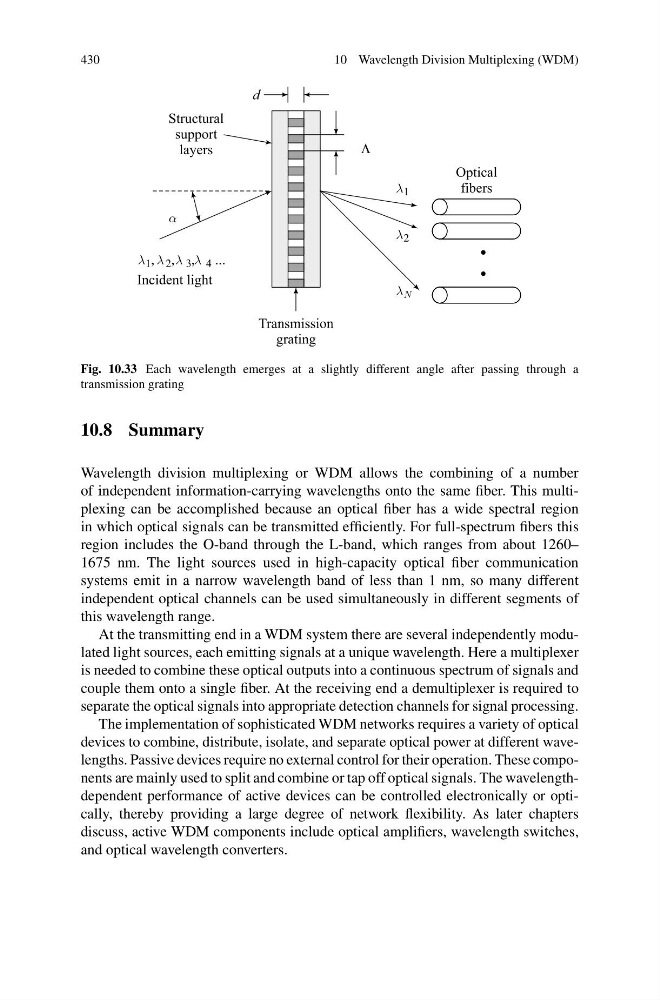
Fig. 10.33 Each wavelength emerges at a slightly different angle after passing through a
transmission grating
10.8 Summary
Wavelength division multiplexing or WDM allows the combining of a number
of independent information-carrying wavelengths onto the same fiber. This multiplexing can be accomplished because an optical fiber has a wide spectral region
in which optical signals can be transmitted efficiently. For full-spectrum fibers this
region includes the O-band through the L-band, which ranges from about 1260–
1675 nm. The light sources used in high-capacity optical fiber communication
systems emit in a narrow wavelength band of less than 1 nm, so many different
independent optical channels can be used simultaneously in different segments of
this wavelength range.
At the transmitting end in a WDM system there are several independently modulated light sources, each emitting signals at a unique wavelength. Here a multiplexer
is needed to combine these optical outputs into a continuous spectrum of signals and
couple them onto a single fiber. At the receiving end a demultiplexer is required to
separate the optical signals into appropriate detection channels for signal processing.
The implementation of sophisticated WDM networks requires a variety of optical
devices to combine, distribute, isolate, and separate optical power at different wavelengths. Passive devices require no external control for their operation. These components are mainly used to split and combine or tap off optical signals. The wavelengthdependent performance of active devices can be controlled electronically or optically, thereby providing a large degree of network flexibility. As later chapters
discuss, active WDM components include optical amplifiers, wavelength switches,
and optical wavelength converters.
10 Wavelength Division Multiplexing (WDM)
Fig. 10.33 Each wavelength emerges at a slightly different angle after passing through a
transmission grating
10.8 Summary
Wavelength division multiplexing or WDM allows the combining of a number
of independent information-carrying wavelengths onto the same fiber. This multiplexing can be accomplished because an optical fiber has a wide spectral region
in which optical signals can be transmitted efficiently. For full-spectrum fibers this
region includes the O-band through the L-band, which ranges from about 1260–
1675 nm. The light sources used in high-capacity optical fiber communication
systems emit in a narrow wavelength band of less than 1 nm, so many different
independent optical channels can be used simultaneously in different segments of
this wavelength range.
At the transmitting end in a WDM system there are several independently modulated light sources, each emitting signals at a unique wavelength. Here a multiplexer
is needed to combine these optical outputs into a continuous spectrum of signals and
couple them onto a single fiber. At the receiving end a demultiplexer is required to
separate the optical signals into appropriate detection channels for signal processing.
The implementation of sophisticated WDM networks requires a variety of optical
devices to combine, distribute, isolate, and separate optical power at different wavelengths. Passive devices require no external control for their operation. These components are mainly used to split and combine or tap off optical signals. The wavelengthdependent performance of active devices can be controlled electronically or optically, thereby providing a large degree of network flexibility. As later chapters
discuss, active WDM components include optical amplifiers, wavelength switches,
and optical wavelength converters.