

10.2 Passive Optical Couplers
409
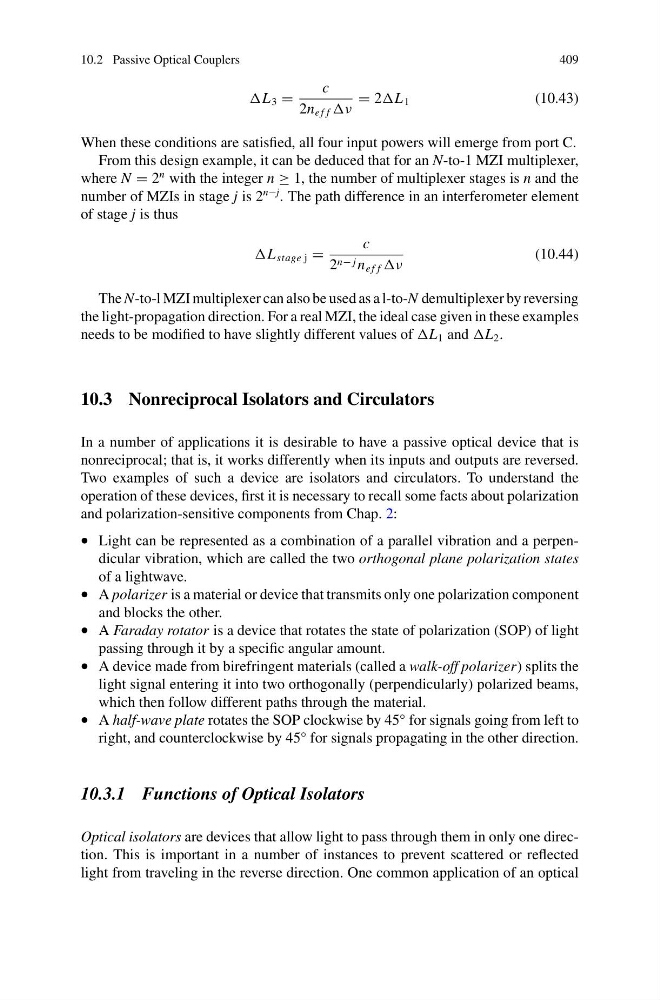
L 3 =
c
2n e f f ν
= 2L 1
(10.43)
When these conditions are satisfied, all four input powers will emerge from port C.
From this design example, it can be deduced that for an N-to-1 MZI multiplexer,
where N = 2
n with the integer n ≥ 1, the number of multiplexer stages is n and the
number of MZIs in stage j is 2
n−j . The path difference in an interferometer element
of stage j is thus
L stage j =
c
2 n− j n e f f ν
(10.44)
The N-to-l MZI multiplexer can also be used as a l-to-N demultiplexer by reversing
the light-propagation direction. For a real MZI, the ideal case given in these examples
needs to be modified to have slightly different values of L 1 and L 2 .
10.3 Nonreciprocal Isolators and Circulators
In a number of applications it is desirable to have a passive optical device that is
nonreciprocal; that is, it works differently when its inputs and outputs are reversed.
Two examples of such a device are isolators and circulators. To understand the
operation of these devices, first it is necessary to recall some facts about polarization
and polarization-sensitive components from Chap. 2:
• Light can be represented as a combination of a parallel vibration and a perpendicular vibration, which are called the two orthogonal plane polarization states
of a lightwave.
• A polarizer is a material or device that transmits only one polarization component
and blocks the other.
• A Faraday rotator is a device that rotates the state of polarization (SOP) of light
passing through it by a specific angular amount.
• A device made from birefringent materials (called a walk-off polarizer) splits the
light signal entering it into two orthogonally (perpendicularly) polarized beams,
which then follow different paths through the material.
• A half-wave plate rotates the SOP clockwise by 45° for signals going from left to
right, and counterclockwise by 45° for signals propagating in the other direction.
10.3.1 Functions of Optical Isolators
Optical isolators are devices that allow light to pass through them in only one direction. This is important in a number of instances to prevent scattered or reflected
light from traveling in the reverse direction. One common application of an optical
409
L 3 =
c
2n e f f ν
= 2L 1
(10.43)
When these conditions are satisfied, all four input powers will emerge from port C.
From this design example, it can be deduced that for an N-to-1 MZI multiplexer,
where N = 2
n with the integer n ≥ 1, the number of multiplexer stages is n and the
number of MZIs in stage j is 2
n−j . The path difference in an interferometer element
of stage j is thus
L stage j =
c
2 n− j n e f f ν
(10.44)
The N-to-l MZI multiplexer can also be used as a l-to-N demultiplexer by reversing
the light-propagation direction. For a real MZI, the ideal case given in these examples
needs to be modified to have slightly different values of L 1 and L 2 .
10.3 Nonreciprocal Isolators and Circulators
In a number of applications it is desirable to have a passive optical device that is
nonreciprocal; that is, it works differently when its inputs and outputs are reversed.
Two examples of such a device are isolators and circulators. To understand the
operation of these devices, first it is necessary to recall some facts about polarization
and polarization-sensitive components from Chap. 2:
• Light can be represented as a combination of a parallel vibration and a perpendicular vibration, which are called the two orthogonal plane polarization states
of a lightwave.
• A polarizer is a material or device that transmits only one polarization component
and blocks the other.
• A Faraday rotator is a device that rotates the state of polarization (SOP) of light
passing through it by a specific angular amount.
• A device made from birefringent materials (called a walk-off polarizer) splits the
light signal entering it into two orthogonally (perpendicularly) polarized beams,
which then follow different paths through the material.
• A half-wave plate rotates the SOP clockwise by 45° for signals going from left to
right, and counterclockwise by 45° for signals propagating in the other direction.
10.3.1 Functions of Optical Isolators
Optical isolators are devices that allow light to pass through them in only one direction. This is important in a number of instances to prevent scattered or reflected
light from traveling in the reverse direction. One common application of an optical