

410
10 Wavelength Division Multiplexing (WDM)
isolator is to keep such backward-traveling light from entering a laser diode and
possibly causing instabilities in the optical output.
Many design configurations of varying complexity exist for optical isolators. The
simple ones depend on the state of polarization of the input light. However, such
a design results in a 3-dB loss (half the power) when unpolarized light is passed
through the device because it blocks half of the input signal. In practice the optical
isolator should be independent of the SOP because light in an optical link normally
is not polarized.
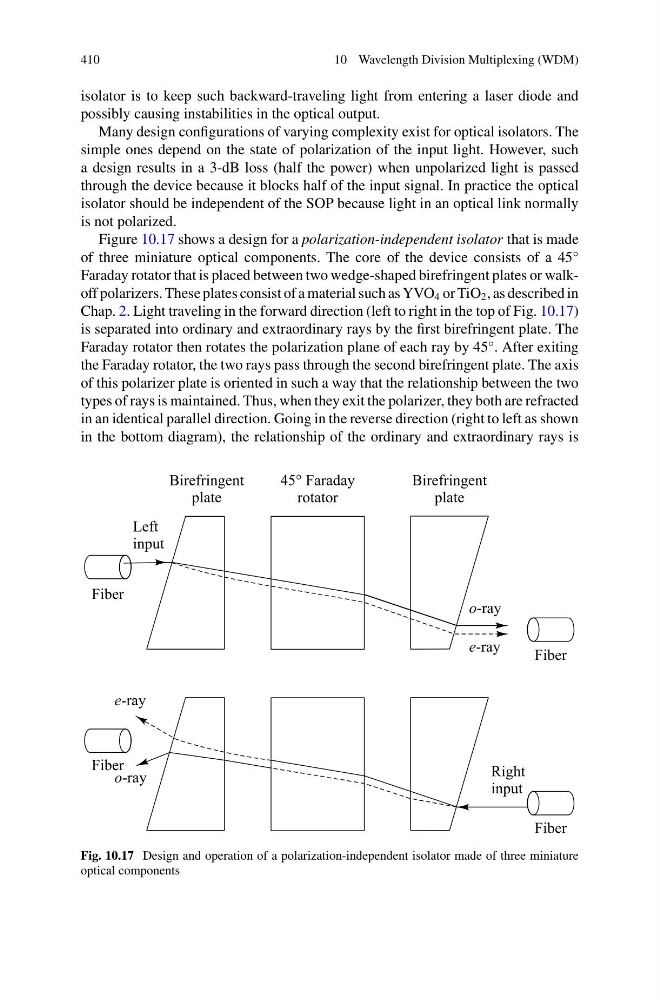
Figure 10.17 shows a design for a polarization-independent isolator that is made
of three miniature optical components. The core of the device consists of a 45°
Faraday rotator that is placed between two wedge-shaped birefringent plates or walkoff polarizers. These plates consist of a material such as YVO 4 or TiO 2 , as described in
Chap. 2. Light traveling in the forward direction (left to right in the top of Fig. 10.17)
is separated into ordinary and extraordinary rays by the first birefringent plate. The
Faraday rotator then rotates the polarization plane of each ray by 45°. After exiting
the Faraday rotator, the two rays pass through the second birefringent plate. The axis
of this polarizer plate is oriented in such a way that the relationship between the two
types of rays is maintained. Thus, when they exit the polarizer, they both are refracted
in an identical parallel direction. Going in the reverse direction (right to left as shown
in the bottom diagram), the relationship of the ordinary and extraordinary rays is
Fig. 10.17 Design and operation of a polarization-independent isolator made of three miniature
optical components
10 Wavelength Division Multiplexing (WDM)
isolator is to keep such backward-traveling light from entering a laser diode and
possibly causing instabilities in the optical output.
Many design configurations of varying complexity exist for optical isolators. The
simple ones depend on the state of polarization of the input light. However, such
a design results in a 3-dB loss (half the power) when unpolarized light is passed
through the device because it blocks half of the input signal. In practice the optical
isolator should be independent of the SOP because light in an optical link normally
is not polarized.
Figure 10.17 shows a design for a polarization-independent isolator that is made
of three miniature optical components. The core of the device consists of a 45°
Faraday rotator that is placed between two wedge-shaped birefringent plates or walkoff polarizers. These plates consist of a material such as YVO 4 or TiO 2 , as described in
Chap. 2. Light traveling in the forward direction (left to right in the top of Fig. 10.17)
is separated into ordinary and extraordinary rays by the first birefringent plate. The
Faraday rotator then rotates the polarization plane of each ray by 45°. After exiting
the Faraday rotator, the two rays pass through the second birefringent plate. The axis
of this polarizer plate is oriented in such a way that the relationship between the two
types of rays is maintained. Thus, when they exit the polarizer, they both are refracted
in an identical parallel direction. Going in the reverse direction (right to left as shown
in the bottom diagram), the relationship of the ordinary and extraordinary rays is
Fig. 10.17 Design and operation of a polarization-independent isolator made of three miniature
optical components