

404
10 Wavelength Division Multiplexing (WDM)
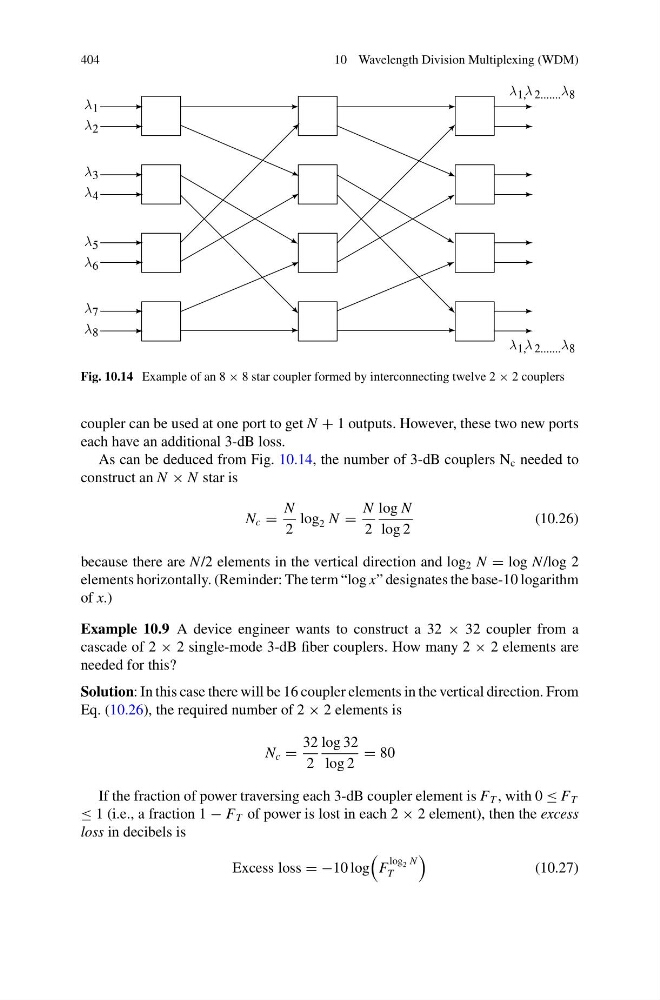
Fig. 10.14 Example of an 8 × 8 star coupler formed by interconnecting twelve 2 × 2 couplers
coupler can be used at one port to get N + 1 outputs. However, these two new ports
each have an additional 3-dB loss.
As can be deduced from Fig. 10.14, the number of 3-dB couplers N c needed to
construct an N × N star is
N c =
N
2
log 2 N =
N
2
log N
log 2
(10.26)
because there are N/2 elements in the vertical direction and log 2 N = log N/log 2
elements horizontally. (Reminder: The term “log x” designates the base-10 logarithm
of x.)
Example 10.9 A device engineer wants to construct a 32 × 32 coupler from a
cascade of 2 × 2 single-mode 3-dB fiber couplers. How many 2 × 2 elements are
needed for this?
Solution: In this case there will be 16 coupler elements in the vertical direction. From
Eq. (10.26), the required number of 2 × 2 elements is
N c =
32
2
log 32
log 2
= 80
If the fraction of power traversing each 3-dB coupler element is F T , with 0 ≤ F T
≤ 1 (i.e., a fraction 1 − F T of power is lost in each 2 × 2 element), then the excess
loss in decibels is
Excess loss = −10 log
F
log 2 N
T
(10.27)
10 Wavelength Division Multiplexing (WDM)
Fig. 10.14 Example of an 8 × 8 star coupler formed by interconnecting twelve 2 × 2 couplers
coupler can be used at one port to get N + 1 outputs. However, these two new ports
each have an additional 3-dB loss.
As can be deduced from Fig. 10.14, the number of 3-dB couplers N c needed to
construct an N × N star is
N c =
N
2
log 2 N =
N
2
log N
log 2
(10.26)
because there are N/2 elements in the vertical direction and log 2 N = log N/log 2
elements horizontally. (Reminder: The term “log x” designates the base-10 logarithm
of x.)
Example 10.9 A device engineer wants to construct a 32 × 32 coupler from a
cascade of 2 × 2 single-mode 3-dB fiber couplers. How many 2 × 2 elements are
needed for this?
Solution: In this case there will be 16 coupler elements in the vertical direction. From
Eq. (10.26), the required number of 2 × 2 elements is
N c =
32
2
log 32
log 2
= 80
If the fraction of power traversing each 3-dB coupler element is F T , with 0 ≤ F T
≤ 1 (i.e., a fraction 1 − F T of power is lost in each 2 × 2 element), then the excess
loss in decibels is
Excess loss = −10 log
F
log 2 N
T
(10.27)