

10.2 Passive Optical Couplers
405
The splitting loss for this star is, again, given by Eq. (10.24). Thus the total loss
experienced by a signal as it passes through the log 2 N stages of the N × N star and
gets divided into N outputs is (in decibels)
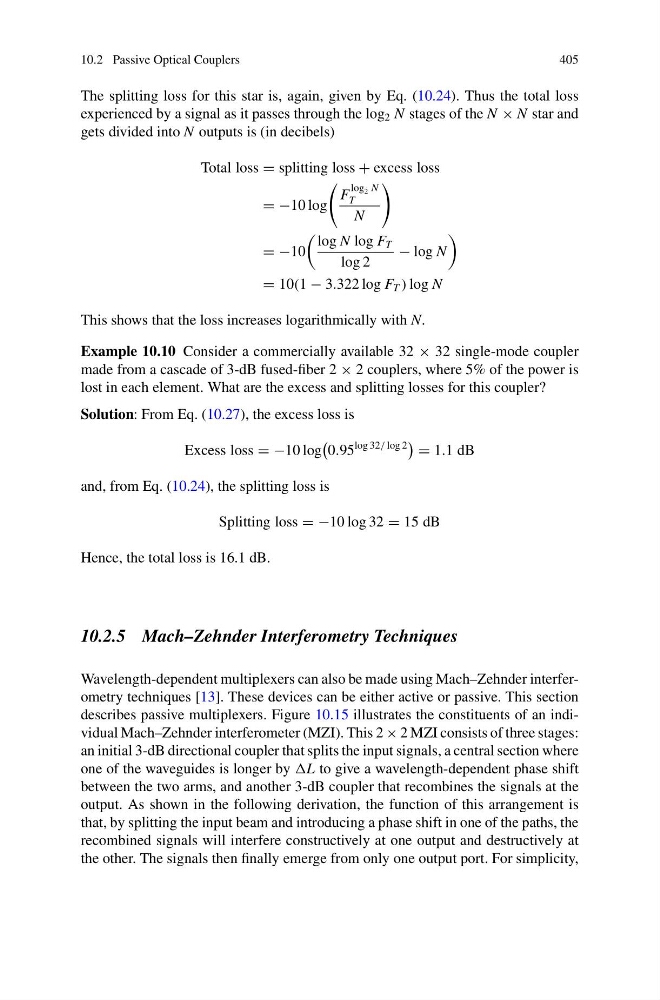
Total loss = splitting loss + excess loss
= −10 log
F
log 2 N
T
N
= −10
log N log F T
log 2
− log N
= 10(1 − 3.322 log F T ) log N
This shows that the loss increases logarithmically with N.
Example 10.10 Consider a commercially available 32 × 32 single-mode coupler
made from a cascade of 3-dB fused-fiber 2 × 2 couplers, where 5% of the power is
lost in each element. What are the excess and splitting losses for this coupler?
Solution: From Eq. (10.27), the excess loss is
Excess loss = −10 log
0.95
log 32/ log 2
= 1.1 dB
and, from Eq. (10.24), the splitting loss is
Splitting loss = −10 log 32 = 15 dB
Hence, the total loss is 16.1 dB.
10.2.5 Mach–Zehnder Interferometry Techniques
Wavelength-dependent multiplexers can also be made using Mach–Zehnder interferometry techniques [13]. These devices can be either active or passive. This section
describes passive multiplexers. Figure 10.15 illustrates the constituents of an individual Mach–Zehnder interferometer (MZI). This 2 × 2 MZI consists of three stages:
an initial 3-dB directional coupler that splits the input signals, a central section where
one of the waveguides is longer by L to give a wavelength-dependent phase shift
between the two arms, and another 3-dB coupler that recombines the signals at the
output. As shown in the following derivation, the function of this arrangement is
that, by splitting the input beam and introducing a phase shift in one of the paths, the
recombined signals will interfere constructively at one output and destructively at
the other. The signals then finally emerge from only one output port. For simplicity,
405
The splitting loss for this star is, again, given by Eq. (10.24). Thus the total loss
experienced by a signal as it passes through the log 2 N stages of the N × N star and
gets divided into N outputs is (in decibels)
Total loss = splitting loss + excess loss
= −10 log
F
log 2 N
T
N
= −10
log N log F T
log 2
− log N
= 10(1 − 3.322 log F T ) log N
This shows that the loss increases logarithmically with N.
Example 10.10 Consider a commercially available 32 × 32 single-mode coupler
made from a cascade of 3-dB fused-fiber 2 × 2 couplers, where 5% of the power is
lost in each element. What are the excess and splitting losses for this coupler?
Solution: From Eq. (10.27), the excess loss is
Excess loss = −10 log
0.95
log 32/ log 2
= 1.1 dB
and, from Eq. (10.24), the splitting loss is
Splitting loss = −10 log 32 = 15 dB
Hence, the total loss is 16.1 dB.
10.2.5 Mach–Zehnder Interferometry Techniques
Wavelength-dependent multiplexers can also be made using Mach–Zehnder interferometry techniques [13]. These devices can be either active or passive. This section
describes passive multiplexers. Figure 10.15 illustrates the constituents of an individual Mach–Zehnder interferometer (MZI). This 2 × 2 MZI consists of three stages:
an initial 3-dB directional coupler that splits the input signals, a central section where
one of the waveguides is longer by L to give a wavelength-dependent phase shift
between the two arms, and another 3-dB coupler that recombines the signals at the
output. As shown in the following derivation, the function of this arrangement is
that, by splitting the input beam and introducing a phase shift in one of the paths, the
recombined signals will interfere constructively at one output and destructively at
the other. The signals then finally emerge from only one output port. For simplicity,