

10.2 Passive Optical Couplers
403
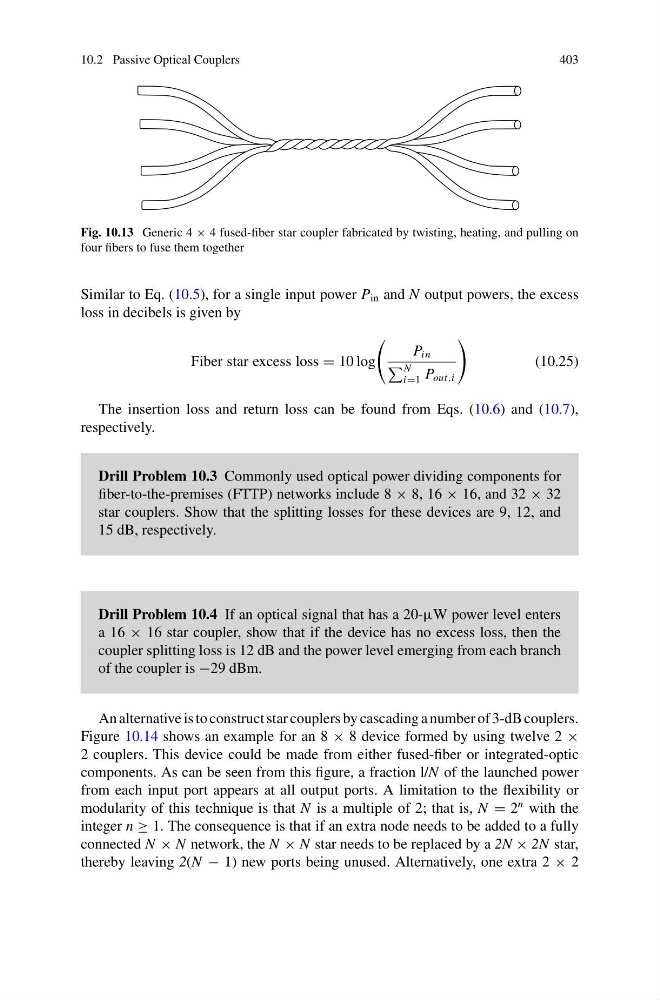
Fig. 10.13 Generic 4 × 4 fused-fiber star coupler fabricated by twisting, heating, and pulling on
four fibers to fuse them together
Similar to Eq. (10.5), for a single input power P in and N output powers, the excess
loss in decibels is given by
Fiber star excess loss = 10 log
P in
N
i=1 P out,i
(10.25)
The insertion loss and return loss can be found from Eqs. (10.6) and (10.7),
respectively.
Drill Problem 10.3 Commonly used optical power dividing components for
fiber-to-the-premises (FTTP) networks include 8 × 8, 16 × 16, and 32 × 32
star couplers. Show that the splitting losses for these devices are 9, 12, and
15 dB, respectively.
Drill Problem 10.4 If an optical signal that has a 20-μW power level enters
a 16 × 16 star coupler, show that if the device has no excess loss, then the
coupler splitting loss is 12 dB and the power level emerging from each branch
of the coupler is −29 dBm.
An alternative is to construct star couplers by cascading a number of 3-dB couplers.
Figure 10.14 shows an example for an 8 × 8 device formed by using twelve 2 ×
2 couplers. This device could be made from either fused-fiber or integrated-optic
components. As can be seen from this figure, a fraction l/N of the launched power
from each input port appears at all output ports. A limitation to the flexibility or
modularity of this technique is that N is a multiple of 2; that is, N = 2
n with the
integer n ≥ 1. The consequence is that if an extra node needs to be added to a fully
connected N × N network, the N × N star needs to be replaced by a 2N × 2N star,
thereby leaving 2(N − 1) new ports being unused. Alternatively, one extra 2 × 2
403
Fig. 10.13 Generic 4 × 4 fused-fiber star coupler fabricated by twisting, heating, and pulling on
four fibers to fuse them together
Similar to Eq. (10.5), for a single input power P in and N output powers, the excess
loss in decibels is given by
Fiber star excess loss = 10 log
P in
N
i=1 P out,i
(10.25)
The insertion loss and return loss can be found from Eqs. (10.6) and (10.7),
respectively.
Drill Problem 10.3 Commonly used optical power dividing components for
fiber-to-the-premises (FTTP) networks include 8 × 8, 16 × 16, and 32 × 32
star couplers. Show that the splitting losses for these devices are 9, 12, and
15 dB, respectively.
Drill Problem 10.4 If an optical signal that has a 20-μW power level enters
a 16 × 16 star coupler, show that if the device has no excess loss, then the
coupler splitting loss is 12 dB and the power level emerging from each branch
of the coupler is −29 dBm.
An alternative is to construct star couplers by cascading a number of 3-dB couplers.
Figure 10.14 shows an example for an 8 × 8 device formed by using twelve 2 ×
2 couplers. This device could be made from either fused-fiber or integrated-optic
components. As can be seen from this figure, a fraction l/N of the launched power
from each input port appears at all output ports. A limitation to the flexibility or
modularity of this technique is that N is a multiple of 2; that is, N = 2
n with the
integer n ≥ 1. The consequence is that if an extra node needs to be added to a fully
connected N × N network, the N × N star needs to be replaced by a 2N × 2N star,
thereby leaving 2(N − 1) new ports being unused. Alternatively, one extra 2 × 2