

8.4 Coherent Detection Schemes
347
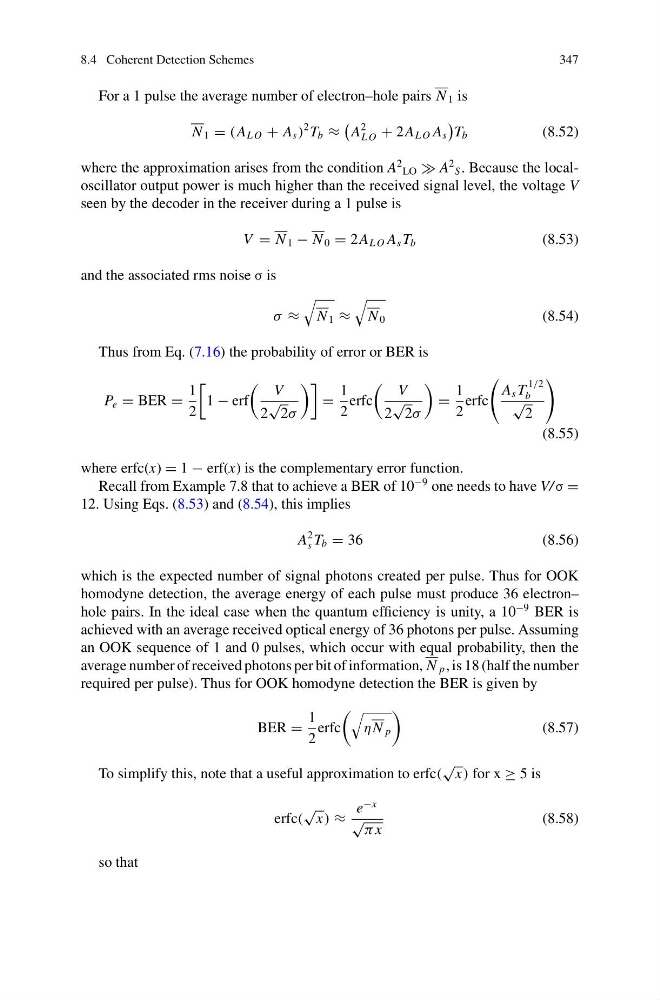
For a 1 pulse the average number of electron–hole pairs N 1 is
N 1 = (A L O + A s )
2 T b ≈
A
2
L O + 2 A L O A s
T b
(8.52)
where the approximation arises from the condition A
2
LO A
2
S . Because the localoscillator output power is much higher than the received signal level, the voltage V
seen by the decoder in the receiver during a 1 pulse is
V = N 1 − N 0 = 2 A L O A s T b
(8.53)
and the associated rms noise σ is
σ ≈
N 1 ≈
N 0
(8.54)
Thus from Eq. (7.16) the probability of error or BER is
P e = BER =
1
2
1 − erf
V
2
√
2σ
=
1
2
erfc
V
2
√
2σ
=
1
2
erfc
A s T
1/2
b
√
2
(8.55)
where erfc(x) = 1 − erf(x) is the complementary error function.
Recall from Example 7.8 that to achieve a BER of 10
−9 one needs to have V/ σ =
12. Using Eqs. (8.53) and (8.54), this implies
A
2
s T b = 36
(8.56)
which is the expected number of signal photons created per pulse. Thus for OOK
homodyne detection, the average energy of each pulse must produce 36 electron–
hole pairs. In the ideal case when the quantum efficiency is unity, a 10
−9 BER is
achieved with an average received optical energy of 36 photons per pulse. Assuming
an OOK sequence of 1 and 0 pulses, which occur with equal probability, then the
average number of received photons per bit of information, N p , is 18 (half the number
required per pulse). Thus for OOK homodyne detection the BER is given by
BER =
1
2
erfc
ηN p
(8.57)
To simplify this, note that a useful approximation to erfc(
√
x) for x ≥ 5 is
erfc(
√
x) ≈
e
−x
√
π x
(8.58)
so that
347
For a 1 pulse the average number of electron–hole pairs N 1 is
N 1 = (A L O + A s )
2 T b ≈
A
2
L O + 2 A L O A s
T b
(8.52)
where the approximation arises from the condition A
2
LO A
2
S . Because the localoscillator output power is much higher than the received signal level, the voltage V
seen by the decoder in the receiver during a 1 pulse is
V = N 1 − N 0 = 2 A L O A s T b
(8.53)
and the associated rms noise σ is
σ ≈
N 1 ≈
N 0
(8.54)
Thus from Eq. (7.16) the probability of error or BER is
P e = BER =
1
2
1 − erf
V
2
√
2σ
=
1
2
erfc
V
2
√
2σ
=
1
2
erfc
A s T
1/2
b
√
2
(8.55)
where erfc(x) = 1 − erf(x) is the complementary error function.
Recall from Example 7.8 that to achieve a BER of 10
−9 one needs to have V/ σ =
12. Using Eqs. (8.53) and (8.54), this implies
A
2
s T b = 36
(8.56)
which is the expected number of signal photons created per pulse. Thus for OOK
homodyne detection, the average energy of each pulse must produce 36 electron–
hole pairs. In the ideal case when the quantum efficiency is unity, a 10
−9 BER is
achieved with an average received optical energy of 36 photons per pulse. Assuming
an OOK sequence of 1 and 0 pulses, which occur with equal probability, then the
average number of received photons per bit of information, N p , is 18 (half the number
required per pulse). Thus for OOK homodyne detection the BER is given by
BER =
1
2
erfc
ηN p
(8.57)
To simplify this, note that a useful approximation to erfc(
√
x) for x ≥ 5 is
erfc(
√
x) ≈
e
−x
√
π x
(8.58)
so that