

346
8 Digital Optical Fiber Links
8.4.5 BER Comparisons in Coherent Detection
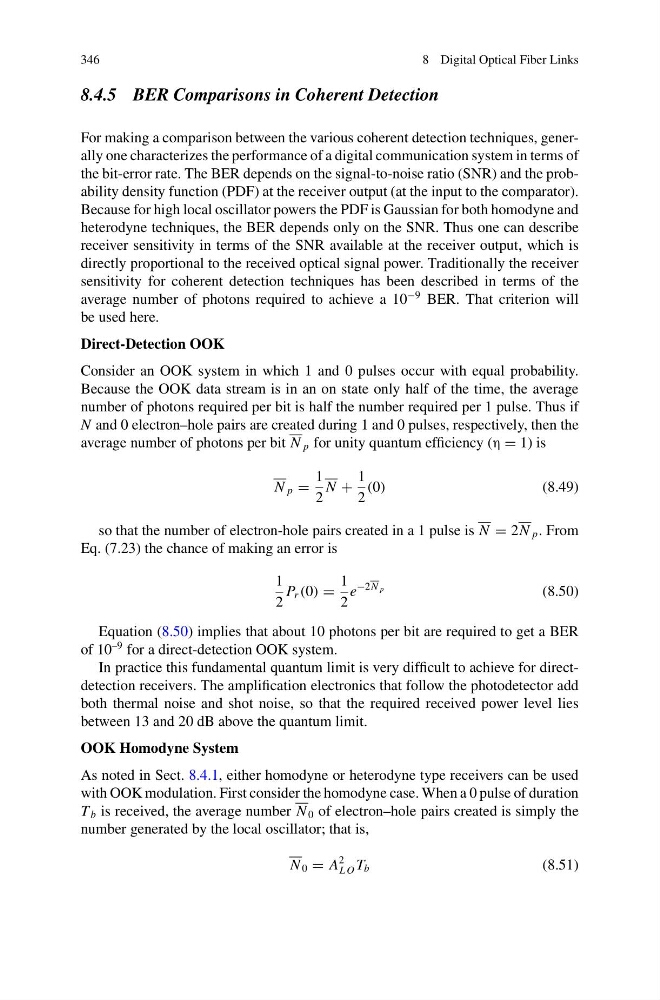
For making a comparison between the various coherent detection techniques, generally one characterizes the performance of a digital communication system in terms of
the bit-error rate. The BER depends on the signal-to-noise ratio (SNR) and the probability density function (PDF) at the receiver output (at the input to the comparator).
Because for high local oscillator powers the PDF is Gaussian for both homodyne and
heterodyne techniques, the BER depends only on the SNR. Thus one can describe
receiver sensitivity in terms of the SNR available at the receiver output, which is
directly proportional to the received optical signal power. Traditionally the receiver
sensitivity for coherent detection techniques has been described in terms of the
average number of photons required to achieve a 10
−9 BER. That criterion will
be used here.
Direct-Detection OOK
Consider an OOK system in which 1 and 0 pulses occur with equal probability.
Because the OOK data stream is in an on state only half of the time, the average
number of photons required per bit is half the number required per 1 pulse. Thus if
N and 0 electron–hole pairs are created during 1 and 0 pulses, respectively, then the
average number of photons per bit N p for unity quantum efficiency (η = 1) is
N p =
1
2
N +
1
2
(0)
(8.49)
so that the number of electron-hole pairs created in a 1 pulse is N = 2N p . From
Eq. (7.23) the chance of making an error is
1
2
P r (0) =
1
2
e
−2N p
(8.50)
Equation (8.50) implies that about 10 photons per bit are required to get a BER
of 10
–9 for a direct-detection OOK system.
In practice this fundamental quantum limit is very difficult to achieve for directdetection receivers. The amplification electronics that follow the photodetector add
both thermal noise and shot noise, so that the required received power level lies
between 13 and 20 dB above the quantum limit.
OOK Homodyne System
As noted in Sect. 8.4.1, either homodyne or heterodyne type receivers can be used
with OOK modulation. First consider the homodyne case. When a 0 pulse of duration
T b is received, the average number N 0 of electron–hole pairs created is simply the
number generated by the local oscillator; that is,
N 0 = A
2
L O T b
(8.51)
8 Digital Optical Fiber Links
8.4.5 BER Comparisons in Coherent Detection
For making a comparison between the various coherent detection techniques, generally one characterizes the performance of a digital communication system in terms of
the bit-error rate. The BER depends on the signal-to-noise ratio (SNR) and the probability density function (PDF) at the receiver output (at the input to the comparator).
Because for high local oscillator powers the PDF is Gaussian for both homodyne and
heterodyne techniques, the BER depends only on the SNR. Thus one can describe
receiver sensitivity in terms of the SNR available at the receiver output, which is
directly proportional to the received optical signal power. Traditionally the receiver
sensitivity for coherent detection techniques has been described in terms of the
average number of photons required to achieve a 10
−9 BER. That criterion will
be used here.
Direct-Detection OOK
Consider an OOK system in which 1 and 0 pulses occur with equal probability.
Because the OOK data stream is in an on state only half of the time, the average
number of photons required per bit is half the number required per 1 pulse. Thus if
N and 0 electron–hole pairs are created during 1 and 0 pulses, respectively, then the
average number of photons per bit N p for unity quantum efficiency (η = 1) is
N p =
1
2
N +
1
2
(0)
(8.49)
so that the number of electron-hole pairs created in a 1 pulse is N = 2N p . From
Eq. (7.23) the chance of making an error is
1
2
P r (0) =
1
2
e
−2N p
(8.50)
Equation (8.50) implies that about 10 photons per bit are required to get a BER
of 10
–9 for a direct-detection OOK system.
In practice this fundamental quantum limit is very difficult to achieve for directdetection receivers. The amplification electronics that follow the photodetector add
both thermal noise and shot noise, so that the required received power level lies
between 13 and 20 dB above the quantum limit.
OOK Homodyne System
As noted in Sect. 8.4.1, either homodyne or heterodyne type receivers can be used
with OOK modulation. First consider the homodyne case. When a 0 pulse of duration
T b is received, the average number N 0 of electron–hole pairs created is simply the
number generated by the local oscillator; that is,
N 0 = A
2
L O T b
(8.51)