

8.4 Coherent Detection Schemes
345
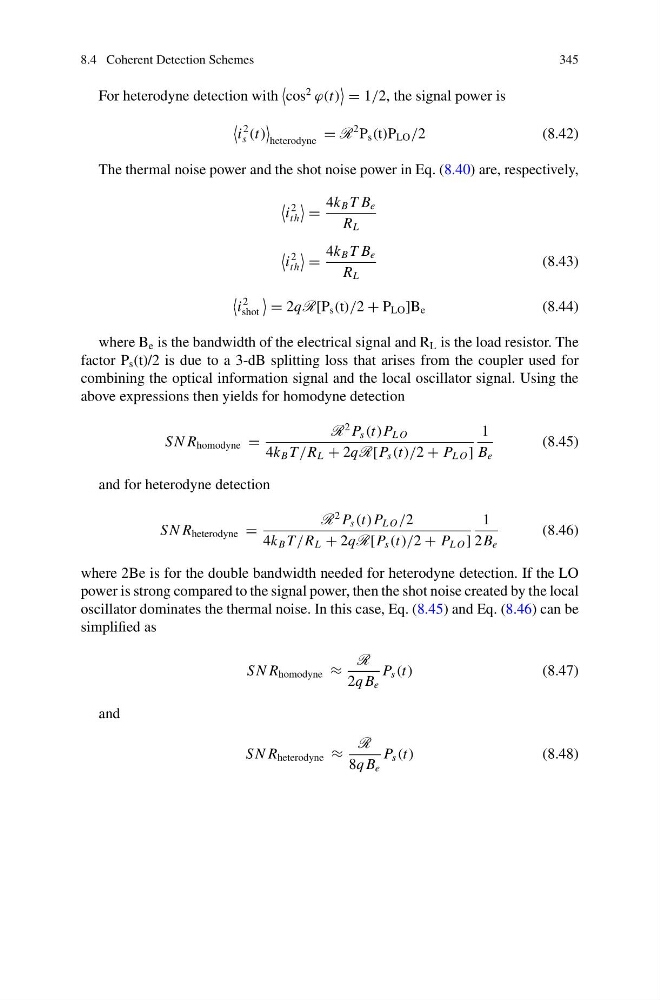
For heterodyne detection with
cos
2
ϕ(t)
= 1/2, the signal power is
i
2
s (t)
heterodyne
= R
2 P s (t)P LO /2
(8.42)
The thermal noise power and the shot noise power in Eq. (8.40) are, respectively,
i
2
th
=
4k B T B e
R L
i
2
th
=
4k B T B e
R L
(8.43)
i
2
shot
= 2qR[P s (t)/2 + P LO ]B e
(8.44)
where B e is the bandwidth of the electrical signal and R L is the load resistor. The
factor P s (t)/2 is due to a 3-dB splitting loss that arises from the coupler used for
combining the optical information signal and the local oscillator signal. Using the
above expressions then yields for homodyne detection
S N R homodyne =
R
2 P s (t)P L O
4k B T /R L + 2qR[P s (t)/2 + P L O ]
1
B e
(8.45)
and for heterodyne detection
S N R heterodyne =
R
2 P s (t)P L O /2
4k B T /R L + 2qR[P s (t)/2 + P L O ]
1
2B e
(8.46)
where 2Be is for the double bandwidth needed for heterodyne detection. If the LO
power is strong compared to the signal power, then the shot noise created by the local
oscillator dominates the thermal noise. In this case, Eq. (8.45) and Eq. (8.46) can be
simplified as
S N R homodyne ≈
R
2q B e
P s (t)
(8.47)
and
S N R heterodyne ≈
R
8q B e
P s (t)
(8.48)
345
For heterodyne detection with
cos
2
ϕ(t)
= 1/2, the signal power is
i
2
s (t)
heterodyne
= R
2 P s (t)P LO /2
(8.42)
The thermal noise power and the shot noise power in Eq. (8.40) are, respectively,
i
2
th
=
4k B T B e
R L
i
2
th
=
4k B T B e
R L
(8.43)
i
2
shot
= 2qR[P s (t)/2 + P LO ]B e
(8.44)
where B e is the bandwidth of the electrical signal and R L is the load resistor. The
factor P s (t)/2 is due to a 3-dB splitting loss that arises from the coupler used for
combining the optical information signal and the local oscillator signal. Using the
above expressions then yields for homodyne detection
S N R homodyne =
R
2 P s (t)P L O
4k B T /R L + 2qR[P s (t)/2 + P L O ]
1
B e
(8.45)
and for heterodyne detection
S N R heterodyne =
R
2 P s (t)P L O /2
4k B T /R L + 2qR[P s (t)/2 + P L O ]
1
2B e
(8.46)
where 2Be is for the double bandwidth needed for heterodyne detection. If the LO
power is strong compared to the signal power, then the shot noise created by the local
oscillator dominates the thermal noise. In this case, Eq. (8.45) and Eq. (8.46) can be
simplified as
S N R homodyne ≈
R
2q B e
P s (t)
(8.47)
and
S N R heterodyne ≈
R
8q B e
P s (t)
(8.48)