

344
8 Digital Optical Fiber Links
optical sources. These criteria include an extremely narrow spectral width (linewidth)
and a high degree of wavelength tunability.
8.4.3 Heterodyne Detection
In heterodyne detection the intermediate frequency ω IF is nonzero and an optical
phase-locked loop is not needed. Consequently heterodyne receivers are much easier
to implement than homodyne receivers. However, the price for this simplification is
a 3-dB degradation in sensitivity compared to homodyne detection.
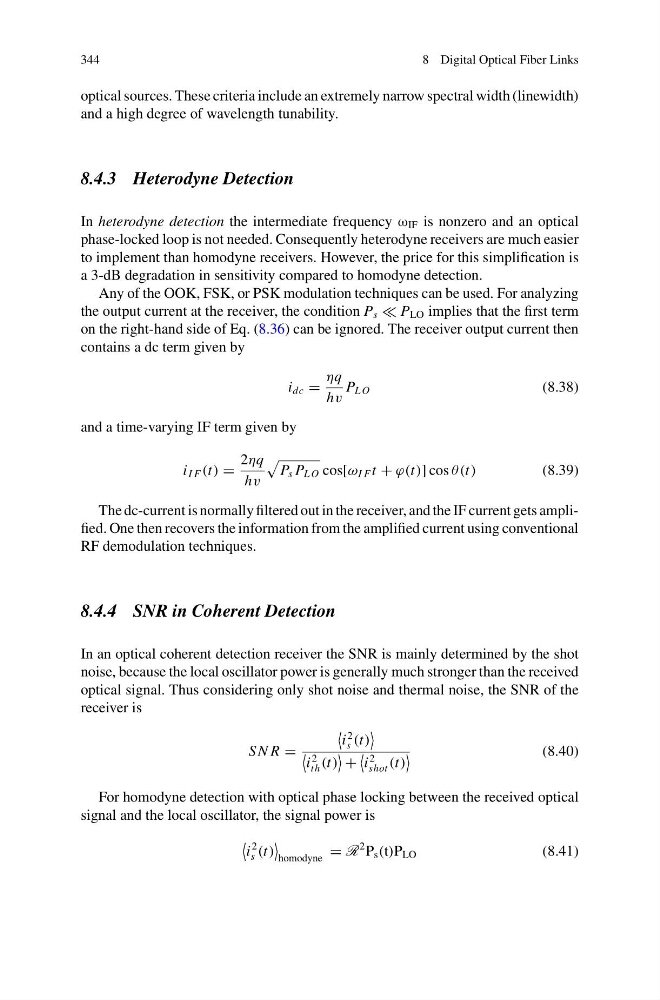
Any of the OOK, FSK, or PSK modulation techniques can be used. For analyzing
the output current at the receiver, the condition P s P LO implies that the first term
on the right-hand side of Eq. (8.36) can be ignored. The receiver output current then
contains a dc term given by
i dc =
ηq
hv
P L O
(8.38)
and a time-varying IF term given by
i I F (t) =
2ηq
hv
P s P L O cos[ω I F t + ϕ(t)] cos θ(t)
(8.39)
The dc-current is normally filtered out in the receiver, and the IF current gets amplified. One then recovers the information from the amplified current using conventional
RF demodulation techniques.
8.4.4 SNR in Coherent Detection
In an optical coherent detection receiver the SNR is mainly determined by the shot
noise, because the local oscillator power is generally much stronger than the received
optical signal. Thus considering only shot noise and thermal noise, the SNR of the
receiver is
S N R =
i
2
s (t)
i
2
th (t)
+
i
2
shot (t)
(8.40)
For homodyne detection with optical phase locking between the received optical
signal and the local oscillator, the signal power is
i
2
s (t)
homodyne
= R
2 P s (t)P LO
(8.41)
8 Digital Optical Fiber Links
optical sources. These criteria include an extremely narrow spectral width (linewidth)
and a high degree of wavelength tunability.
8.4.3 Heterodyne Detection
In heterodyne detection the intermediate frequency ω IF is nonzero and an optical
phase-locked loop is not needed. Consequently heterodyne receivers are much easier
to implement than homodyne receivers. However, the price for this simplification is
a 3-dB degradation in sensitivity compared to homodyne detection.
Any of the OOK, FSK, or PSK modulation techniques can be used. For analyzing
the output current at the receiver, the condition P s P LO implies that the first term
on the right-hand side of Eq. (8.36) can be ignored. The receiver output current then
contains a dc term given by
i dc =
ηq
hv
P L O
(8.38)
and a time-varying IF term given by
i I F (t) =
2ηq
hv
P s P L O cos[ω I F t + ϕ(t)] cos θ(t)
(8.39)
The dc-current is normally filtered out in the receiver, and the IF current gets amplified. One then recovers the information from the amplified current using conventional
RF demodulation techniques.
8.4.4 SNR in Coherent Detection
In an optical coherent detection receiver the SNR is mainly determined by the shot
noise, because the local oscillator power is generally much stronger than the received
optical signal. Thus considering only shot noise and thermal noise, the SNR of the
receiver is
S N R =
i
2
s (t)
i
2
th (t)
+
i
2
shot (t)
(8.40)
For homodyne detection with optical phase locking between the received optical
signal and the local oscillator, the signal power is
i
2
s (t)
homodyne
= R
2 P s (t)P LO
(8.41)