

8.4 Coherent Detection Schemes
343
where ϕ(t) = ϕ s (t) − ϕ LO (t) is the relative phase difference between the incoming
information-bearing signal and the local-oscillator signal, and
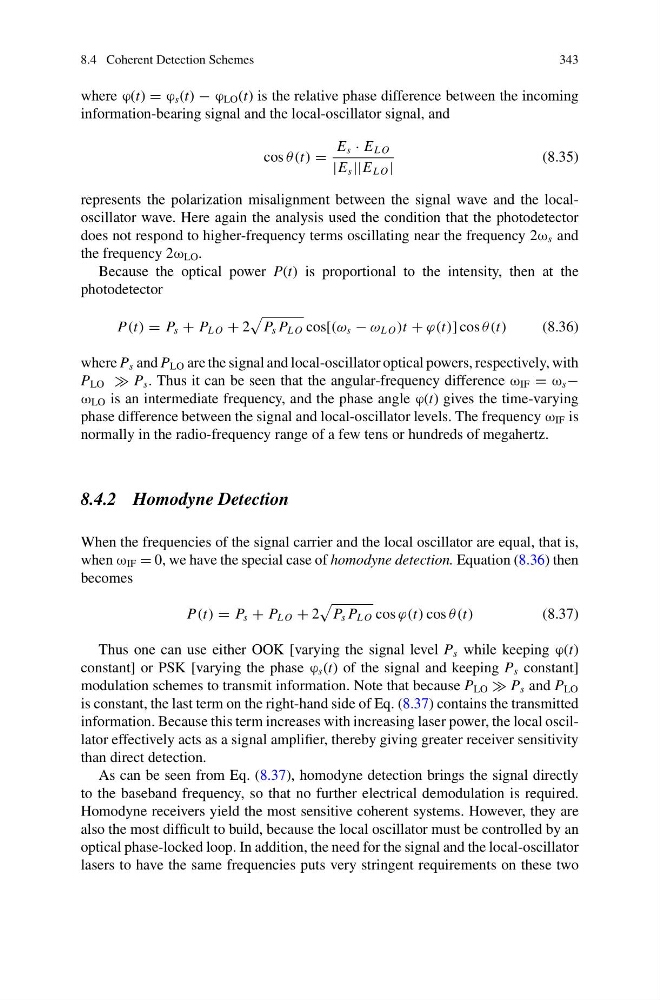
cos θ(t) =
E s · E L O
|E s ||E L O |
(8.35)
represents the polarization misalignment between the signal wave and the localoscillator wave. Here again the analysis used the condition that the photodetector
does not respond to higher-frequency terms oscillating near the frequency 2ω s and
the frequency 2ω LO .
Because the optical power P(t) is proportional to the intensity, then at the
photodetector
P(t) = P s + P L O + 2
P s P L O cos[(ω s − ω L O )t + ϕ(t)] cos θ(t)
(8.36)
where P s and P LO are the signal and local-oscillator optical powers, respectively, with
P LO P s . Thus it can be seen that the angular-frequency difference ω IF = ω s −
ω LO is an intermediate frequency, and the phase angle ϕ(t) gives the time-varying
phase difference between the signal and local-oscillator levels. The frequency ω IF is
normally in the radio-frequency range of a few tens or hundreds of megahertz.
8.4.2 Homodyne Detection
When the frequencies of the signal carrier and the local oscillator are equal, that is,
when ω IF = 0, we have the special case of homodyne detection. Equation (8.36) then
becomes
P(t) = P s + P L O + 2
P s P L O cos ϕ(t) cos θ(t)
(8.37)
Thus one can use either OOK [varying the signal level P s while keeping ϕ(t)
constant] or PSK [varying the phase ϕ s (t) of the signal and keeping P s constant]
modulation schemes to transmit information. Note that because P LO P s and P LO
is constant, the last term on the right-hand side of Eq. (8.37) contains the transmitted
information. Because this term increases with increasing laser power, the local oscillator effectively acts as a signal amplifier, thereby giving greater receiver sensitivity
than direct detection.
As can be seen from Eq. (8.37), homodyne detection brings the signal directly
to the baseband frequency, so that no further electrical demodulation is required.
Homodyne receivers yield the most sensitive coherent systems. However, they are
also the most difficult to build, because the local oscillator must be controlled by an
optical phase-locked loop. In addition, the need for the signal and the local-oscillator
lasers to have the same frequencies puts very stringent requirements on these two
343
where ϕ(t) = ϕ s (t) − ϕ LO (t) is the relative phase difference between the incoming
information-bearing signal and the local-oscillator signal, and
cos θ(t) =
E s · E L O
|E s ||E L O |
(8.35)
represents the polarization misalignment between the signal wave and the localoscillator wave. Here again the analysis used the condition that the photodetector
does not respond to higher-frequency terms oscillating near the frequency 2ω s and
the frequency 2ω LO .
Because the optical power P(t) is proportional to the intensity, then at the
photodetector
P(t) = P s + P L O + 2
P s P L O cos[(ω s − ω L O )t + ϕ(t)] cos θ(t)
(8.36)
where P s and P LO are the signal and local-oscillator optical powers, respectively, with
P LO P s . Thus it can be seen that the angular-frequency difference ω IF = ω s −
ω LO is an intermediate frequency, and the phase angle ϕ(t) gives the time-varying
phase difference between the signal and local-oscillator levels. The frequency ω IF is
normally in the radio-frequency range of a few tens or hundreds of megahertz.
8.4.2 Homodyne Detection
When the frequencies of the signal carrier and the local oscillator are equal, that is,
when ω IF = 0, we have the special case of homodyne detection. Equation (8.36) then
becomes
P(t) = P s + P L O + 2
P s P L O cos ϕ(t) cos θ(t)
(8.37)
Thus one can use either OOK [varying the signal level P s while keeping ϕ(t)
constant] or PSK [varying the phase ϕ s (t) of the signal and keeping P s constant]
modulation schemes to transmit information. Note that because P LO P s and P LO
is constant, the last term on the right-hand side of Eq. (8.37) contains the transmitted
information. Because this term increases with increasing laser power, the local oscillator effectively acts as a signal amplifier, thereby giving greater receiver sensitivity
than direct detection.
As can be seen from Eq. (8.37), homodyne detection brings the signal directly
to the baseband frequency, so that no further electrical demodulation is required.
Homodyne receivers yield the most sensitive coherent systems. However, they are
also the most difficult to build, because the local oscillator must be controlled by an
optical phase-locked loop. In addition, the need for the signal and the local-oscillator
lasers to have the same frequencies puts very stringent requirements on these two