

342
8 Digital Optical Fiber Links
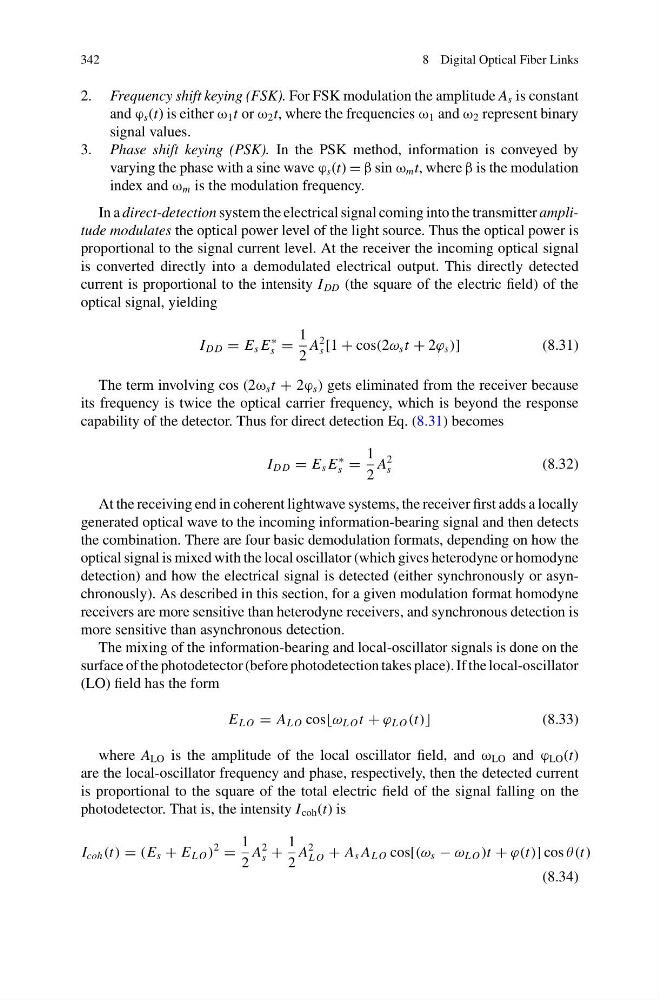
2. Frequency shift keying (FSK). For FSK modulation the amplitude A s is constant
and ϕ s (t) is either ω 1 t or ω 2 t, where the frequencies ω 1 and ω 2 represent binary
signal values.
3. Phase shift keying (PSK). In the PSK method, information is conveyed by
varying the phase with a sine wave ϕ s (t) = β sin ω m t, where β is the modulation
index and ω m is the modulation frequency.
In a direct-detection system the electrical signal coming into the transmitter amplitude modulates the optical power level of the light source. Thus the optical power is
proportional to the signal current level. At the receiver the incoming optical signal
is converted directly into a demodulated electrical output. This directly detected
current is proportional to the intensity I DD (the square of the electric field) of the
optical signal, yielding
I D D = E s E
∗
s =
1
2
A
2
s [1 + cos(2ω s t + 2ϕ s )]
(8.31)
The term involving cos (2ω s t + 2ϕ s ) gets eliminated from the receiver because
its frequency is twice the optical carrier frequency, which is beyond the response
capability of the detector. Thus for direct detection Eq. (8.31) becomes
I D D = E s E
∗
s =
1
2
A
2
s
(8.32)
At the receiving end in coherent lightwave systems, the receiver first adds a locally
generated optical wave to the incoming information-bearing signal and then detects
the combination. There are four basic demodulation formats, depending on how the
optical signal is mixed with the local oscillator (which gives heterodyne or homodyne
detection) and how the electrical signal is detected (either synchronously or asynchronously). As described in this section, for a given modulation format homodyne
receivers are more sensitive than heterodyne receivers, and synchronous detection is
more sensitive than asynchronous detection.
The mixing of the information-bearing and local-oscillator signals is done on the
surface of the photodetector (before photodetection takes place). If the local-oscillator
(LO) field has the form
E L O = A L O cosω L O t + ϕ L O (t)
(8.33)
where A LO is the amplitude of the local oscillator field, and ω LO and ϕ LO (t)
are the local-oscillator frequency and phase, respectively, then the detected current
is proportional to the square of the total electric field of the signal falling on the
photodetector. That is, the intensity I coh (t) is
I coh (t) = (E s + E L O )
2
=
1
2
A
2
s +
1
2
A
2
L O + A s A L O cos[(ω s − ω L O )t + ϕ(t)] cos θ(t)
(8.34)
8 Digital Optical Fiber Links
2. Frequency shift keying (FSK). For FSK modulation the amplitude A s is constant
and ϕ s (t) is either ω 1 t or ω 2 t, where the frequencies ω 1 and ω 2 represent binary
signal values.
3. Phase shift keying (PSK). In the PSK method, information is conveyed by
varying the phase with a sine wave ϕ s (t) = β sin ω m t, where β is the modulation
index and ω m is the modulation frequency.
In a direct-detection system the electrical signal coming into the transmitter amplitude modulates the optical power level of the light source. Thus the optical power is
proportional to the signal current level. At the receiver the incoming optical signal
is converted directly into a demodulated electrical output. This directly detected
current is proportional to the intensity I DD (the square of the electric field) of the
optical signal, yielding
I D D = E s E
∗
s =
1
2
A
2
s [1 + cos(2ω s t + 2ϕ s )]
(8.31)
The term involving cos (2ω s t + 2ϕ s ) gets eliminated from the receiver because
its frequency is twice the optical carrier frequency, which is beyond the response
capability of the detector. Thus for direct detection Eq. (8.31) becomes
I D D = E s E
∗
s =
1
2
A
2
s
(8.32)
At the receiving end in coherent lightwave systems, the receiver first adds a locally
generated optical wave to the incoming information-bearing signal and then detects
the combination. There are four basic demodulation formats, depending on how the
optical signal is mixed with the local oscillator (which gives heterodyne or homodyne
detection) and how the electrical signal is detected (either synchronously or asynchronously). As described in this section, for a given modulation format homodyne
receivers are more sensitive than heterodyne receivers, and synchronous detection is
more sensitive than asynchronous detection.
The mixing of the information-bearing and local-oscillator signals is done on the
surface of the photodetector (before photodetection takes place). If the local-oscillator
(LO) field has the form
E L O = A L O cosω L O t + ϕ L O (t)
(8.33)
where A LO is the amplitude of the local oscillator field, and ω LO and ϕ LO (t)
are the local-oscillator frequency and phase, respectively, then the detected current
is proportional to the square of the total electric field of the signal falling on the
photodetector. That is, the intensity I coh (t) is
I coh (t) = (E s + E L O )
2
=
1
2
A
2
s +
1
2
A
2
L O + A s A L O cos[(ω s − ω L O )t + ϕ(t)] cos θ(t)
(8.34)