

8.4 Coherent Detection Schemes
341
coherent detection techniques enable a higher spectral efficiency and greater tolerance to chromatic dispersion and polarization-mode dispersion than direct detection
methods.
8.4.1 Fundamental Concepts
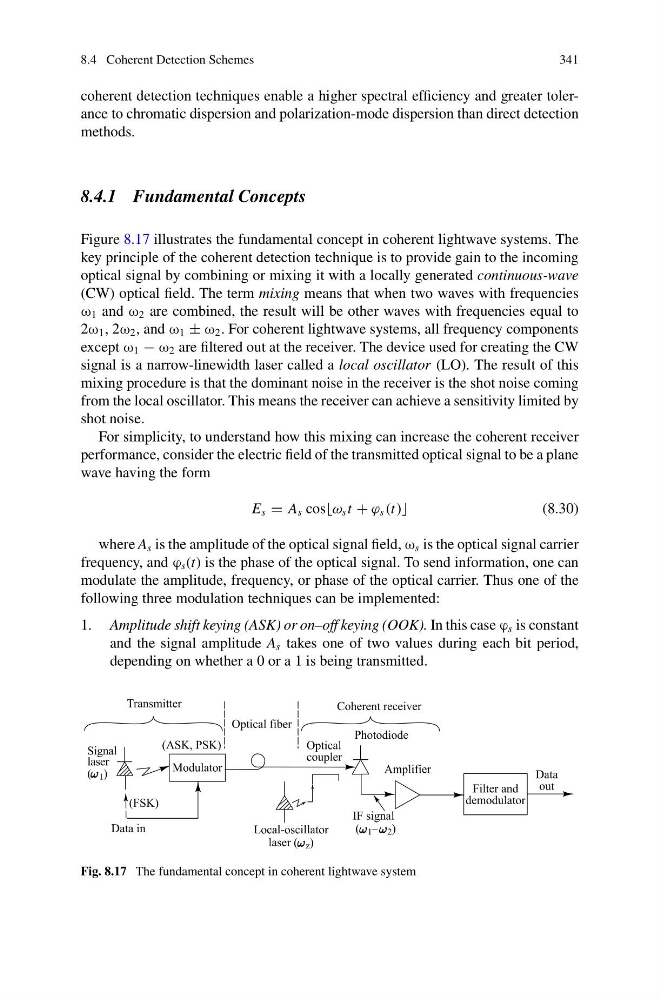
Figure 8.17 illustrates the fundamental concept in coherent lightwave systems. The
key principle of the coherent detection technique is to provide gain to the incoming
optical signal by combining or mixing it with a locally generated continuous-wave
(CW) optical field. The term mixing means that when two waves with frequencies
ω 1 and ω 2 are combined, the result will be other waves with frequencies equal to
2ω 1 , 2ω 2 , and ω 1 ± ω 2 . For coherent lightwave systems, all frequency components
except ω 1 − ω 2 are filtered out at the receiver. The device used for creating the CW
signal is a narrow-linewidth laser called a local oscillator (LO). The result of this
mixing procedure is that the dominant noise in the receiver is the shot noise coming
from the local oscillator. This means the receiver can achieve a sensitivity limited by
shot noise.
For simplicity, to understand how this mixing can increase the coherent receiver
performance, consider the electric field of the transmitted optical signal to be a plane
wave having the form
E s = A s cosω s t + ϕ s (t)
(8.30)
where A s is the amplitude of the optical signal field, ω s is the optical signal carrier
frequency, and ϕ s (t) is the phase of the optical signal. To send information, one can
modulate the amplitude, frequency, or phase of the optical carrier. Thus one of the
following three modulation techniques can be implemented:
1. Amplitude shift keying (ASK) or on–off keying (OOK). In this case ϕ s is constant
and the signal amplitude A s takes one of two values during each bit period,
depending on whether a 0 or a 1 is being transmitted.
Fig. 8.17 The fundamental concept in coherent lightwave system
341
coherent detection techniques enable a higher spectral efficiency and greater tolerance to chromatic dispersion and polarization-mode dispersion than direct detection
methods.
8.4.1 Fundamental Concepts
Figure 8.17 illustrates the fundamental concept in coherent lightwave systems. The
key principle of the coherent detection technique is to provide gain to the incoming
optical signal by combining or mixing it with a locally generated continuous-wave
(CW) optical field. The term mixing means that when two waves with frequencies
ω 1 and ω 2 are combined, the result will be other waves with frequencies equal to
2ω 1 , 2ω 2 , and ω 1 ± ω 2 . For coherent lightwave systems, all frequency components
except ω 1 − ω 2 are filtered out at the receiver. The device used for creating the CW
signal is a narrow-linewidth laser called a local oscillator (LO). The result of this
mixing procedure is that the dominant noise in the receiver is the shot noise coming
from the local oscillator. This means the receiver can achieve a sensitivity limited by
shot noise.
For simplicity, to understand how this mixing can increase the coherent receiver
performance, consider the electric field of the transmitted optical signal to be a plane
wave having the form
E s = A s cosω s t + ϕ s (t)
(8.30)
where A s is the amplitude of the optical signal field, ω s is the optical signal carrier
frequency, and ϕ s (t) is the phase of the optical signal. To send information, one can
modulate the amplitude, frequency, or phase of the optical carrier. Thus one of the
following three modulation techniques can be implemented:
1. Amplitude shift keying (ASK) or on–off keying (OOK). In this case ϕ s is constant
and the signal amplitude A s takes one of two values during each bit period,
depending on whether a 0 or a 1 is being transmitted.
Fig. 8.17 The fundamental concept in coherent lightwave system