

296
7 Optical Receiver Operation
F t = noise figure of the baseband amplifier.
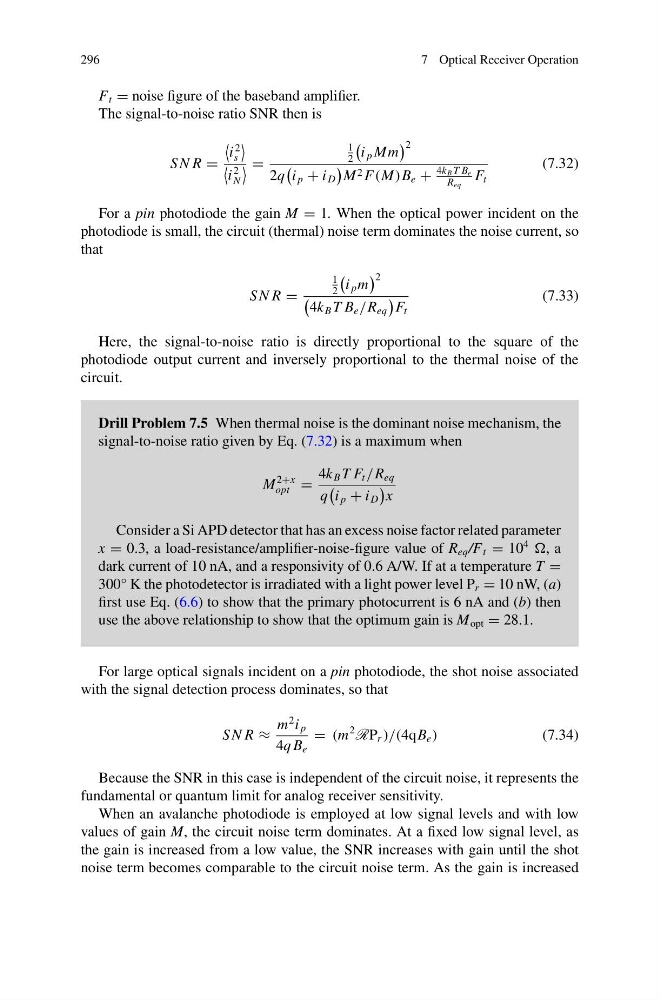
The signal-to-noise ratio SNR then is
S N R =
i
2
s
i
2
N
=
1
2
i p Mm
2
2q
i p + i D
M 2 F(M)B e +
4k B T B e
R eq
F t
(7.32)
For a pin photodiode the gain M = 1. When the optical power incident on the
photodiode is small, the circuit (thermal) noise term dominates the noise current, so
that
S N R =
1
2
i p m
2
4k B T B e /R eq
F t
(7.33)
Here, the signal-to-noise ratio is directly proportional to the square of the
photodiode output current and inversely proportional to the thermal noise of the
circuit.
Drill Problem 7.5 When thermal noise is the dominant noise mechanism, the
signal-to-noise ratio given by Eq. (7.32) is a maximum when
M
2+x
opt =
4k B T F t /R eq
q
i p + i D
x
Consider a Si APD detector that has an excess noise factor related parameter
x = 0.3, a load-resistance/amplifier-noise-figure value of R eq /F t = 10
4
, a
dark current of 10 nA, and a responsivity of 0.6 A/W. If at a temperature T =
300° K the photodetector is irradiated with a light power level P r = 10 nW, (a)
first use Eq. (6.6) to show that the primary photocurrent is 6 nA and (b) then
use the above relationship to show that the optimum gain is M opt = 28.1.
For large optical signals incident on a pin photodiode, the shot noise associated
with the signal detection process dominates, so that
S N R ≈
m
2 i p
4q B e
= (m
2
RP r )/(4qB e )
(7.34)
Because the SNR in this case is independent of the circuit noise, it represents the
fundamental or quantum limit for analog receiver sensitivity.
When an avalanche photodiode is employed at low signal levels and with low
values of gain M, the circuit noise term dominates. At a fixed low signal level, as
the gain is increased from a low value, the SNR increases with gain until the shot
noise term becomes comparable to the circuit noise term. As the gain is increased
7 Optical Receiver Operation
F t = noise figure of the baseband amplifier.
The signal-to-noise ratio SNR then is
S N R =
i
2
s
i
2
N
=
1
2
i p Mm
2
2q
i p + i D
M 2 F(M)B e +
4k B T B e
R eq
F t
(7.32)
For a pin photodiode the gain M = 1. When the optical power incident on the
photodiode is small, the circuit (thermal) noise term dominates the noise current, so
that
S N R =
1
2
i p m
2
4k B T B e /R eq
F t
(7.33)
Here, the signal-to-noise ratio is directly proportional to the square of the
photodiode output current and inversely proportional to the thermal noise of the
circuit.
Drill Problem 7.5 When thermal noise is the dominant noise mechanism, the
signal-to-noise ratio given by Eq. (7.32) is a maximum when
M
2+x
opt =
4k B T F t /R eq
q
i p + i D
x
Consider a Si APD detector that has an excess noise factor related parameter
x = 0.3, a load-resistance/amplifier-noise-figure value of R eq /F t = 10
4
, a
dark current of 10 nA, and a responsivity of 0.6 A/W. If at a temperature T =
300° K the photodetector is irradiated with a light power level P r = 10 nW, (a)
first use Eq. (6.6) to show that the primary photocurrent is 6 nA and (b) then
use the above relationship to show that the optimum gain is M opt = 28.1.
For large optical signals incident on a pin photodiode, the shot noise associated
with the signal detection process dominates, so that
S N R ≈
m
2 i p
4q B e
= (m
2
RP r )/(4qB e )
(7.34)
Because the SNR in this case is independent of the circuit noise, it represents the
fundamental or quantum limit for analog receiver sensitivity.
When an avalanche photodiode is employed at low signal levels and with low
values of gain M, the circuit noise term dominates. At a fixed low signal level, as
the gain is increased from a low value, the SNR increases with gain until the shot
noise term becomes comparable to the circuit noise term. As the gain is increased