

7.5 Characteristics of Analog Receivers
295
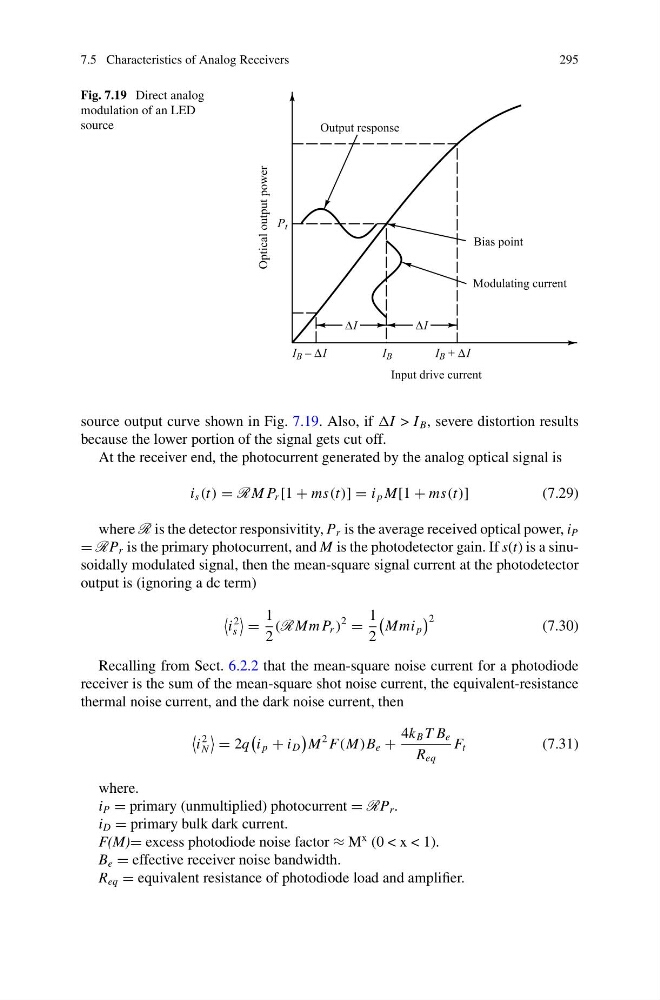
Fig. 7.19 Direct analog
modulation of an LED
source
source output curve shown in Fig. 7.19. Also, if > I B , severe distortion results
because the lower portion of the signal gets cut off.
At the receiver end, the photocurrent generated by the analog optical signal is
i s (t) = R M P r [1 + ms(t)] = i p M[1 + ms(t)]
(7.29)
where R is the detector responsivitity, P r is the average received optical power, i P
= RP r is the primary photocurrent, and M is the photodetector gain. If s(t) is a sinusoidally modulated signal, then the mean-square signal current at the photodetector
output is (ignoring a dc term)
i
2
s
=
1
2
(R Mm P r )
2
=
1
2
Mmi p
2
(7.30)
Recalling from Sect. 6.2.2 that the mean-square noise current for a photodiode
receiver is the sum of the mean-square shot noise current, the equivalent-resistance
thermal noise current, and the dark noise current, then
i
2
N
= 2q
i p + i D
M
2 F(M)B e +
4k B T B e
R eq
F t
(7.31)
where.
i P = primary (unmultiplied) photocurrent = RP r .
i D = primary bulk dark current.
F(M)= excess photodiode noise factor ≈ M
x (0 < x < 1).
B e = effective receiver noise bandwidth.
R eq = equivalent resistance of photodiode load and amplifier.
295
Fig. 7.19 Direct analog
modulation of an LED
source
source output curve shown in Fig. 7.19. Also, if > I B , severe distortion results
because the lower portion of the signal gets cut off.
At the receiver end, the photocurrent generated by the analog optical signal is
i s (t) = R M P r [1 + ms(t)] = i p M[1 + ms(t)]
(7.29)
where R is the detector responsivitity, P r is the average received optical power, i P
= RP r is the primary photocurrent, and M is the photodetector gain. If s(t) is a sinusoidally modulated signal, then the mean-square signal current at the photodetector
output is (ignoring a dc term)
i
2
s
=
1
2
(R Mm P r )
2
=
1
2
Mmi p
2
(7.30)
Recalling from Sect. 6.2.2 that the mean-square noise current for a photodiode
receiver is the sum of the mean-square shot noise current, the equivalent-resistance
thermal noise current, and the dark noise current, then
i
2
N
= 2q
i p + i D
M
2 F(M)B e +
4k B T B e
R eq
F t
(7.31)
where.
i P = primary (unmultiplied) photocurrent = RP r .
i D = primary bulk dark current.
F(M)= excess photodiode noise factor ≈ M
x (0 < x < 1).
B e = effective receiver noise bandwidth.
R eq = equivalent resistance of photodiode load and amplifier.