

7.5 Characteristics of Analog Receivers
297
further beyond this point, the signal-to-noise ratio decreases as F(M)
−1 . Thus for a
given set of operating conditions, there exists an optimum value of the avalanche gain
for which the signal-to-noise ratio is a maximum. Because an avalanche photodiode
increases the SNR for small optical signal levels, it is the preferred photodetector for
this situation.
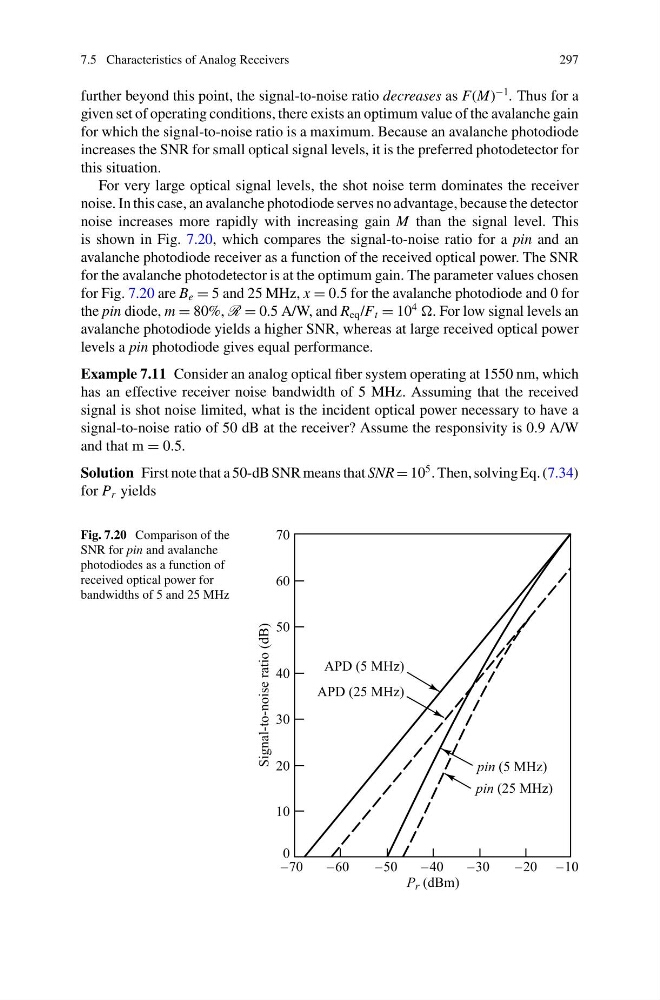
For very large optical signal levels, the shot noise term dominates the receiver
noise. In this case, an avalanche photodiode serves no advantage, because the detector
noise increases more rapidly with increasing gain M than the signal level. This
is shown in Fig. 7.20, which compares the signal-to-noise ratio for a pin and an
avalanche photodiode receiver as a function of the received optical power. The SNR
for the avalanche photodetector is at the optimum gain. The parameter values chosen
for Fig. 7.20 are B e = 5 and 25 MHz, x = 0.5 for the avalanche photodiode and 0 for
the pin diode, m = 80%, R = 0.5 A/W, and R eq /F t = 10
4
. For low signal levels an
avalanche photodiode yields a higher SNR, whereas at large received optical power
levels a pin photodiode gives equal performance.
Example 7.11 Consider an analog optical fiber system operating at 1550 nm, which
has an effective receiver noise bandwidth of 5 MHz. Assuming that the received
signal is shot noise limited, what is the incident optical power necessary to have a
signal-to-noise ratio of 50 dB at the receiver? Assume the responsivity is 0.9 A/W
and that m = 0.5.
Solution First note that a 50-dB SNR means that SNR = 10
5 . Then, solving Eq. (7.34)
for P r yields
Fig. 7.20 Comparison of the
SNR for pin and avalanche
photodiodes as a function of
received optical power for
bandwidths of 5 and 25 MHz
297
further beyond this point, the signal-to-noise ratio decreases as F(M)
−1 . Thus for a
given set of operating conditions, there exists an optimum value of the avalanche gain
for which the signal-to-noise ratio is a maximum. Because an avalanche photodiode
increases the SNR for small optical signal levels, it is the preferred photodetector for
this situation.
For very large optical signal levels, the shot noise term dominates the receiver
noise. In this case, an avalanche photodiode serves no advantage, because the detector
noise increases more rapidly with increasing gain M than the signal level. This
is shown in Fig. 7.20, which compares the signal-to-noise ratio for a pin and an
avalanche photodiode receiver as a function of the received optical power. The SNR
for the avalanche photodetector is at the optimum gain. The parameter values chosen
for Fig. 7.20 are B e = 5 and 25 MHz, x = 0.5 for the avalanche photodiode and 0 for
the pin diode, m = 80%, R = 0.5 A/W, and R eq /F t = 10
4
. For low signal levels an
avalanche photodiode yields a higher SNR, whereas at large received optical power
levels a pin photodiode gives equal performance.
Example 7.11 Consider an analog optical fiber system operating at 1550 nm, which
has an effective receiver noise bandwidth of 5 MHz. Assuming that the received
signal is shot noise limited, what is the incident optical power necessary to have a
signal-to-noise ratio of 50 dB at the receiver? Assume the responsivity is 0.9 A/W
and that m = 0.5.
Solution First note that a 50-dB SNR means that SNR = 10
5 . Then, solving Eq. (7.34)
for P r yields
Fig. 7.20 Comparison of the
SNR for pin and avalanche
photodiodes as a function of
received optical power for
bandwidths of 5 and 25 MHz