

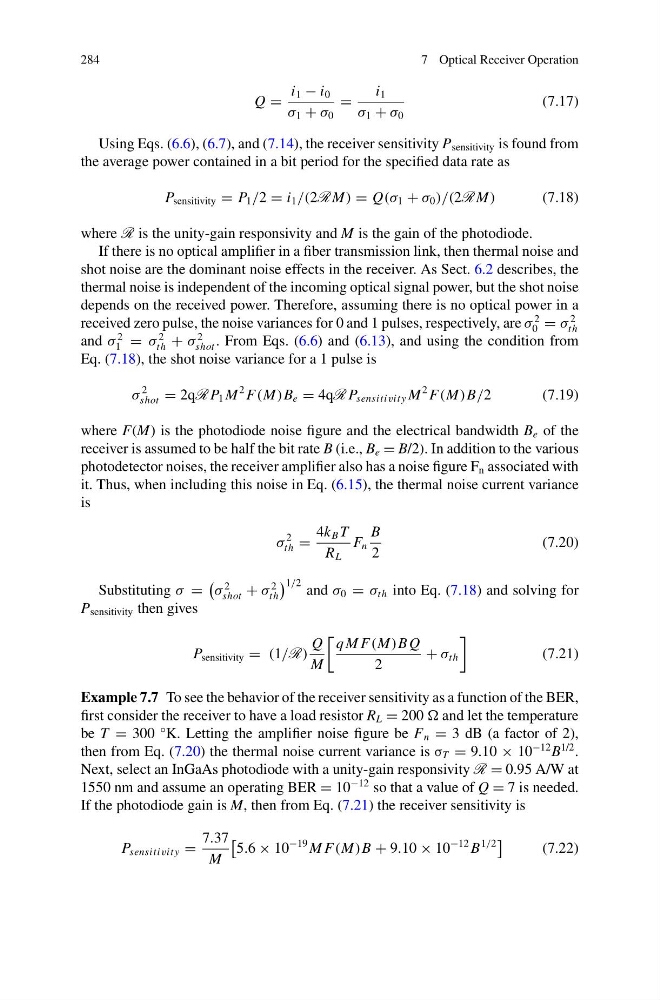
284
7 Optical Receiver Operation
Q =
i 1 − i 0
σ 1 + σ 0
=
i 1
σ 1 + σ 0
(7.17)
Using Eqs. (6.6), (6.7), and (7.14), the receiver sensitivity P sensitivity is found from
the average power contained in a bit period for the specified data rate as
P sensitivity = P 1 /2 = i 1 /(2R M) = Q(σ 1 + σ 0 )/(2R M)
(7.18)
where R is the unity-gain responsivity and M is the gain of the photodiode.
If there is no optical amplifier in a fiber transmission link, then thermal noise and
shot noise are the dominant noise effects in the receiver. As Sect. 6.2 describes, the
thermal noise is independent of the incoming optical signal power, but the shot noise
depends on the received power. Therefore, assuming there is no optical power in a
received zero pulse, the noise variances for 0 and 1 pulses, respectively, are σ
2
0 = σ
2
th
and σ
2
1 = σ
2
th + σ
2
shot . From Eqs. (6.6) and (6.13), and using the condition from
Eq. (7.18), the shot noise variance for a 1 pulse is
σ
2
shot = 2qR P 1 M
2 F(M)B e = 4qR P sensitivit y M
2 F(M)B/2
(7.19)
where F(M) is the photodiode noise figure and the electrical bandwidth B e of the
receiver is assumed to be half the bit rate B (i.e., B e = B/2). In addition to the various
photodetector noises, the receiver amplifier also has a noise figure F n associated with
it. Thus, when including this noise in Eq. (6.15), the thermal noise current variance
is
σ
2
th =
4k B T
R L
F n
B
2
(7.20)
Substituting σ =
σ
2
shot + σ
2
th
1/2 and σ 0 = σ th into Eq. (7.18) and solving for
P sensitivity then gives
P sensitivity = (1/R)
Q
M
q M F(M)B Q
2
+ σ th
(7.21)
Example 7.7 To see the behavior of the receiver sensitivity as a function of the BER,
first consider the receiver to have a load resistor R L = 200 and let the temperature
be T = 300 °K. Letting the amplifier noise figure be F n = 3 dB (a factor of 2),
then from Eq. (7.20) the thermal noise current variance is σ T = 9.10 × 10
−12 B
1/2 .
Next, select an InGaAs photodiode with a unity-gain responsivity R = 0.95 A/W at
1550 nm and assume an operating BER = 10
−12 so that a value of Q = 7 is needed.
If the photodiode gain is M, then from Eq. (7.21) the receiver sensitivity is
P sensitivit y =
7.37
M
5.6 × 10
−19 M F(M)B + 9.10 × 10
−12 B
1/2
(7.22)
7 Optical Receiver Operation
Q =
i 1 − i 0
σ 1 + σ 0
=
i 1
σ 1 + σ 0
(7.17)
Using Eqs. (6.6), (6.7), and (7.14), the receiver sensitivity P sensitivity is found from
the average power contained in a bit period for the specified data rate as
P sensitivity = P 1 /2 = i 1 /(2R M) = Q(σ 1 + σ 0 )/(2R M)
(7.18)
where R is the unity-gain responsivity and M is the gain of the photodiode.
If there is no optical amplifier in a fiber transmission link, then thermal noise and
shot noise are the dominant noise effects in the receiver. As Sect. 6.2 describes, the
thermal noise is independent of the incoming optical signal power, but the shot noise
depends on the received power. Therefore, assuming there is no optical power in a
received zero pulse, the noise variances for 0 and 1 pulses, respectively, are σ
2
0 = σ
2
th
and σ
2
1 = σ
2
th + σ
2
shot . From Eqs. (6.6) and (6.13), and using the condition from
Eq. (7.18), the shot noise variance for a 1 pulse is
σ
2
shot = 2qR P 1 M
2 F(M)B e = 4qR P sensitivit y M
2 F(M)B/2
(7.19)
where F(M) is the photodiode noise figure and the electrical bandwidth B e of the
receiver is assumed to be half the bit rate B (i.e., B e = B/2). In addition to the various
photodetector noises, the receiver amplifier also has a noise figure F n associated with
it. Thus, when including this noise in Eq. (6.15), the thermal noise current variance
is
σ
2
th =
4k B T
R L
F n
B
2
(7.20)
Substituting σ =
σ
2
shot + σ
2
th
1/2 and σ 0 = σ th into Eq. (7.18) and solving for
P sensitivity then gives
P sensitivity = (1/R)
Q
M
q M F(M)B Q
2
+ σ th
(7.21)
Example 7.7 To see the behavior of the receiver sensitivity as a function of the BER,
first consider the receiver to have a load resistor R L = 200 and let the temperature
be T = 300 °K. Letting the amplifier noise figure be F n = 3 dB (a factor of 2),
then from Eq. (7.20) the thermal noise current variance is σ T = 9.10 × 10
−12 B
1/2 .
Next, select an InGaAs photodiode with a unity-gain responsivity R = 0.95 A/W at
1550 nm and assume an operating BER = 10
−12 so that a value of Q = 7 is needed.
If the photodiode gain is M, then from Eq. (7.21) the receiver sensitivity is
P sensitivit y =
7.37
M
5.6 × 10
−19 M F(M)B + 9.10 × 10
−12 B
1/2
(7.22)