

7.2 Performance Characteristics of Digital Receivers
283
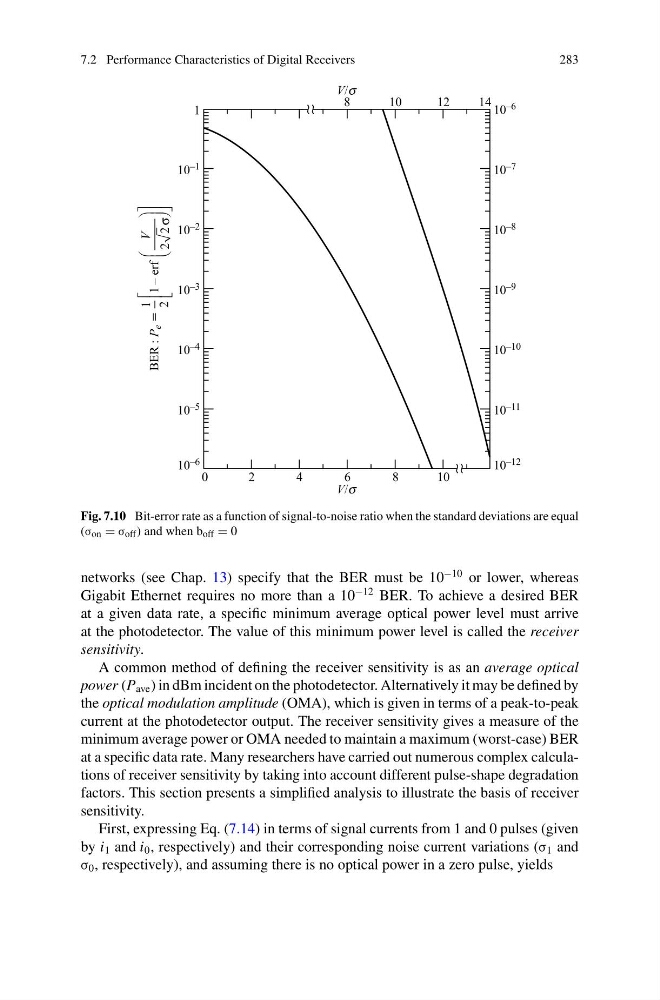
Fig. 7.10 Bit-error rate as a function of signal-to-noise ratio when the standard deviations are equal
(σ on = σ off ) and when b off = 0
networks (see Chap. 13) specify that the BER must be 10
−10 or lower, whereas
Gigabit Ethernet requires no more than a 10
−12 BER. To achieve a desired BER
at a given data rate, a specific minimum average optical power level must arrive
at the photodetector. The value of this minimum power level is called the receiver
sensitivity.
A common method of defining the receiver sensitivity is as an average optical
power (P ave ) in dBm incident on the photodetector. Alternatively it may be defined by
the optical modulation amplitude (OMA), which is given in terms of a peak-to-peak
current at the photodetector output. The receiver sensitivity gives a measure of the
minimum average power or OMA needed to maintain a maximum (worst-case) BER
at a specific data rate. Many researchers have carried out numerous complex calculations of receiver sensitivity by taking into account different pulse-shape degradation
factors. This section presents a simplified analysis to illustrate the basis of receiver
sensitivity.
First, expressing Eq. (7.14) in terms of signal currents from 1 and 0 pulses (given
by i 1 and i 0 , respectively) and their corresponding noise current variations (σ 1 and
σ 0 , respectively), and assuming there is no optical power in a zero pulse, yields
283
Fig. 7.10 Bit-error rate as a function of signal-to-noise ratio when the standard deviations are equal
(σ on = σ off ) and when b off = 0
networks (see Chap. 13) specify that the BER must be 10
−10 or lower, whereas
Gigabit Ethernet requires no more than a 10
−12 BER. To achieve a desired BER
at a given data rate, a specific minimum average optical power level must arrive
at the photodetector. The value of this minimum power level is called the receiver
sensitivity.
A common method of defining the receiver sensitivity is as an average optical
power (P ave ) in dBm incident on the photodetector. Alternatively it may be defined by
the optical modulation amplitude (OMA), which is given in terms of a peak-to-peak
current at the photodetector output. The receiver sensitivity gives a measure of the
minimum average power or OMA needed to maintain a maximum (worst-case) BER
at a specific data rate. Many researchers have carried out numerous complex calculations of receiver sensitivity by taking into account different pulse-shape degradation
factors. This section presents a simplified analysis to illustrate the basis of receiver
sensitivity.
First, expressing Eq. (7.14) in terms of signal currents from 1 and 0 pulses (given
by i 1 and i 0 , respectively) and their corresponding noise current variations (σ 1 and
σ 0 , respectively), and assuming there is no optical power in a zero pulse, yields