

272
7 Optical Receiver Operation
random arrival of photons at the detector. If the detector is illuminated by an optical
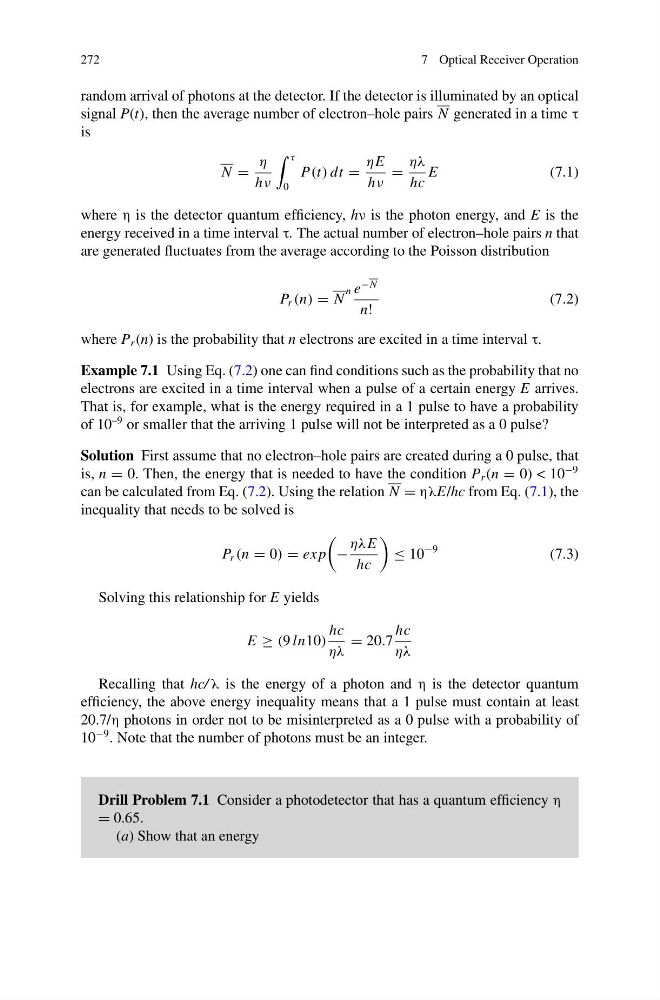
signal P(t), then the average number of electron–hole pairs N generated in a time τ
is
N =
η
hν
τ
0
P(t) dt =
ηE
hν
=
ηλ
hc
E
(7.1)
where η is the detector quantum efficiency, hν is the photon energy, and E is the
energy received in a time interval τ. The actual number of electron–hole pairs n that
are generated fluctuates from the average according to the Poisson distribution
P r (n) = N
n e
−N
n!
(7.2)
where P r (n) is the probability that n electrons are excited in a time interval τ.
Example 7.1 Using Eq. (7.2) one can find conditions such as the probability that no
electrons are excited in a time interval when a pulse of a certain energy E arrives.
That is, for example, what is the energy required in a 1 pulse to have a probability
of 10
–9 or smaller that the arriving 1 pulse will not be interpreted as a 0 pulse?
Solution First assume that no electron–hole pairs are created during a 0 pulse, that
is, n = 0. Then, the energy that is needed to have the condition P r (n = 0) < 10
−9
can be calculated from Eq. (7.2). Using the relation N = ηλE/hc from Eq. (7.1), the
inequality that needs to be solved is
P r (n = 0) = ex p
−
ηλE
hc
≤ 10
−9
(7.3)
Solving this relationship for E yields
E ≥ (9 ln10)
hc
ηλ
= 20.7
hc
ηλ
Recalling that hc/ λ is the energy of a photon and η is the detector quantum
efficiency, the above energy inequality means that a 1 pulse must contain at least
20.7/η photons in order not to be misinterpreted as a 0 pulse with a probability of
10
−9 . Note that the number of photons must be an integer.
Drill Problem 7.1 Consider a photodetector that has a quantum efficiency η
= 0.65.
(a) Show that an energy
7 Optical Receiver Operation
random arrival of photons at the detector. If the detector is illuminated by an optical
signal P(t), then the average number of electron–hole pairs N generated in a time τ
is
N =
η
hν
τ
0
P(t) dt =
ηE
hν
=
ηλ
hc
E
(7.1)
where η is the detector quantum efficiency, hν is the photon energy, and E is the
energy received in a time interval τ. The actual number of electron–hole pairs n that
are generated fluctuates from the average according to the Poisson distribution
P r (n) = N
n e
−N
n!
(7.2)
where P r (n) is the probability that n electrons are excited in a time interval τ.
Example 7.1 Using Eq. (7.2) one can find conditions such as the probability that no
electrons are excited in a time interval when a pulse of a certain energy E arrives.
That is, for example, what is the energy required in a 1 pulse to have a probability
of 10
–9 or smaller that the arriving 1 pulse will not be interpreted as a 0 pulse?
Solution First assume that no electron–hole pairs are created during a 0 pulse, that
is, n = 0. Then, the energy that is needed to have the condition P r (n = 0) < 10
−9
can be calculated from Eq. (7.2). Using the relation N = ηλE/hc from Eq. (7.1), the
inequality that needs to be solved is
P r (n = 0) = ex p
−
ηλE
hc
≤ 10
−9
(7.3)
Solving this relationship for E yields
E ≥ (9 ln10)
hc
ηλ
= 20.7
hc
ηλ
Recalling that hc/ λ is the energy of a photon and η is the detector quantum
efficiency, the above energy inequality means that a 1 pulse must contain at least
20.7/η photons in order not to be misinterpreted as a 0 pulse with a probability of
10
−9 . Note that the number of photons must be an integer.
Drill Problem 7.1 Consider a photodetector that has a quantum efficiency η
= 0.65.
(a) Show that an energy