

7.1 Basic Receiver Operation
271
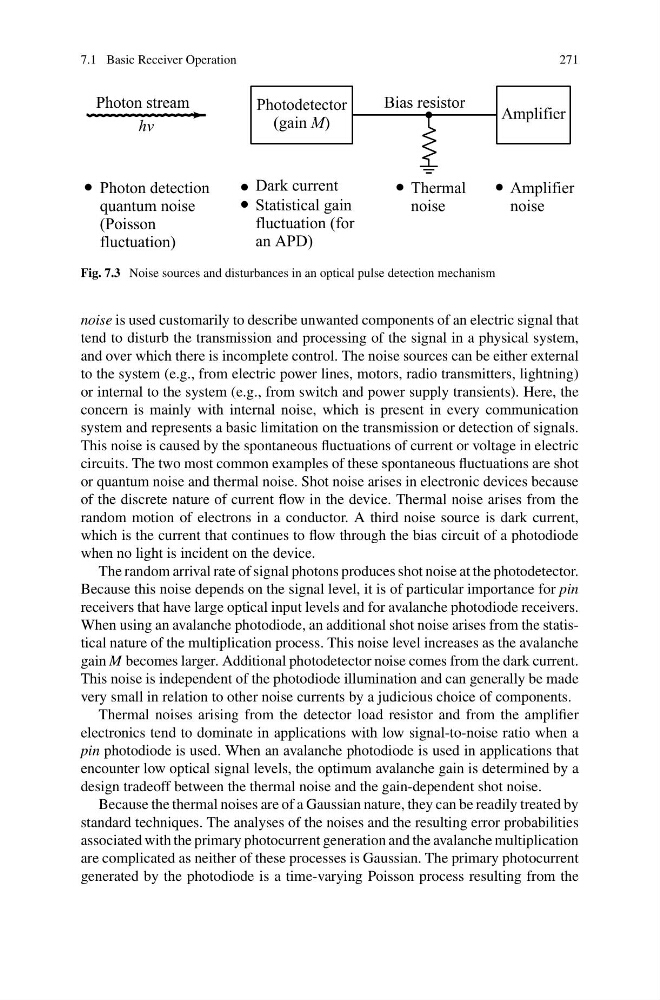
Fig. 7.3 Noise sources and disturbances in an optical pulse detection mechanism
noise is used customarily to describe unwanted components of an electric signal that
tend to disturb the transmission and processing of the signal in a physical system,
and over which there is incomplete control. The noise sources can be either external
to the system (e.g., from electric power lines, motors, radio transmitters, lightning)
or internal to the system (e.g., from switch and power supply transients). Here, the
concern is mainly with internal noise, which is present in every communication
system and represents a basic limitation on the transmission or detection of signals.
This noise is caused by the spontaneous fluctuations of current or voltage in electric
circuits. The two most common examples of these spontaneous fluctuations are shot
or quantum noise and thermal noise. Shot noise arises in electronic devices because
of the discrete nature of current flow in the device. Thermal noise arises from the
random motion of electrons in a conductor. A third noise source is dark current,
which is the current that continues to flow through the bias circuit of a photodiode
when no light is incident on the device.
The random arrival rate of signal photons produces shot noise at the photodetector.
Because this noise depends on the signal level, it is of particular importance for pin
receivers that have large optical input levels and for avalanche photodiode receivers.
When using an avalanche photodiode, an additional shot noise arises from the statistical nature of the multiplication process. This noise level increases as the avalanche
gain M becomes larger. Additional photodetector noise comes from the dark current.
This noise is independent of the photodiode illumination and can generally be made
very small in relation to other noise currents by a judicious choice of components.
Thermal noises arising from the detector load resistor and from the amplifier
electronics tend to dominate in applications with low signal-to-noise ratio when a
pin photodiode is used. When an avalanche photodiode is used in applications that
encounter low optical signal levels, the optimum avalanche gain is determined by a
design tradeoff between the thermal noise and the gain-dependent shot noise.
Because the thermal noises are of a Gaussian nature, they can be readily treated by
standard techniques. The analyses of the noises and the resulting error probabilities
associated with the primary photocurrent generation and the avalanche multiplication
are complicated as neither of these processes is Gaussian. The primary photocurrent
generated by the photodiode is a time-varying Poisson process resulting from the
271
Fig. 7.3 Noise sources and disturbances in an optical pulse detection mechanism
noise is used customarily to describe unwanted components of an electric signal that
tend to disturb the transmission and processing of the signal in a physical system,
and over which there is incomplete control. The noise sources can be either external
to the system (e.g., from electric power lines, motors, radio transmitters, lightning)
or internal to the system (e.g., from switch and power supply transients). Here, the
concern is mainly with internal noise, which is present in every communication
system and represents a basic limitation on the transmission or detection of signals.
This noise is caused by the spontaneous fluctuations of current or voltage in electric
circuits. The two most common examples of these spontaneous fluctuations are shot
or quantum noise and thermal noise. Shot noise arises in electronic devices because
of the discrete nature of current flow in the device. Thermal noise arises from the
random motion of electrons in a conductor. A third noise source is dark current,
which is the current that continues to flow through the bias circuit of a photodiode
when no light is incident on the device.
The random arrival rate of signal photons produces shot noise at the photodetector.
Because this noise depends on the signal level, it is of particular importance for pin
receivers that have large optical input levels and for avalanche photodiode receivers.
When using an avalanche photodiode, an additional shot noise arises from the statistical nature of the multiplication process. This noise level increases as the avalanche
gain M becomes larger. Additional photodetector noise comes from the dark current.
This noise is independent of the photodiode illumination and can generally be made
very small in relation to other noise currents by a judicious choice of components.
Thermal noises arising from the detector load resistor and from the amplifier
electronics tend to dominate in applications with low signal-to-noise ratio when a
pin photodiode is used. When an avalanche photodiode is used in applications that
encounter low optical signal levels, the optimum avalanche gain is determined by a
design tradeoff between the thermal noise and the gain-dependent shot noise.
Because the thermal noises are of a Gaussian nature, they can be readily treated by
standard techniques. The analyses of the noises and the resulting error probabilities
associated with the primary photocurrent generation and the avalanche multiplication
are complicated as neither of these processes is Gaussian. The primary photocurrent
generated by the photodiode is a time-varying Poisson process resulting from the