

6.5 Summary
263
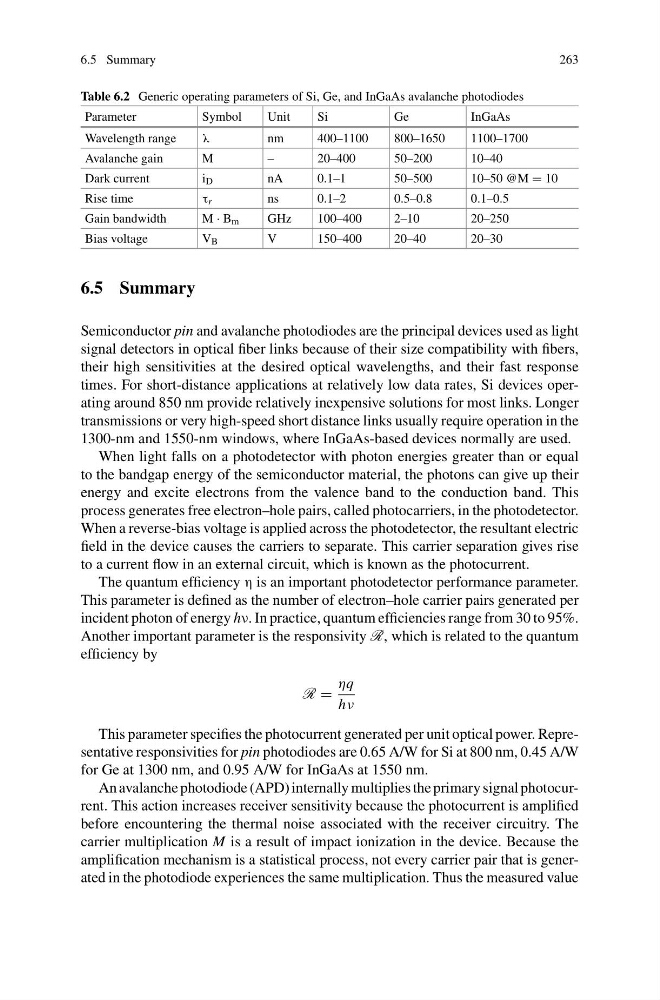
Table 6.2 Generic operating parameters of Si, Ge, and InGaAs avalanche photodiodes
Parameter
Symbol
Unit
Si
Ge
InGaAs
Wavelength range
λ
nm
400–1100
800–1650
1100–1700
Avalanche gain
M
–
20–400
50–200
10–40
Dark current
i D
nA
0.1–1
50–500
10–50 @M = 10
Rise time
τ r
ns
0.1–2
0.5–0.8
0.1–0.5
Gain bandwidth
M · B m
GHz
100–400
2–10
20–250
Bias voltage
V B
V
150–400
20–40
20–30
6.5 Summary
Semiconductor pin and avalanche photodiodes are the principal devices used as light
signal detectors in optical fiber links because of their size compatibility with fibers,
their high sensitivities at the desired optical wavelengths, and their fast response
times. For short-distance applications at relatively low data rates, Si devices operating around 850 nm provide relatively inexpensive solutions for most links. Longer
transmissions or very high-speed short distance links usually require operation in the
1300-nm and 1550-nm windows, where InGaAs-based devices normally are used.
When light falls on a photodetector with photon energies greater than or equal
to the bandgap energy of the semiconductor material, the photons can give up their
energy and excite electrons from the valence band to the conduction band. This
process generates free electron–hole pairs, called photocarriers, in the photodetector.
When a reverse-bias voltage is applied across the photodetector, the resultant electric
field in the device causes the carriers to separate. This carrier separation gives rise
to a current flow in an external circuit, which is known as the photocurrent.
The quantum efficiency η is an important photodetector performance parameter.
This parameter is defined as the number of electron–hole carrier pairs generated per
incident photon of energy hν. In practice, quantum efficiencies range from 30 to 95%.
Another important parameter is the responsivity R, which is related to the quantum
efficiency by
R =
ηq
hν
This parameter specifies the photocurrent generated per unit optical power. Representative responsivities for pin photodiodes are 0.65 A/W for Si at 800 nm, 0.45 A/W
for Ge at 1300 nm, and 0.95 A/W for InGaAs at 1550 nm.
An avalanche photodiode (APD) internally multiplies the primary signal photocurrent. This action increases receiver sensitivity because the photocurrent is amplified
before encountering the thermal noise associated with the receiver circuitry. The
carrier multiplication M is a result of impact ionization in the device. Because the
amplification mechanism is a statistical process, not every carrier pair that is generated in the photodiode experiences the same multiplication. Thus the measured value
263
Table 6.2 Generic operating parameters of Si, Ge, and InGaAs avalanche photodiodes
Parameter
Symbol
Unit
Si
Ge
InGaAs
Wavelength range
λ
nm
400–1100
800–1650
1100–1700
Avalanche gain
M
–
20–400
50–200
10–40
Dark current
i D
nA
0.1–1
50–500
10–50 @M = 10
Rise time
τ r
ns
0.1–2
0.5–0.8
0.1–0.5
Gain bandwidth
M · B m
GHz
100–400
2–10
20–250
Bias voltage
V B
V
150–400
20–40
20–30
6.5 Summary
Semiconductor pin and avalanche photodiodes are the principal devices used as light
signal detectors in optical fiber links because of their size compatibility with fibers,
their high sensitivities at the desired optical wavelengths, and their fast response
times. For short-distance applications at relatively low data rates, Si devices operating around 850 nm provide relatively inexpensive solutions for most links. Longer
transmissions or very high-speed short distance links usually require operation in the
1300-nm and 1550-nm windows, where InGaAs-based devices normally are used.
When light falls on a photodetector with photon energies greater than or equal
to the bandgap energy of the semiconductor material, the photons can give up their
energy and excite electrons from the valence band to the conduction band. This
process generates free electron–hole pairs, called photocarriers, in the photodetector.
When a reverse-bias voltage is applied across the photodetector, the resultant electric
field in the device causes the carriers to separate. This carrier separation gives rise
to a current flow in an external circuit, which is known as the photocurrent.
The quantum efficiency η is an important photodetector performance parameter.
This parameter is defined as the number of electron–hole carrier pairs generated per
incident photon of energy hν. In practice, quantum efficiencies range from 30 to 95%.
Another important parameter is the responsivity R, which is related to the quantum
efficiency by
R =
ηq
hν
This parameter specifies the photocurrent generated per unit optical power. Representative responsivities for pin photodiodes are 0.65 A/W for Si at 800 nm, 0.45 A/W
for Ge at 1300 nm, and 0.95 A/W for InGaAs at 1550 nm.
An avalanche photodiode (APD) internally multiplies the primary signal photocurrent. This action increases receiver sensitivity because the photocurrent is amplified
before encountering the thermal noise associated with the receiver circuitry. The
carrier multiplication M is a result of impact ionization in the device. Because the
amplification mechanism is a statistical process, not every carrier pair that is generated in the photodiode experiences the same multiplication. Thus the measured value