

264
6 Photodetection Devices
of M is expressed as an average quantity. Analogous to the pin photodiode, the
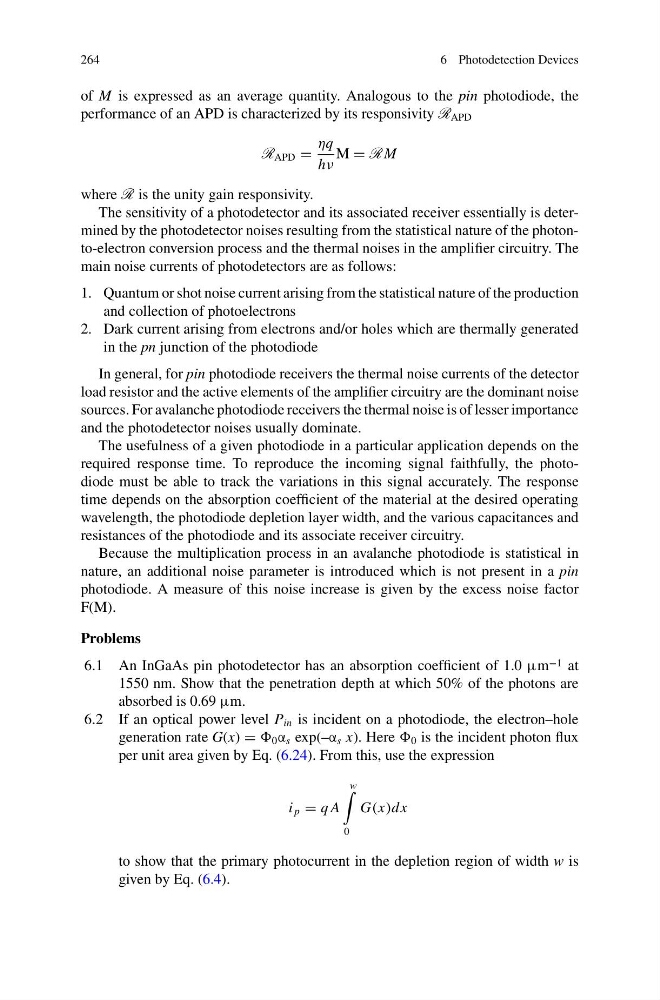
performance of an APD is characterized by its responsivity R APD
R APD =
ηq
hν
M = R M
where R is the unity gain responsivity.
The sensitivity of a photodetector and its associated receiver essentially is determined by the photodetector noises resulting from the statistical nature of the photonto-electron conversion process and the thermal noises in the amplifier circuitry. The
main noise currents of photodetectors are as follows:
1. Quantum or shot noise current arising from the statistical nature of the production
and collection of photoelectrons
2. Dark current arising from electrons and/or holes which are thermally generated
in the pn junction of the photodiode
In general, for pin photodiode receivers the thermal noise currents of the detector
load resistor and the active elements of the amplifier circuitry are the dominant noise
sources. For avalanche photodiode receivers the thermal noise is of lesser importance
and the photodetector noises usually dominate.
The usefulness of a given photodiode in a particular application depends on the
required response time. To reproduce the incoming signal faithfully, the photodiode must be able to track the variations in this signal accurately. The response
time depends on the absorption coefficient of the material at the desired operating
wavelength, the photodiode depletion layer width, and the various capacitances and
resistances of the photodiode and its associate receiver circuitry.
Because the multiplication process in an avalanche photodiode is statistical in
nature, an additional noise parameter is introduced which is not present in a pin
photodiode. A measure of this noise increase is given by the excess noise factor
F(M).
Problems
6.1 An InGaAs pin photodetector has an absorption coefficient of 1.0 μm −1 at
1550 nm. Show that the penetration depth at which 50% of the photons are
absorbed is 0.69 μm.
6.2 If an optical power level P in is incident on a photodiode, the electron–hole
generation rate G(x) = 0 α s exp(–α s x). Here 0 is the incident photon flux
per unit area given by Eq. (6.24). From this, use the expression
i p = q A
w
0
G(x)dx
to show that the primary photocurrent in the depletion region of width w is
given by Eq. (6.4).
6 Photodetection Devices
of M is expressed as an average quantity. Analogous to the pin photodiode, the
performance of an APD is characterized by its responsivity R APD
R APD =
ηq
hν
M = R M
where R is the unity gain responsivity.
The sensitivity of a photodetector and its associated receiver essentially is determined by the photodetector noises resulting from the statistical nature of the photonto-electron conversion process and the thermal noises in the amplifier circuitry. The
main noise currents of photodetectors are as follows:
1. Quantum or shot noise current arising from the statistical nature of the production
and collection of photoelectrons
2. Dark current arising from electrons and/or holes which are thermally generated
in the pn junction of the photodiode
In general, for pin photodiode receivers the thermal noise currents of the detector
load resistor and the active elements of the amplifier circuitry are the dominant noise
sources. For avalanche photodiode receivers the thermal noise is of lesser importance
and the photodetector noises usually dominate.
The usefulness of a given photodiode in a particular application depends on the
required response time. To reproduce the incoming signal faithfully, the photodiode must be able to track the variations in this signal accurately. The response
time depends on the absorption coefficient of the material at the desired operating
wavelength, the photodiode depletion layer width, and the various capacitances and
resistances of the photodiode and its associate receiver circuitry.
Because the multiplication process in an avalanche photodiode is statistical in
nature, an additional noise parameter is introduced which is not present in a pin
photodiode. A measure of this noise increase is given by the excess noise factor
F(M).
Problems
6.1 An InGaAs pin photodetector has an absorption coefficient of 1.0 μm −1 at
1550 nm. Show that the penetration depth at which 50% of the photons are
absorbed is 0.69 μm.
6.2 If an optical power level P in is incident on a photodiode, the electron–hole
generation rate G(x) = 0 α s exp(–α s x). Here 0 is the incident photon flux
per unit area given by Eq. (6.24). From this, use the expression
i p = q A
w
0
G(x)dx
to show that the primary photocurrent in the depletion region of width w is
given by Eq. (6.4).