

6.2 Noise Effects in Photodetectors
255
S N R =
i
2
p
M
2
2qi p M 2 F(M)B e + 4k B T B e /R L
(6.17)
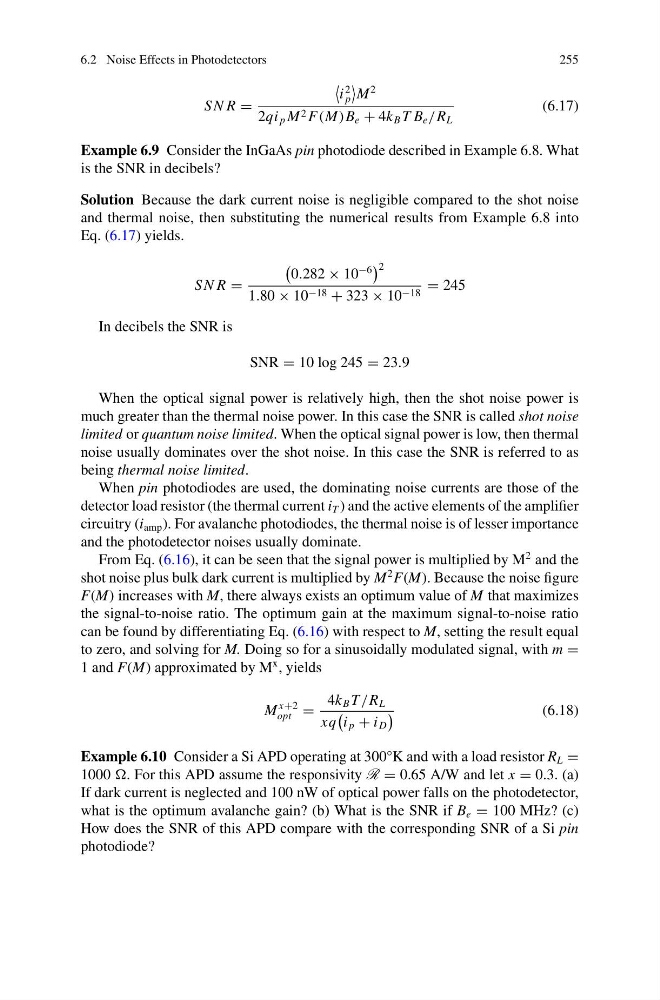
Example 6.9 Consider the InGaAs pin photodiode described in Example 6.8. What
is the SNR in decibels?
Solution Because the dark current noise is negligible compared to the shot noise
and thermal noise, then substituting the numerical results from Example 6.8 into
Eq. (6.17) yields.
S N R =
0.282 × 10
−6
2
1.80 × 10 −18 + 323 × 10 −18 = 245
In decibels the SNR is
SNR = 10 log 245 = 23.9
When the optical signal power is relatively high, then the shot noise power is
much greater than the thermal noise power. In this case the SNR is called shot noise
limited or quantum noise limited. When the optical signal power is low, then thermal
noise usually dominates over the shot noise. In this case the SNR is referred to as
being thermal noise limited.
When pin photodiodes are used, the dominating noise currents are those of the
detector load resistor (the thermal current i T ) and the active elements of the amplifier
circuitry (i amp ). For avalanche photodiodes, the thermal noise is of lesser importance
and the photodetector noises usually dominate.
From Eq. (6.16), it can be seen that the signal power is multiplied by M
2 and the
shot noise plus bulk dark current is multiplied by M
2 F(M). Because the noise figure
F(M) increases with M, there always exists an optimum value of M that maximizes
the signal-to-noise ratio. The optimum gain at the maximum signal-to-noise ratio
can be found by differentiating Eq. (6.16) with respect to M, setting the result equal
to zero, and solving for M. Doing so for a sinusoidally modulated signal, with m =
1 and F(M) approximated by M
x , yields
M
x+2
opt =
4k B T /R L
xq
i p + i D
(6.18)
Example 6.10 Consider a Si APD operating at 300°K and with a load resistor R L =
1000 . For this APD assume the responsivity R = 0.65 A/W and let x = 0.3. (a)
If dark current is neglected and 100 nW of optical power falls on the photodetector,
what is the optimum avalanche gain? (b) What is the SNR if B e = 100 MHz? (c)
How does the SNR of this APD compare with the corresponding SNR of a Si pin
photodiode?
255
S N R =
i
2
p
M
2
2qi p M 2 F(M)B e + 4k B T B e /R L
(6.17)
Example 6.9 Consider the InGaAs pin photodiode described in Example 6.8. What
is the SNR in decibels?
Solution Because the dark current noise is negligible compared to the shot noise
and thermal noise, then substituting the numerical results from Example 6.8 into
Eq. (6.17) yields.
S N R =
0.282 × 10
−6
2
1.80 × 10 −18 + 323 × 10 −18 = 245
In decibels the SNR is
SNR = 10 log 245 = 23.9
When the optical signal power is relatively high, then the shot noise power is
much greater than the thermal noise power. In this case the SNR is called shot noise
limited or quantum noise limited. When the optical signal power is low, then thermal
noise usually dominates over the shot noise. In this case the SNR is referred to as
being thermal noise limited.
When pin photodiodes are used, the dominating noise currents are those of the
detector load resistor (the thermal current i T ) and the active elements of the amplifier
circuitry (i amp ). For avalanche photodiodes, the thermal noise is of lesser importance
and the photodetector noises usually dominate.
From Eq. (6.16), it can be seen that the signal power is multiplied by M
2 and the
shot noise plus bulk dark current is multiplied by M
2 F(M). Because the noise figure
F(M) increases with M, there always exists an optimum value of M that maximizes
the signal-to-noise ratio. The optimum gain at the maximum signal-to-noise ratio
can be found by differentiating Eq. (6.16) with respect to M, setting the result equal
to zero, and solving for M. Doing so for a sinusoidally modulated signal, with m =
1 and F(M) approximated by M
x , yields
M
x+2
opt =
4k B T /R L
xq
i p + i D
(6.18)
Example 6.10 Consider a Si APD operating at 300°K and with a load resistor R L =
1000 . For this APD assume the responsivity R = 0.65 A/W and let x = 0.3. (a)
If dark current is neglected and 100 nW of optical power falls on the photodetector,
what is the optimum avalanche gain? (b) What is the SNR if B e = 100 MHz? (c)
How does the SNR of this APD compare with the corresponding SNR of a Si pin
photodiode?