

254
6 Photodetection Devices
Solution
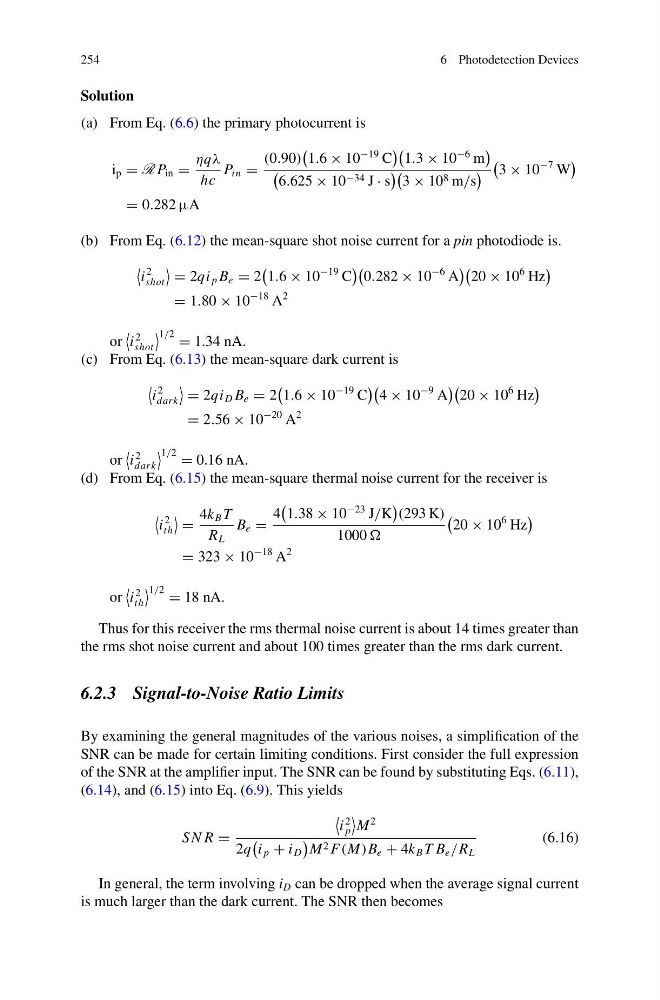
(a) From Eq. (6.6) the primary photocurrent is
i p = R P in =
ηqλ
hc
P in =
(0.90)
1.6 × 10
−19 C
1.3 × 10
−6 m
6.625 × 10 −34 J · s
3 × 10 8 m/s
3 × 10
−7 W
= 0.282 μA
(b) From Eq. (6.12) the mean-square shot noise current for a pin photodiode is.
i
2
shot
= 2qi p B e = 2
1.6 × 10
−19 C
0.282 × 10
−6 A
20 × 10
6 Hz
= 1.80 × 10
−18 A
2
or
i
2
shot
1/2 = 1.34 nA.
(c) From Eq. (6.13) the mean-square dark current is
i
2
dark
= 2qi D B e = 2
1.6 × 10
−19 C
4 × 10
−9 A
20 × 10
6 Hz
= 2.56 × 10
−20 A
2
or
i
2
dark
1/2 = 0.16 nA.
(d) From Eq. (6.15) the mean-square thermal noise current for the receiver is
i
2
th
=
4k B T
R L
B e =
4
1.38 × 10
−23 J/K
(293 K)
1000
20 × 10
6 Hz
= 323 × 10
−18 A
2
or
i
2
th
1/2 = 18 nA.
Thus for this receiver the rms thermal noise current is about 14 times greater than
the rms shot noise current and about 100 times greater than the rms dark current.
6.2.3 Signal-to-Noise Ratio Limits
By examining the general magnitudes of the various noises, a simplification of the
SNR can be made for certain limiting conditions. First consider the full expression
of the SNR at the amplifier input. The SNR can be found by substituting Eqs. (6.11),
(6.14), and (6.15) into Eq. (6.9). This yields
S N R =
i
2
p
M
2
2q
i p + i D
M 2 F(M)B e + 4k B T B e /R L
(6.16)
In general, the term involving i D can be dropped when the average signal current
is much larger than the dark current. The SNR then becomes
6 Photodetection Devices
Solution
(a) From Eq. (6.6) the primary photocurrent is
i p = R P in =
ηqλ
hc
P in =
(0.90)
1.6 × 10
−19 C
1.3 × 10
−6 m
6.625 × 10 −34 J · s
3 × 10 8 m/s
3 × 10
−7 W
= 0.282 μA
(b) From Eq. (6.12) the mean-square shot noise current for a pin photodiode is.
i
2
shot
= 2qi p B e = 2
1.6 × 10
−19 C
0.282 × 10
−6 A
20 × 10
6 Hz
= 1.80 × 10
−18 A
2
or
i
2
shot
1/2 = 1.34 nA.
(c) From Eq. (6.13) the mean-square dark current is
i
2
dark
= 2qi D B e = 2
1.6 × 10
−19 C
4 × 10
−9 A
20 × 10
6 Hz
= 2.56 × 10
−20 A
2
or
i
2
dark
1/2 = 0.16 nA.
(d) From Eq. (6.15) the mean-square thermal noise current for the receiver is
i
2
th
=
4k B T
R L
B e =
4
1.38 × 10
−23 J/K
(293 K)
1000
20 × 10
6 Hz
= 323 × 10
−18 A
2
or
i
2
th
1/2 = 18 nA.
Thus for this receiver the rms thermal noise current is about 14 times greater than
the rms shot noise current and about 100 times greater than the rms dark current.
6.2.3 Signal-to-Noise Ratio Limits
By examining the general magnitudes of the various noises, a simplification of the
SNR can be made for certain limiting conditions. First consider the full expression
of the SNR at the amplifier input. The SNR can be found by substituting Eqs. (6.11),
(6.14), and (6.15) into Eq. (6.9). This yields
S N R =
i
2
p
M
2
2q
i p + i D
M 2 F(M)B e + 4k B T B e /R L
(6.16)
In general, the term involving i D can be dropped when the average signal current
is much larger than the dark current. The SNR then becomes