

6.2 Noise Effects in Photodetectors
253
is negligible. The bulk dark current i dark arises from electrons and/or holes that are
thermally generated in the pn junction of the photodiode. In an APD, these liberated
carriers also get accelerated by the high electric field present at the pn junction, and
are therefore multiplied by the avalanche gain mechanism. The mean-square value
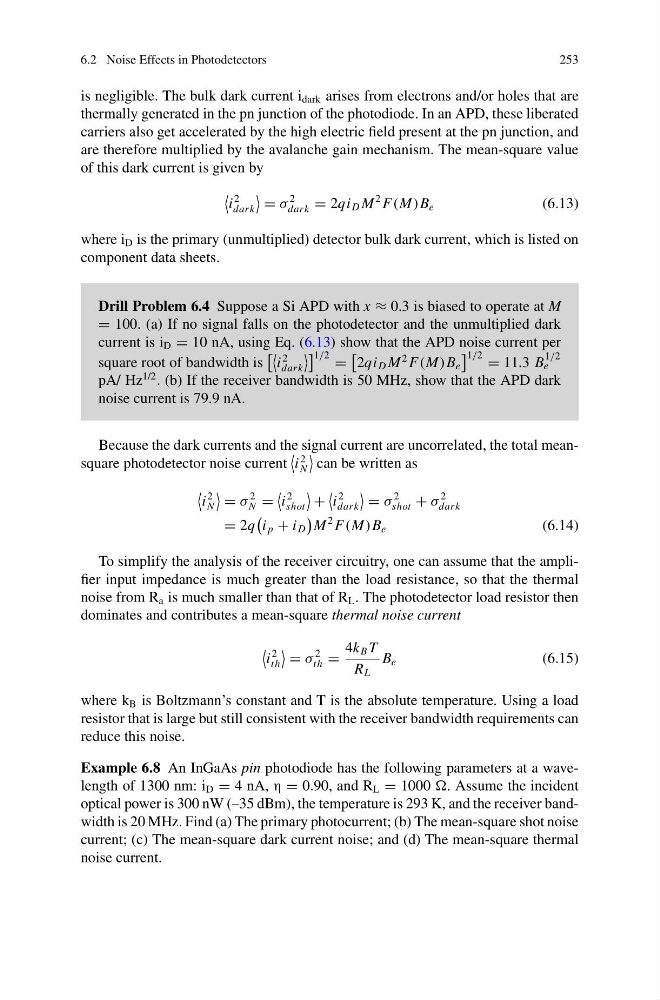
of this dark current is given by
i
2
dark
= σ
2
dark = 2qi D M
2 F(M)B e
(6.13)
where i D is the primary (unmultiplied) detector bulk dark current, which is listed on
component data sheets.
Drill Problem 6.4 Suppose a Si APD with x ≈ 0.3 is biased to operate at M
= 100. (a) If no signal falls on the photodetector and the unmultiplied dark
current is i D = 10 nA, using Eq. (6.13) show that the APD noise current per
square root of bandwidth is
i
2
dark
1/2 =
2qi D M
2 F(M)B e
1/2 = 11.3 B
1/2
e
pA/ Hz
1/2 . (b) If the receiver bandwidth is 50 MHz, show that the APD dark
noise current is 79.9 nA.
Because the dark currents and the signal current are uncorrelated, the total meansquare photodetector noise current
i
2
N
can be written as
i
2
N
= σ
2
N =
i
2
shot
+
i
2
dark
= σ
2
shot + σ
2
dark
= 2q
i p + i D
M
2 F(M)B e
(6.14)
To simplify the analysis of the receiver circuitry, one can assume that the amplifier input impedance is much greater than the load resistance, so that the thermal
noise from R a is much smaller than that of R L . The photodetector load resistor then
dominates and contributes a mean-square thermal noise current
i
2
th
= σ
2
th =
4k B T
R L
B e
(6.15)
where k B is Boltzmann’s constant and T is the absolute temperature. Using a load
resistor that is large but still consistent with the receiver bandwidth requirements can
reduce this noise.
Example 6.8 An InGaAs pin photodiode has the following parameters at a wavelength of 1300 nm: i D = 4 nA, η = 0.90, and R L = 1000 . Assume the incident
optical power is 300 nW (–35 dBm), the temperature is 293 K, and the receiver bandwidth is 20 MHz. Find (a) The primary photocurrent; (b) The mean-square shot noise
current; (c) The mean-square dark current noise; and (d) The mean-square thermal
noise current.
253
is negligible. The bulk dark current i dark arises from electrons and/or holes that are
thermally generated in the pn junction of the photodiode. In an APD, these liberated
carriers also get accelerated by the high electric field present at the pn junction, and
are therefore multiplied by the avalanche gain mechanism. The mean-square value
of this dark current is given by
i
2
dark
= σ
2
dark = 2qi D M
2 F(M)B e
(6.13)
where i D is the primary (unmultiplied) detector bulk dark current, which is listed on
component data sheets.
Drill Problem 6.4 Suppose a Si APD with x ≈ 0.3 is biased to operate at M
= 100. (a) If no signal falls on the photodetector and the unmultiplied dark
current is i D = 10 nA, using Eq. (6.13) show that the APD noise current per
square root of bandwidth is
i
2
dark
1/2 =
2qi D M
2 F(M)B e
1/2 = 11.3 B
1/2
e
pA/ Hz
1/2 . (b) If the receiver bandwidth is 50 MHz, show that the APD dark
noise current is 79.9 nA.
Because the dark currents and the signal current are uncorrelated, the total meansquare photodetector noise current
i
2
N
can be written as
i
2
N
= σ
2
N =
i
2
shot
+
i
2
dark
= σ
2
shot + σ
2
dark
= 2q
i p + i D
M
2 F(M)B e
(6.14)
To simplify the analysis of the receiver circuitry, one can assume that the amplifier input impedance is much greater than the load resistance, so that the thermal
noise from R a is much smaller than that of R L . The photodetector load resistor then
dominates and contributes a mean-square thermal noise current
i
2
th
= σ
2
th =
4k B T
R L
B e
(6.15)
where k B is Boltzmann’s constant and T is the absolute temperature. Using a load
resistor that is large but still consistent with the receiver bandwidth requirements can
reduce this noise.
Example 6.8 An InGaAs pin photodiode has the following parameters at a wavelength of 1300 nm: i D = 4 nA, η = 0.90, and R L = 1000 . Assume the incident
optical power is 300 nW (–35 dBm), the temperature is 293 K, and the receiver bandwidth is 20 MHz. Find (a) The primary photocurrent; (b) The mean-square shot noise
current; (c) The mean-square dark current noise; and (d) The mean-square thermal
noise current.