

252
6 Photodetection Devices
Load
resistor
Amplifier circuit
Photodiode circuit
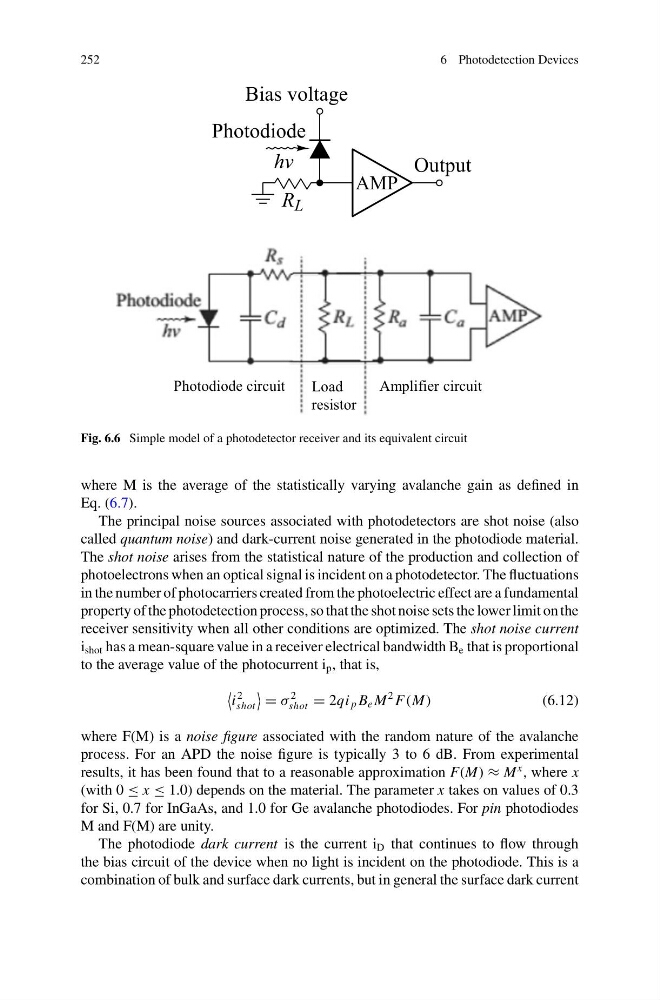
Fig. 6.6 Simple model of a photodetector receiver and its equivalent circuit
where M is the average of the statistically varying avalanche gain as defined in
Eq. (6.7).
The principal noise sources associated with photodetectors are shot noise (also
called quantum noise) and dark-current noise generated in the photodiode material.
The shot noise arises from the statistical nature of the production and collection of
photoelectrons when an optical signal is incident on a photodetector. The fluctuations
in the number of photocarriers created from the photoelectric effect are a fundamental
property of the photodetection process, so that the shot noise sets the lower limit on the
receiver sensitivity when all other conditions are optimized. The shot noise current
i shot has a mean-square value in a receiver electrical bandwidth B e that is proportional
to the average value of the photocurrent i p , that is,
i
2
shot
= σ
2
shot = 2qi p B e M
2 F(M)
(6.12)
where F(M) is a noise figure associated with the random nature of the avalanche
process. For an APD the noise figure is typically 3 to 6 dB. From experimental
results, it has been found that to a reasonable approximation F(M) ≈ M
x , where x
(with 0 ≤ x ≤ 1.0) depends on the material. The parameter x takes on values of 0.3
for Si, 0.7 for InGaAs, and 1.0 for Ge avalanche photodiodes. For pin photodiodes
M and F(M) are unity.
The photodiode dark current is the current i D that continues to flow through
the bias circuit of the device when no light is incident on the photodiode. This is a
combination of bulk and surface dark currents, but in general the surface dark current
6 Photodetection Devices
Load
resistor
Amplifier circuit
Photodiode circuit
Fig. 6.6 Simple model of a photodetector receiver and its equivalent circuit
where M is the average of the statistically varying avalanche gain as defined in
Eq. (6.7).
The principal noise sources associated with photodetectors are shot noise (also
called quantum noise) and dark-current noise generated in the photodiode material.
The shot noise arises from the statistical nature of the production and collection of
photoelectrons when an optical signal is incident on a photodetector. The fluctuations
in the number of photocarriers created from the photoelectric effect are a fundamental
property of the photodetection process, so that the shot noise sets the lower limit on the
receiver sensitivity when all other conditions are optimized. The shot noise current
i shot has a mean-square value in a receiver electrical bandwidth B e that is proportional
to the average value of the photocurrent i p , that is,
i
2
shot
= σ
2
shot = 2qi p B e M
2 F(M)
(6.12)
where F(M) is a noise figure associated with the random nature of the avalanche
process. For an APD the noise figure is typically 3 to 6 dB. From experimental
results, it has been found that to a reasonable approximation F(M) ≈ M
x , where x
(with 0 ≤ x ≤ 1.0) depends on the material. The parameter x takes on values of 0.3
for Si, 0.7 for InGaAs, and 1.0 for Ge avalanche photodiodes. For pin photodiodes
M and F(M) are unity.
The photodiode dark current is the current i D that continues to flow through
the bias circuit of the device when no light is incident on the photodiode. This is a
combination of bulk and surface dark currents, but in general the surface dark current