

256
6 Photodetection Devices
Solution
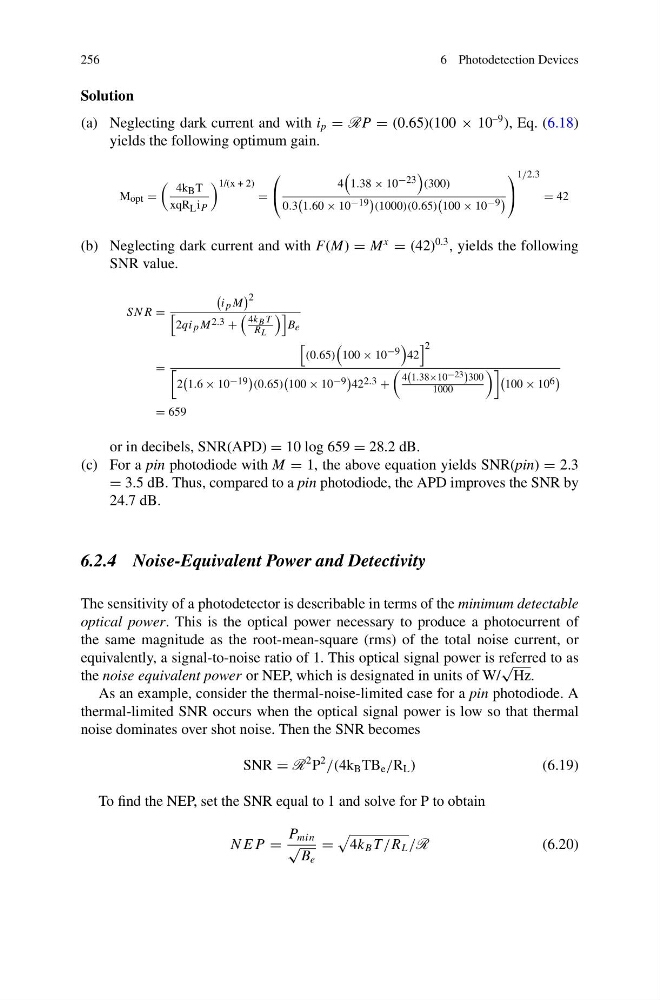
(a) Neglecting dark current and with i p = RP = (0.65)(100 × 10
–9 ), Eq. (6.18)
yields the following optimum gain.
M opt =
4k B T
xqR L i P
1/(x + 2)
=
⎛
⎝
4
1.38 × 10 −23
(300)
0.3
1.60 × 10 −19 (1000)(0.65)
100 × 10 −9
⎞
⎠
1/2.3
= 42
(b) Neglecting dark current and with F(M) = M
x
= (42)
0.3 , yields the following
SNR value.
SN R =
i p M
2
2qi p M 2.3 +
4k B T
R L
B e
=
(0.65)
100 × 10 −9
42
2
2
1.6 × 10 −19
(0.65)
100 × 10 −9
42 2.3 +
4
1.38×10 −23
300
1000
100 × 10 6
= 659
or in decibels, SNR(APD) = 10 log 659 = 28.2 dB.
(c) For a pin photodiode with M = 1, the above equation yields SNR(pin) = 2.3
= 3.5 dB. Thus, compared to a pin photodiode, the APD improves the SNR by
24.7 dB.
6.2.4 Noise-Equivalent Power and Detectivity
The sensitivity of a photodetector is describable in terms of the minimum detectable
optical power. This is the optical power necessary to produce a photocurrent of
the same magnitude as the root-mean-square (rms) of the total noise current, or
equivalently, a signal-to-noise ratio of 1. This optical signal power is referred to as
the noise equivalent power or NEP, which is designated in units of W/
√
Hz.
As an example, consider the thermal-noise-limited case for a pin photodiode. A
thermal-limited SNR occurs when the optical signal power is low so that thermal
noise dominates over shot noise. Then the SNR becomes
SNR = R
2 P
2
/(4k B TB e /R L )
(6.19)
To find the NEP, set the SNR equal to 1 and solve for P to obtain
N E P =
P min
√
B e
=
4k B T /R L /R
(6.20)
6 Photodetection Devices
Solution
(a) Neglecting dark current and with i p = RP = (0.65)(100 × 10
–9 ), Eq. (6.18)
yields the following optimum gain.
M opt =
4k B T
xqR L i P
1/(x + 2)
=
⎛
⎝
4
1.38 × 10 −23
(300)
0.3
1.60 × 10 −19 (1000)(0.65)
100 × 10 −9
⎞
⎠
1/2.3
= 42
(b) Neglecting dark current and with F(M) = M
x
= (42)
0.3 , yields the following
SNR value.
SN R =
i p M
2
2qi p M 2.3 +
4k B T
R L
B e
=
(0.65)
100 × 10 −9
42
2
2
1.6 × 10 −19
(0.65)
100 × 10 −9
42 2.3 +
4
1.38×10 −23
300
1000
100 × 10 6
= 659
or in decibels, SNR(APD) = 10 log 659 = 28.2 dB.
(c) For a pin photodiode with M = 1, the above equation yields SNR(pin) = 2.3
= 3.5 dB. Thus, compared to a pin photodiode, the APD improves the SNR by
24.7 dB.
6.2.4 Noise-Equivalent Power and Detectivity
The sensitivity of a photodetector is describable in terms of the minimum detectable
optical power. This is the optical power necessary to produce a photocurrent of
the same magnitude as the root-mean-square (rms) of the total noise current, or
equivalently, a signal-to-noise ratio of 1. This optical signal power is referred to as
the noise equivalent power or NEP, which is designated in units of W/
√
Hz.
As an example, consider the thermal-noise-limited case for a pin photodiode. A
thermal-limited SNR occurs when the optical signal power is low so that thermal
noise dominates over shot noise. Then the SNR becomes
SNR = R
2 P
2
/(4k B TB e /R L )
(6.19)
To find the NEP, set the SNR equal to 1 and solve for P to obtain
N E P =
P min
√
B e
=
4k B T /R L /R
(6.20)