

250
6 Photodetection Devices
where i M is the average value of the total multiplied output current and i p is the primary
unmultiplied photocurrent defined in Eq. (6.4). In practice, the avalanche mechanism
is a statistical process, because not every carrier pair generated in the diode experiences the same multiplication. Thus, the measured value of M is expressed as an
average quantity.
Analogous to the pin photodiode, the performance of an APD is characterized by
its responsivity R APD , which is given by
R APD =
ηq
hν
M = R M
(6.8)
where R is the unity gain responsivity.
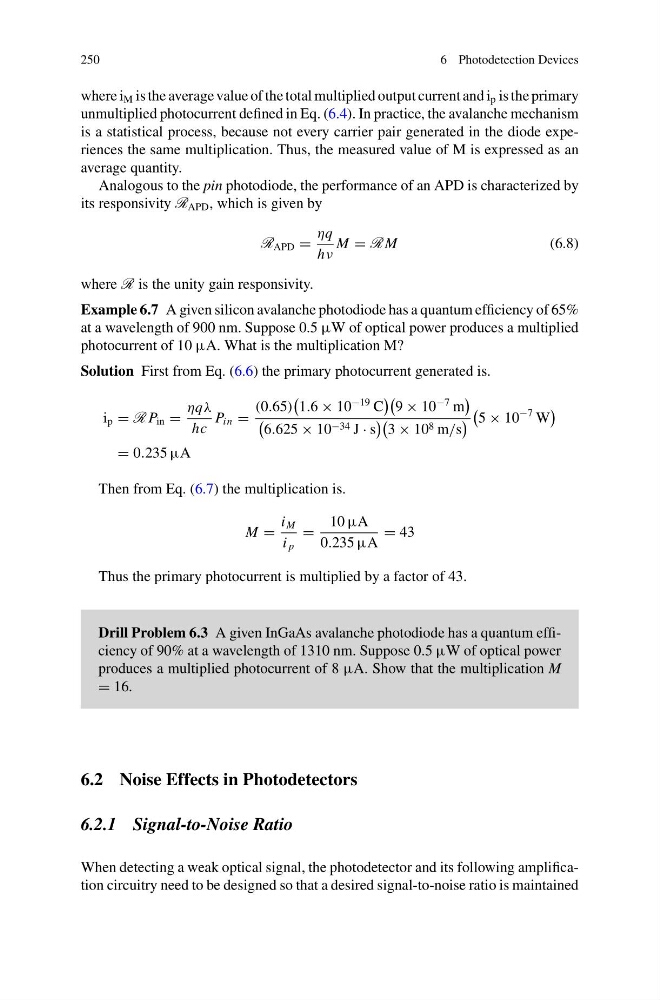
Example 6.7 A given silicon avalanche photodiode has a quantum efficiency of 65%
at a wavelength of 900 nm. Suppose 0.5 μW of optical power produces a multiplied
photocurrent of 10 μA. What is the multiplication M?
Solution First from Eq. (6.6) the primary photocurrent generated is.
i p = R P in =
ηqλ
hc
P in =
(0.65)
1.6 × 10
−19 C
9 × 10
−7 m
6.625 × 10 −34 J · s
3 × 10 8 m/s
5 × 10
−7 W
= 0.235 μA
Then from Eq. (6.7) the multiplication is.
M =
i M
i p
=
10 μA
0.235 μA
= 43
Thus the primary photocurrent is multiplied by a factor of 43.
Drill Problem 6.3 A given InGaAs avalanche photodiode has a quantum efficiency of 90% at a wavelength of 1310 nm. Suppose 0.5 μW of optical power
produces a multiplied photocurrent of 8 μA. Show that the multiplication M
= 16.
6.2 Noise Effects in Photodetectors
6.2.1 Signal-to-Noise Ratio
When detecting a weak optical signal, the photodetector and its following amplification circuitry need to be designed so that a desired signal-to-noise ratio is maintained
6 Photodetection Devices
where i M is the average value of the total multiplied output current and i p is the primary
unmultiplied photocurrent defined in Eq. (6.4). In practice, the avalanche mechanism
is a statistical process, because not every carrier pair generated in the diode experiences the same multiplication. Thus, the measured value of M is expressed as an
average quantity.
Analogous to the pin photodiode, the performance of an APD is characterized by
its responsivity R APD , which is given by
R APD =
ηq
hν
M = R M
(6.8)
where R is the unity gain responsivity.
Example 6.7 A given silicon avalanche photodiode has a quantum efficiency of 65%
at a wavelength of 900 nm. Suppose 0.5 μW of optical power produces a multiplied
photocurrent of 10 μA. What is the multiplication M?
Solution First from Eq. (6.6) the primary photocurrent generated is.
i p = R P in =
ηqλ
hc
P in =
(0.65)
1.6 × 10
−19 C
9 × 10
−7 m
6.625 × 10 −34 J · s
3 × 10 8 m/s
5 × 10
−7 W
= 0.235 μA
Then from Eq. (6.7) the multiplication is.
M =
i M
i p
=
10 μA
0.235 μA
= 43
Thus the primary photocurrent is multiplied by a factor of 43.
Drill Problem 6.3 A given InGaAs avalanche photodiode has a quantum efficiency of 90% at a wavelength of 1310 nm. Suppose 0.5 μW of optical power
produces a multiplied photocurrent of 8 μA. Show that the multiplication M
= 16.
6.2 Noise Effects in Photodetectors
6.2.1 Signal-to-Noise Ratio
When detecting a weak optical signal, the photodetector and its following amplification circuitry need to be designed so that a desired signal-to-noise ratio is maintained