

6.1 Operation of Photodiodes
249
6.1.2 Basics of Avalanche Photodiodes
Avalanche photodiodes (APDs) internally multiply the primary signal photocurrent
before it enters the input circuitry of the following amplifier [14–16]. This multiplication action increases receiver sensitivity because the photocurrent is multiplied before
encountering the thermal noise associated with the receiver circuit. As shown in
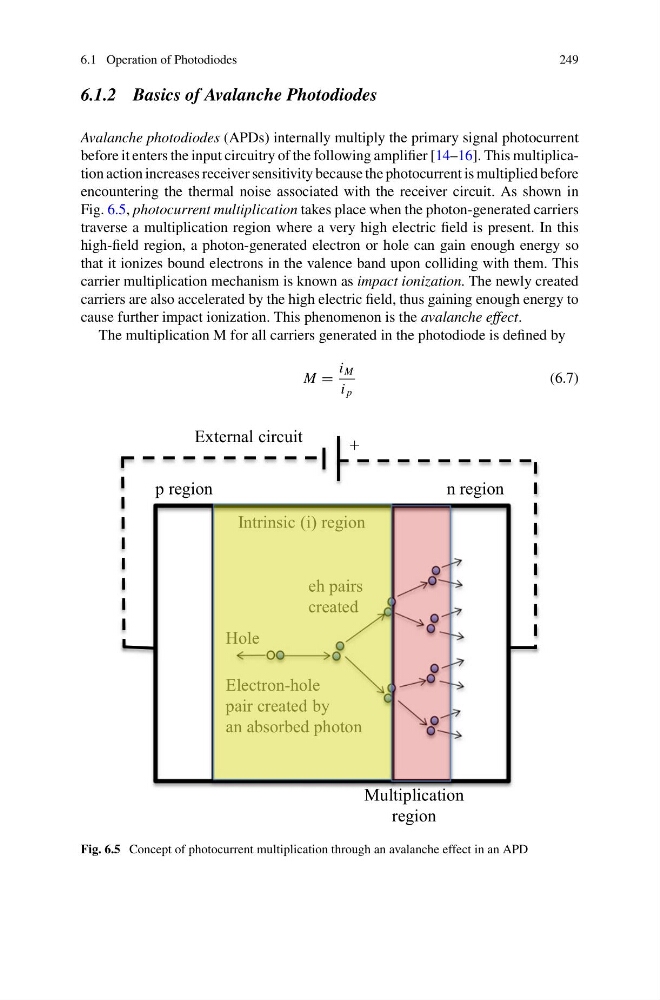
Fig. 6.5, photocurrent multiplication takes place when the photon-generated carriers
traverse a multiplication region where a very high electric field is present. In this
high-field region, a photon-generated electron or hole can gain enough energy so
that it ionizes bound electrons in the valence band upon colliding with them. This
carrier multiplication mechanism is known as impact ionization. The newly created
carriers are also accelerated by the high electric field, thus gaining enough energy to
cause further impact ionization. This phenomenon is the avalanche effect.
The multiplication M for all carriers generated in the photodiode is defined by
M =
i M
i p
(6.7)
Electron-hole
pair created by
an absorbed photon
Hole
eh pairs
created
p region
Multiplication
region
Intrinsic (i) region
n region
+
External circuit
Fig. 6.5 Concept of photocurrent multiplication through an avalanche effect in an APD
249
6.1.2 Basics of Avalanche Photodiodes
Avalanche photodiodes (APDs) internally multiply the primary signal photocurrent
before it enters the input circuitry of the following amplifier [14–16]. This multiplication action increases receiver sensitivity because the photocurrent is multiplied before
encountering the thermal noise associated with the receiver circuit. As shown in
Fig. 6.5, photocurrent multiplication takes place when the photon-generated carriers
traverse a multiplication region where a very high electric field is present. In this
high-field region, a photon-generated electron or hole can gain enough energy so
that it ionizes bound electrons in the valence band upon colliding with them. This
carrier multiplication mechanism is known as impact ionization. The newly created
carriers are also accelerated by the high electric field, thus gaining enough energy to
cause further impact ionization. This phenomenon is the avalanche effect.
The multiplication M for all carriers generated in the photodiode is defined by
M =
i M
i p
(6.7)
Electron-hole
pair created by
an absorbed photon
Hole
eh pairs
created
p region
Multiplication
region
Intrinsic (i) region
n region
+
External circuit
Fig. 6.5 Concept of photocurrent multiplication through an avalanche effect in an APD