

6.1 Operation of Photodiodes
245
Fall offs due
to insufficient
photon energy
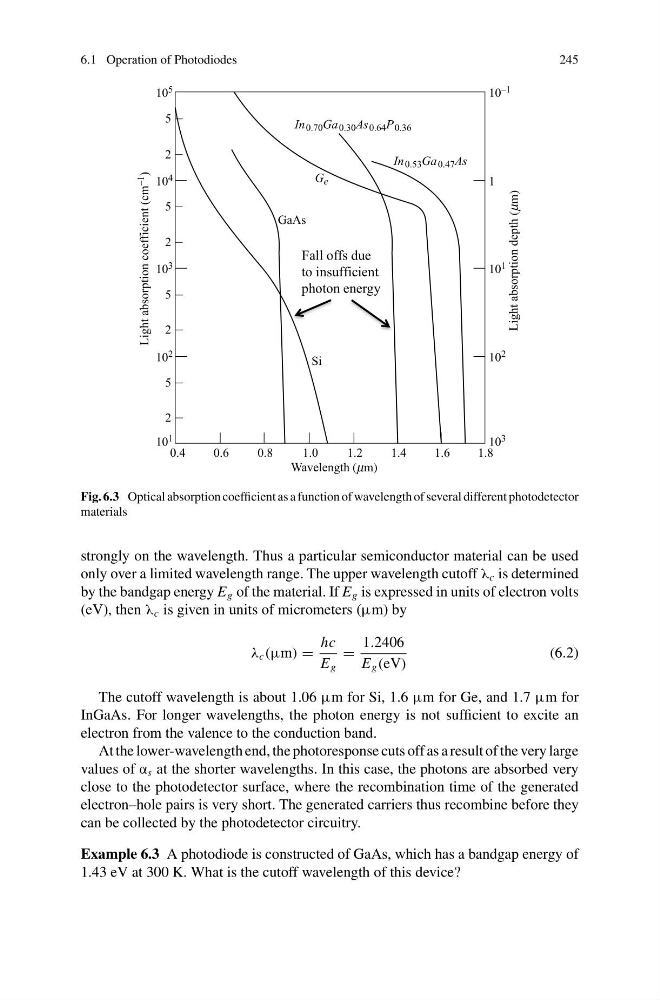
Fig. 6.3 Optical absorption coefficient as a function of wavelength of several different photodetector
materials
strongly on the wavelength. Thus a particular semiconductor material can be used
only over a limited wavelength range. The upper wavelength cutoff λ c is determined
by the bandgap energy E g of the material. If E g is expressed in units of electron volts
(eV), then λ c is given in units of micrometers (μm) by
λ c (μm) =
hc
E g
=
1.2406
E g (eV)
(6.2)
The cutoff wavelength is about 1.06 μm for Si, 1.6 μm for Ge, and 1.7 μm for
InGaAs. For longer wavelengths, the photon energy is not sufficient to excite an
electron from the valence to the conduction band.
At the lower-wavelength end, the photoresponse cuts off as a result of the very large
values of α s at the shorter wavelengths. In this case, the photons are absorbed very
close to the photodetector surface, where the recombination time of the generated
electron–hole pairs is very short. The generated carriers thus recombine before they
can be collected by the photodetector circuitry.
Example 6.3 A photodiode is constructed of GaAs, which has a bandgap energy of
1.43 eV at 300 K. What is the cutoff wavelength of this device?
245
Fall offs due
to insufficient
photon energy
Fig. 6.3 Optical absorption coefficient as a function of wavelength of several different photodetector
materials
strongly on the wavelength. Thus a particular semiconductor material can be used
only over a limited wavelength range. The upper wavelength cutoff λ c is determined
by the bandgap energy E g of the material. If E g is expressed in units of electron volts
(eV), then λ c is given in units of micrometers (μm) by
λ c (μm) =
hc
E g
=
1.2406
E g (eV)
(6.2)
The cutoff wavelength is about 1.06 μm for Si, 1.6 μm for Ge, and 1.7 μm for
InGaAs. For longer wavelengths, the photon energy is not sufficient to excite an
electron from the valence to the conduction band.
At the lower-wavelength end, the photoresponse cuts off as a result of the very large
values of α s at the shorter wavelengths. In this case, the photons are absorbed very
close to the photodetector surface, where the recombination time of the generated
electron–hole pairs is very short. The generated carriers thus recombine before they
can be collected by the photodetector circuitry.
Example 6.3 A photodiode is constructed of GaAs, which has a bandgap energy of
1.43 eV at 300 K. What is the cutoff wavelength of this device?